
Most advice about AI lead generation follows a familiar pattern: buy this tool, connect it to your CRM, watch the leads pour in. It doesn’t work that way. Tools don’t generate leads — systems do. And most people building “AI-powered lead gen” are really just building an expensive contact form with a chatbot emoji on it.
The actual problem isn’t access to tools. It’s that 80% of new leads never convert into a sale — largely because there’s no system behind the capture. No traffic source. No nurture sequence. No reason for the lead to care. Add AI on top of that broken foundation and you get faster failure, not faster growth.
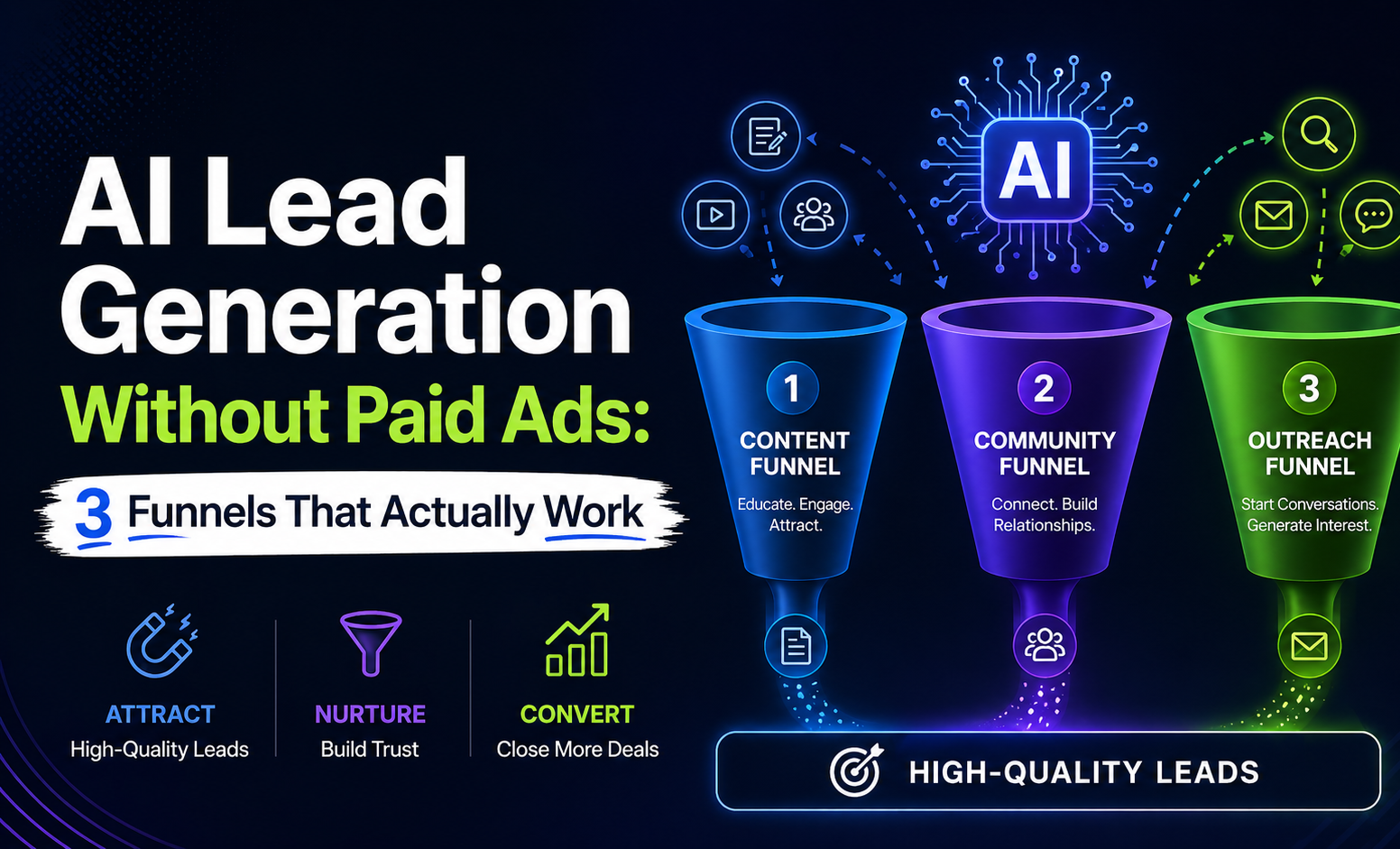
This guide covers three funnels that work without a cent of paid advertising. Not theoretical models — real structures with documented conversion benchmarks and examples from companies that have actually run them. The funnels are: an AI quiz funnel, an AI chatbot funnel, and an AI content + SEO funnel. Each one is different in how it attracts traffic and converts it. What they share is a clear structure from first touch to qualified lead.

What Is AI Lead Generation (And Why Most Methods Fail)
What AI Lead Generation Means
AI lead generation means using artificial intelligence — whether that’s a chatbot, a quiz with adaptive logic, or content generated and optimized at scale — to attract, qualify, and capture potential customers without manual effort at each step. The “AI” part isn’t just marketing language anymore. By 2026, 92% of businesses have invested in generative AI for revenue operations, and the gap between teams that have a system and teams that just have tools is widening fast.
The definition matters because it sets expectations correctly. AI lead generation isn’t a magic button. It’s a set of automated touchpoints — from traffic acquisition through to lead qualification — that runs continuously and scales without proportional headcount.
Why Most Strategies Fail
There’s a specific failure pattern that shows up across companies trying to “do AI lead gen.” It almost always comes down to the same three things.
First, there’s no traffic source. A quiz funnel with zero visitors converts zero leads. A chatbot on a page that gets 50 visits a month isn’t a system — it’s decoration. Traffic is the input; without it, nothing downstream matters.
Second, teams over-rely on tools. Buying Clay, Apollo, or Instantly and calling it a lead generation strategy is like buying a kitchen and calling it a restaurant. The tools are inputs, not outputs. The number of companies that have spent thousands on lead gen software while ignoring organic traffic, community presence, or content is… large.
Third, there’s no funnel structure. A funnel has a sequence: traffic → capture → qualification → nurture → conversion. Most “strategies” are really just one of these steps, disconnected from the others. 44% of sales reps never follow up with a lead at all — which means even when capture works, the deal dies in the handoff.

How to Generate Leads with AI Without Paid Ads
Core Formula
The math here is simple and worth stating plainly:
Leads = Traffic × Conversion Rate
That’s it. Every other variable — your copy, your chatbot, your email sequence — exists to move one of those two numbers. If your traffic is 500 visitors/month and your conversion rate is 3%, you get 15 leads. Want 60 leads? Either quadruple the traffic, quadruple the conversion rate, or find a combination in between. This framing matters because it tells you where to diagnose problems. Low leads could mean low traffic or low conversion — and the fix is different for each.
Traffic Sources Without Ads
SEO is the most scalable organic channel for lead generation. Businesses that publish blogs consistently generate 13× more leads than those that don’t. The tradeoff is time — it takes months to build, but compounds indefinitely. A well-ranked page keeps delivering traffic without any ongoing spend.

Reddit hosts over 100,000 active communities where B2B decision-makers discuss real problems, evaluate vendors, and look for recommendations. Participating authentically in the right subreddits (r/entrepreneur, r/SaaS, r/marketing) builds authority and drives traffic to your content or landing pages. It’s slow at first and gets shut down fast if you’re spammy — but done right, it’s a consistent inbound signal.
Telegram is underused as a lead gen channel, especially in markets outside the US. Building a Telegram community or channel around a niche gives you a direct line to an audience that’s opted in and actively engaged — without algorithm interference. The leads that come from Telegram communities tend to be warmer than cold outreach because the relationship is already established.
X (Twitter/𝕏) rewards consistency and specificity. Posting daily in a niche — whether that’s SaaS growth, B2B sales, or e-commerce operations — builds a following that can be directed to a lead capture page, a quiz, or a newsletter. The accounts that convert best are the ones with a clear point of view, not just content volume.
Where AI Fits in the Funnel
AI touches every stage, but not in the same way.
At the traffic acquisition stage, AI helps with content creation at scale — writing SEO articles, generating topic clusters, optimizing existing pages for search intent. Tools like Surfer SEO or Jasper don’t replace the strategy, but they compress the production timeline significantly.
At the conversion stage, AI chatbots and quiz logic replace static forms. Instead of “fill out this form,” the visitor has a conversation or takes an assessment. This is where the biggest conversion lift happens — interactive formats like quizzes average a 47.3% conversion rate compared to just 2.8% for static forms, according to the Outgrow 2025 Interactive Content Benchmark Report.
At the automation stage, AI handles lead scoring, email sequence personalization, and CRM enrichment — making sure the right follow-up reaches the right person at the right time, without a human in the loop for every step.

AI Lead Generation Funnel #1 — AI Quiz Funnel
A quiz funnel works by giving visitors something to do instead of something to fill out. The psychology is straightforward: quizzes feel personal, fast, and rewarding. The result page delivers value — a recommendation, a score, an assessment — and in exchange, the visitor gives their email.
The AI component in modern quiz funnels goes beyond static branching logic. Platforms like Interact and Involve.me now use AI to adapt questions based on previous answers, generate personalized result pages, and trigger different email sequences depending on how someone scored. This isn’t just a nicer form — it’s a full qualification layer built into the experience.
Step-by-step flow:
The visitor lands on a page from SEO, social, or a Reddit thread. A headline like “What’s Killing Your Conversion Rate? Take the 2-Minute Assessment” pulls them in — not because it’s clever, but because it speaks to a problem they’re already thinking about. They click and start the quiz. Each question gathers qualification data: their role, company size, specific pain point. At the end, they enter their email to receive their personalized result. That result triggers a segmented email sequence tailored to their quiz outcome.
Real example: In July 2025, marketing coach Kylie Kelly ran a quiz funnel — no paid ads, no viral post — and generated 135 qualified leads in 30 days with an 86% conversion rate using Interact. Agency Gecko Squared used a LeadQuizzes funnel to convert quiz-qualified leads into $800,000 in new business. GothRider Coffee built a single funnel that delivered 75,000 leads. These aren’t outliers — agencies across industries report 300–500% higher conversion rates from quiz funnels compared to static forms.
The overall quiz-to-lead conversion rate sits at 40.1% — a number that has stayed consistent since Interact started tracking in 2013. What’s changed in 2026 is what quizzes people will actually complete: the ones performing best now are assessment-style quizzes that answer a question the visitor genuinely wants to know about themselves.
Funnel conversion benchmarks:
| Step | Conversion Rate |
| Click → Quiz Start | 30–40% |
| Quiz Start → Email Submitted | 30–50% |
| Email → Qualified Lead | 10–20% |
One thing that kills quiz funnels fast: making the questions feel like a contact form in disguise. If every question is “what’s your budget” and “how soon are you buying,” completion drops off a cliff. The questions need to feel like they’re for the visitor’s benefit, not yours.
AI Lead Generation Funnel #2 — AI Chatbot Funnel
Where quiz funnels work best for top-of-funnel lead capture, chatbot funnels shine when there’s already intent — a visitor on a pricing page, a demo page, or a product comparison page. Instead of making them fill out a form and wait 48 hours for a reply, the bot qualifies them in real time and either books a meeting or routes them into a nurture sequence.
Businesses using AI chatbots convert 3× better than those using static website forms, according to Dashly’s analysis of their SaaS and EdTech customer base. Chatbot-led funnels convert at 2.4× the rate of static forms, with average ROI between 148% and 200% within 12 months. And 70–80% of B2B decision-makers now prefer real-time digital chat over phone calls for sales conversations, which means this isn’t a novelty — it’s the expected experience.
Use case for SaaS: A visitor lands on your pricing page from an SEO article comparing tools in your category. Instead of a static pricing table, a chatbot opens: “Trying to figure out which plan fits your team? Let me help.” It asks two or three qualification questions — team size, current tool, main goal — and then either routes to a demo booking link for high-intent leads or sends a comparison guide to lower-intent ones. The entire interaction takes under two minutes.
Use case for service businesses: A visitor reads a blog post about Facebook ad audits, clicks through to the homepage. The chatbot triggers based on scroll depth: “Want a free audit of your current campaigns? Takes 3 minutes.” Qualification happens inside the chat. A qualified lead books directly. No form. No waiting.
A mid-sized SaaS company tested this approach by adding an AI chatbot to their CRM using BANT-based qualification logic — probing for Budget, Authority, Need, and Timeline through natural conversation. The result was more qualified leads, faster demo scheduling, and better close rates from chatbot-qualified leads compared to their previous form-based flow.
Chatbot funnel conversion benchmarks:
| Step | Benchmark |
| Page Visit → Chat Open | 10–20% |
| Chat Open → Qualification Complete | 40–60% |
| Qualified → Meeting Booked | 20–35% |
| Full Funnel: Visit → SQL | 3–8% |
The platforms worth knowing: Drift (now part of Salesloft) is built for enterprise B2B with deep Salesforce integration and ABM playbooks. Intercom Fin combines support and lead gen in one platform — better for product-led SaaS. Chatbase is the fastest to set up for smaller teams: point it at your docs or website, configure a lead capture trigger, and it’s live in under 30 minutes.
One thing worth being blunt about: 62% of SMBs abandon complex chatbot setups within 90 days, according to IDC’s 2026 AI Tools report. The reason is almost always over-engineering at the start. A chatbot with three qualification questions and a calendar link outperforms a 40-step flow that nobody finishes configuring.
AI Lead Generation Funnel #3 — AI Content + SEO Funnel
The SEO funnel is the slowest to build and the hardest to kill. Content that ranks keeps generating leads for months or years after it’s published — without any recurring cost. The AI component here isn’t about generating thin filler content; it’s about producing content at a volume and consistency that would be impossible manually, while keeping the quality high enough to actually rank and convert.
The structure is: identify high-intent keywords in your niche → produce thorough content targeting those keywords → embed a lead capture mechanism (quiz, chatbot, or email opt-in) inside the content → let the content compound over time.
AI’s role in this funnel is operational, not creative. Tools like Surfer SEO or Clearscope identify what competing content covers and where the gaps are. AI assists with drafts and outlines. But the unique angles, real examples, and expert takes still need human input — because 9 in 10 B2B decision-makers are more receptive to agencies that consistently produce high-quality, insight-rich content, according to a LinkedIn/Edelman study. Generic AI content doesn’t meet that bar.

Example content structure for a SaaS tool:
- Top of funnel: “What is [category]?” — informational, attracts broad audience
- Middle of funnel: “[Tool A] vs [Tool B]: Which Is Better for [Use Case]?” — comparison content, high purchase intent
- Bottom of funnel: “[Category] for [Specific Niche] — A Step-by-Step Guide” — ready-to-convert audience
- Lead capture: Quiz or chatbot embedded in middle- and bottom-funnel content
Realistic SEO timeline:
| Month | Estimated Monthly Traffic |
| 1 | 0–100 |
| 2 | 200–500 |
| 3 | 500–1,500 |
| 6 | 3,000–8,000 |
| 12 | 10,000+ |
These numbers assume consistent publishing (2–4 articles/week), proper on-page optimization, and internal linking. They’re not guaranteed — competitive niches take longer, new domains take longer. But the direction is clear: the channel compounds, and 76% of businesses that committed to content marketing reported measurable improvement in lead generation.

The biggest mistake with this funnel is treating content as a separate thing from lead capture. A blog post that ranks but has no CTA, no embedded quiz, no chatbot, and no email opt-in is traffic with no destination. Every piece of content needs a clear next step for the visitor.
Best AI Lead Generation Tools (Tested)
There are hundreds of tools claiming to “AI-power” your lead generation. Most of them are features dressed up as platforms. The ones below have documented use cases and clear roles in the funnel.
| Tool | Use Case | Difficulty |
| Interact | Building quiz funnels with email segmentation | Easy |
| Chatbase | Fast AI chatbot setup from docs or URL | Easy |
| Drift (Salesloft) | Enterprise B2B chatbot with ABM playbooks | Medium–Hard |
| Intercom Fin | Combined support + lead gen for SaaS | Medium |
| Clay | Prospect enrichment from 50+ data sources + AI outreach | Hard |
| Apollo.io | Outbound prospecting with AI sequencing | Medium |
| Surfer SEO | AI-assisted content optimization for organic traffic | Medium |
| Involve.me | Multi-step quiz + form funnels with CRM sync | Easy–Medium |
Interact is the go-to for quiz funnels. The Interact team started in 2013 after noticing that sites converting at 1% jumped to 40% when a quiz replaced the static opt-in — and the platform has since driven over 100 million leads. The 2025 Content Marketing Institute gave the award for Best Content Strategy to Direct Energy, an Interact customer running a hub of 10 niche quizzes.
Clay is a different category entirely — it’s for teams doing outbound who want to enrich leads from multiple data sources and automate personalized outreach. The learning curve is real, but AI improves lead scoring precision by 25–40% when the underlying data is clean (McKinsey, 2025).
Chatbase is what you reach for when you need a chatbot live today. Upload a PDF or point it at a URL — the bot knows your product immediately. The lead capture form inside the chat window is basic, but it gets the job done for solo founders or small teams who aren’t ready for Intercom’s pricing.
Common Mistakes in AI Lead Generation
A lot of teams diagnose their lead gen problem wrong. They think the issue is the tool when it’s actually the system. Here are the patterns that keep showing up.
Relying only on AI tools without building a traffic source. A perfect quiz funnel with zero visitors produces zero leads. The tool is downstream of the traffic problem. Fix the source first.
Ignoring traffic entirely and focusing on conversion optimization. The opposite mistake: teams A/B testing button colors on a page that gets 200 visits a month. Moving conversion rate from 2% to 4% on 200 visits nets you four extra leads. Doubling traffic is almost always the higher-leverage move at early stages.
Copying funnels blindly from other industries. A quiz funnel that worked for a fitness coach won’t necessarily work for a B2B SaaS product — and vice versa. The questions, the result framing, the CTA, the follow-up sequence all need to match the audience’s decision process. Transposing without adapting is a common way to waste three months.
Focusing only on CTR and ignoring lead quality. Getting 500 email addresses from a quiz is meaningless if none of them are in your target customer profile. Nurtured leads make purchases 47% larger than non-nurtured leads — but only if they were the right leads to begin with. Build qualification into the funnel, not just capture.
Over-automating outreach before the system is proven. Running 1,000 AI-generated cold emails before you’ve validated that your offer resonates is a fast way to burn a domain and learn nothing useful.
Pros and Cons of AI Lead Generation Without Ads
| Pros | Cons |
| No ongoing ad spend — cost compounds down over time | Slower to results than paid campaigns |
| Leads tend to be warmer — they found you, not the other way around | Requires consistent effort on traffic (SEO, community, content) |
| Scales without proportional headcount | Takes 3–6 months to see meaningful SEO traction |
| Quiz and chatbot funnels run 24/7 across time zones | Tool setup and integration takes real time upfront |
| Data from quizzes and chatbots improves segmentation and product insight | AI content without human editorial oversight often ranks poorly |
| Compound effect: good content and a good quiz keep working after you stop | Harder to scale rapidly — no budget dial to turn up |
Final Thoughts
AI lead generation without paid ads works — but it’s not fast, and it’s not passive in the way people imagine. It requires building something real first: a traffic source, a conversion mechanism, and a qualification layer that hands off to a nurture sequence. When all three are in place, the system runs largely on its own.
It doesn’t work when someone buys a tool, connects it to a landing page with no traffic, and calls it a funnel. That describes most implementations. The AI part isn’t the hard part — distribution is the hard part.
The cleanest version of this: pick one traffic source (SEO or a community), build one funnel (quiz or chatbot), and connect it to a simple email sequence. Measure for 90 days. Then optimize what the data shows you. Starting with three traffic sources and two funnels and a complex automation sequence usually means nothing gets done properly.
System over tools. Always.
FAQ
Yes — and it does so through organic traffic channels like SEO, social communities, and content. The key is connecting that traffic to a conversion mechanism (a quiz or chatbot) rather than a passive landing page. It takes longer to build than a paid campaign, but the cost per lead drops significantly over time.
It depends on your timeline and traffic source. For fastest results with existing traffic, an AI chatbot on high-intent pages (pricing, demo) delivers the most immediate lift. For compounding long-term results, an SEO + content funnel with an embedded quiz is the most sustainable combination.
A chatbot funnel can start generating leads within days if you have existing traffic. A quiz funnel typically takes 2–4 weeks to optimize after launch. An SEO funnel takes 3–6 months before meaningful traffic arrives — but then runs indefinitely without additional spend.
For quiz funnels: Interact or Involve.me. For chatbot funnels: Chatbase (fast setup), Intercom Fin (SaaS), or Drift (enterprise B2B). For SEO content production: Surfer SEO for optimization, paired with your own editorial judgment for the actual writing. No single tool replaces the funnel structure.
For inbound-focused businesses, yes — inbound leads close faster and require less convincing because the prospect already has context. For outbound, AI tools like Clay and Apollo improve prospecting speed and personalization, but the fundamentals of a good offer and clear ICP still determine whether it works.



Leave a Reply