
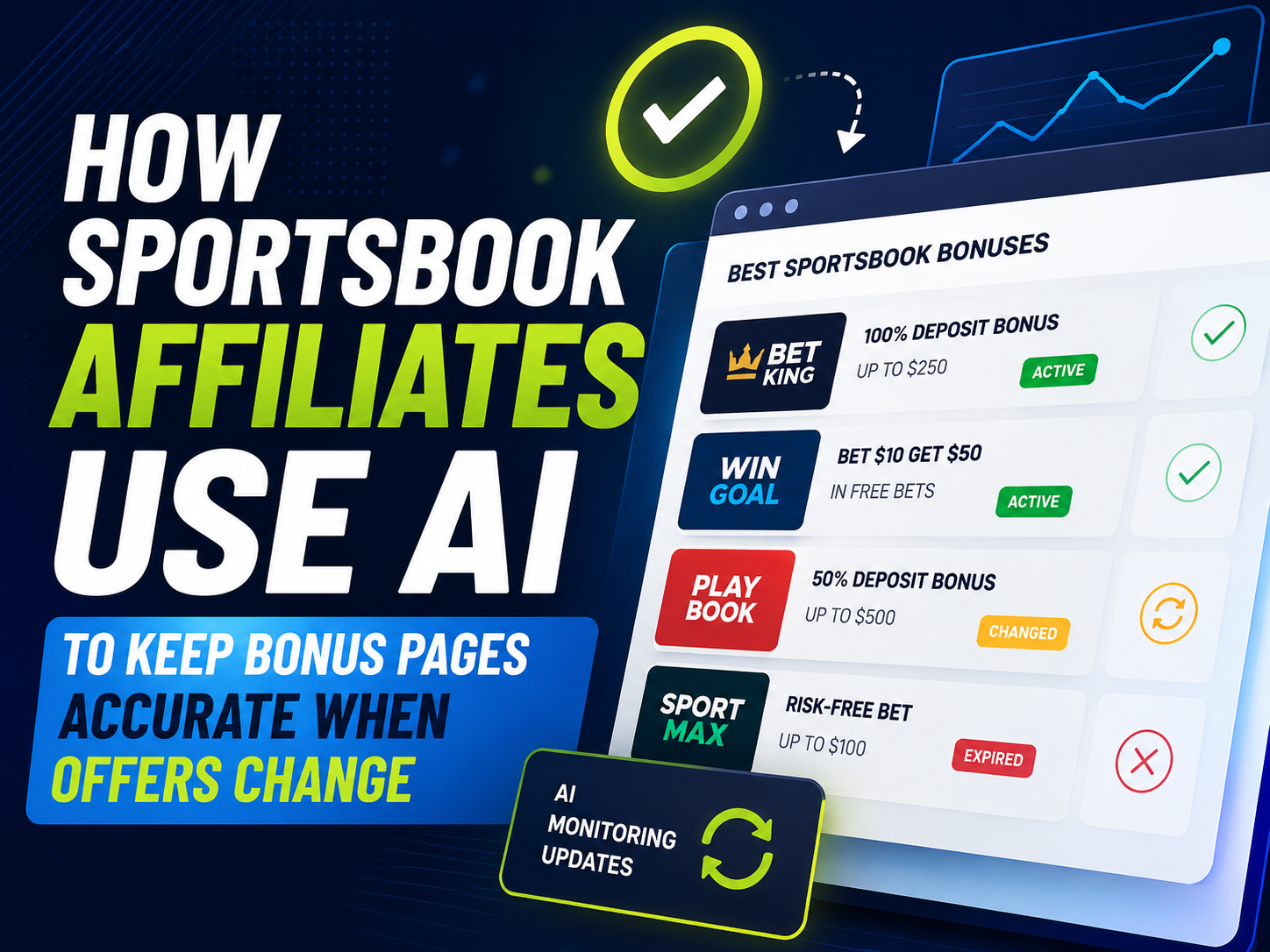
A sportsbook changes its welcome bonus on a Monday morning. Maybe it’s a wagering requirement that drops from 5x to 3x, maybe the deposit match caps out at a different number, maybe a whole promo gets pulled because a regulator in one GEO flagged the wording. By Wednesday, the operator’s own landing page reflects the change. By Friday, dozens of affiliate sites — including some ranking on page one — are still showing the old terms.
Nobody did anything wrong, exactly. The content team didn’t forget. There was no article to write yet. The actual problem is upstream of writing: nobody knew the offer had changed until a user complained in the comments, or until the operator’s affiliate manager mentioned it in passing on a Slack call three weeks later.
That’s the part outsiders miss when they think about bonus page maintenance. It’s not a content production problem. It’s a detection problem wearing a content problem’s clothes.
Why Bonus Pages Become a Hidden Operational Problem
If you run a handful of bonus pages, you can keep them accurate by checking manually every few days. That breaks down fast once you’re operating at any real scale — a few hundred pages, multiple GEOs, several operators each running their own promo calendar on their own schedule.
The math gets ugly quickly. Say you’re tracking 40 operators across 8 GEOs. Some run weekly reload bonuses. Some change wagering terms seasonally. Some quietly adjust minimum odds requirements without announcing anything anywhere except a one-line update to their T&Cs page. If even 15% of your operators touch their offers in a given month, you’re looking at dozens of silent changes landing across your site with no single trigger telling you where to look.
Most teams don’t discover this the hard way through a dramatic ranking drop. They discover it through small, embarrassing moments: a user on Trustpilot saying “the bonus page said 3x wagering, the site required 6x, I felt scammed.” That single review does more damage to trust than a week of stale content, because it turns an operational lag into a credibility problem in front of everyone who reads it afterward.

Figure 1: Why Bonus Pages Become Outdated
The Real Bottleneck Is Not Writing Content
Every team we’ve talked to that runs into this problem has the writing capacity to fix a bonus page in fifteen minutes once they know something changed. The actual bottleneck sits earlier in the chain: knowing, fast, that something needs fixing at all.
Manual checking doesn’t scale linearly — it scales worse than linearly. Checking 20 pages a week is manageable for one editor doing a rotation. Checking 200 pages means either hiring more editors to do the same repetitive checking, or accepting that pages get reviewed on a much slower cycle, which means the average bonus page sits wrong for longer before anyone notices.
There’s also a quieter cost that doesn’t show up in any dashboard: editor fatigue on repetitive verification work. Checking the same operator’s terms page for the fortieth time, looking for a number that’s probably unchanged, is exactly the kind of task that produces errors precisely because it’s boring. People start skimming. They miss the one field that did change because the other nineteen didn’t.
This is where AI-assisted monitoring earns its place — not as a replacement for editorial judgment, but as the thing that removes the boring repetitive scanning so editors can spend their attention on the 5% of changes that actually matter.
How Affiliate Teams Actually Detect Offer Changes
Before any AI enters the picture, it’s worth being honest about how teams currently find out about bonus changes, because the methods vary a lot in reliability:
- Operator affiliate dashboards — the most reliable source when operators bother to update them, which not all do consistently.
- Direct communication from affiliate managers — email or Slack, often the fastest channel, but entirely dependent on whether your AM remembers to loop you in.
- Manual page checks — visiting the operator’s own site on a schedule and comparing against your published page.
- User reports — the worst-case detection method, because by the time a user complains, the wrong information has already been live and indexed for however long.
- Competitor monitoring — noticing that a competing affiliate site updated their numbers first, which tells you something changed but not exactly what or when.
Most teams run on some mix of the first three, with the fourth happening more often than anyone wants to admit. The gap between “operator changed the offer” and “our page reflects it” is the number that actually matters, and for teams without a systematic monitoring process, that gap regularly runs four to six days — sometimes longer around holidays, when both operators and affiliate teams are slower to react.
Where Manual Updates Start Breaking
It’s not just the bonus amount that goes stale. A bonus page carries more moving parts than it looks like from the outside, and each one has its own failure mode:
- Wagering requirements change more often than headline bonus amounts, and they’re easy to miss because they’re buried in a T&Cs paragraph rather than the hero banner.
- Payment methods get added or dropped, especially in GEOs where local payment processors rotate in and out due to regulatory shifts.
- Screenshots of the operator’s actual bonus page or deposit flow go stale the moment the operator redesigns their UI — and redesigns happen far more often than promo changes.
- Expired promotions linger on pages long after the offer window closed, sometimes for months, quietly telling users something that no longer exists.
- FAQ sections answer questions based on old terms, which is particularly bad because FAQs are often the first thing a skimming user actually reads carefully.
- Schema markup — the structured data behind the page — drifts out of sync with visible content, which search engines notice even when human readers don’t.
Any one of these breaking is a minor issue. All six drifting slowly and independently across 300 pages is how a site ends up with a reputation problem it didn’t see coming.

Figure 2: AI Bonus Page Monitoring Workflow
Building an AI-Assisted Bonus Monitoring Workflow
Here’s the workflow that actually holds up once you’re managing enough pages that manual checking stops being realistic:
- Operator changes bonus — the trigger event, whatever form it takes (dashboard update, T&Cs edit, AM notification).
- Monitoring detects change — automated checks against operator pages and T&Cs at a set interval, flagging anything that differs from the last known version.
- AI compares old and new information — rather than just flagging “something changed,” the comparison step identifies specifically what changed — bonus amount, wagering multiplier, payment method list, expiry date — and produces a structured diff.
- Important sections identified — the system ranks what changed by how much it matters. A wagering requirement change is high-priority. A rewording of a disclaimer sentence with no substantive change is low-priority and can queue for a routine review instead of an urgent one.
- Editor reviews — a human reads the flagged diff, not the entire page. This is the step that makes the whole thing sustainable — editors are reviewing changes, not re-verifying pages from scratch every time.
- Page updated — the actual content edit, informed by the AI’s draft suggestion but finalized by the editor.
- SEO checks completed — internal links still resolve, schema matches the visible content again, meta descriptions reflect the current offer, and the page is re-crawled if needed.
The part that trips teams up when they first try to build this: they assume the AI step should replace the editor step. It shouldn’t, and the teams that try that version tend to walk it back within a month, usually after a compliance-sensitive statement gets published without anyone catching it.
What AI Should Do — And What Humans Must Control
This is worth being blunt about, because a lot of automation pitches oversell what AI can safely do unsupervised in a regulated, compliance-sensitive vertical like gambling affiliate content.
What AI can reasonably automate:
- Monitoring operator pages and T&Cs for changes on a schedule
- Comparing old versus new content and producing a structured diff
- Drafting the updated wording for bonus amounts, terms, and payment method lists
- Generating an FAQ draft that reflects the new terms
- Flagging which changed fields are high-priority versus cosmetic
What needs a human every time:
- Any language that reads as a recommendation or endorsement of the operator
- Trust-related statements — anything implying safety, reliability, or fairness of the operator
- Final approval before publishing
- Compliance-sensitive wording, especially around responsible gambling disclosures and regulatory language that varies by GEO
The pattern that works: AI handles detection, comparison, and first-draft wording. Humans handle judgment calls, tone, and anything that could create legal or trust exposure if it’s wrong. Teams that blur this line — usually to save a bit more editor time — tend to regret it the first time an AI-drafted paragraph makes a claim about an operator that isn’t quite true, or that was true last month but isn’t anymore.

Figure 3: What AI Can Update vs What Humans Review
A Realistic Case: How One Multi-GEO Network Fixed Its Bonus Page Problem
A mid-sized iGaming affiliate network — call it the kind of operation running around 340 bonus pages across 12 GEOs, with a content team of four editors — had been maintaining pages the traditional way: a rotating manual check schedule, roughly once every two weeks per page, done by whichever editor had bandwidth that day.
The problem surfaced gradually rather than all at once. A GEO manager noticed that one of their top-performing Canadian bonus pages had dropped from position 4 to position 11 for its main keyword over about six weeks, with no obvious external cause — no algorithm update, no new aggressive competitor. Digging in, the page still displayed a wagering requirement the operator had lowered nearly two months earlier. The page had, in effect, been quietly wrong and quietly losing trust signals for weeks before anyone caught it.
That triggered an audit of the other pages tied to the same operator group. Out of 58 pages linked to operators the team suspected of frequent changes, 11 had outdated wagering terms, 6 had payment method lists missing at least one newly added option, and 3 were promoting bonuses that had technically expired three to five weeks prior.
What they tried first: doubling the check frequency for high-traffic pages, from every two weeks to every week. This helped marginally but doubled the manual workload for the same four editors, who were already stretched across content production and updates. Within two months, the team quietly reverted to the old cadence because it wasn’t sustainable.
What they built instead: an automated monitoring layer that checked operator T&Cs pages and known bonus-terms URLs on a daily cycle, produced a structured comparison against the last recorded version, and routed anything flagged as a substantive change into a review queue ranked by priority. Cosmetic changes went into a low-priority weekly batch; anything touching bonus amount, wagering requirement, or expiry date went to the top of an editor’s queue same-day.
Measurable results after roughly ten weeks:
- Average detection-to-publish time for offer changes dropped from an estimated 5–6 days to under 24 hours for high-priority changes.
- The audit-flagged error rate (pages with at least one outdated field) fell from roughly 19% of the sampled 58 pages to under 4% on a follow-up audit three months later.
- Editor time spent on routine verification dropped by close to a third, freeing capacity that went into new page production rather than a headcount cut — worth noting, since the team was explicit that the goal was never to reduce editorial staff, just to stop wasting their time on repetitive scanning.
- The Canadian page that triggered the whole audit recovered to position 6 within five weeks of the correction, not fully back to its prior position but a clear directional recovery.
None of this required replacing editorial judgment. It required getting editors out of the business of manually re-checking pages that hadn’t changed, so they had bandwidth for the ones that had.

Figure 4: Manual Updates vs AI-Assisted Workflow

Figure 5: Affiliate Bonus Page Maintenance Cycle
Building the Habit, Not Just the Tool
One thing worth saying plainly: none of this works as a one-time setup. Operators keep changing offers indefinitely, so the monitoring and review cycle has to run indefinitely too. Teams that treat this as a project — build it, ship it, move on — tend to find the system quietly degrading within a few months as operator page structures shift and the monitoring rules stop matching reality.
The teams that keep this working long-term treat it the way they’d treat any other recurring operational process: someone owns it, it gets reviewed periodically for accuracy (not just the bonus pages, but the monitoring rules themselves), and the review queue gets checked daily rather than “whenever there’s time.” That last part is the one that quietly fails first when priorities get busy.

Figure 6: Bonus Page Update Checklist
FAQ
How often should sportsbook bonus pages be updated?
There’s no fixed schedule that works across the board — it depends on how often the specific operator changes terms. The more useful target is detection speed rather than a calendar: high-priority changes (bonus amount, wagering requirement, expiry) should reach an editor’s queue within a day of happening, not on a fixed weekly or biweekly cycle.
Can AI automatically update affiliate content without a human involved?
Technically, yes, but doing so on compliance-sensitive gambling content is a risk most established teams aren’t willing to take. AI can draft the update; a human should approve it before it goes live, especially anything touching trust language or regulatory disclosures.
How do affiliate teams monitor competitor bonuses?
Usually a mix of manual spot-checks and, for more mature teams, automated tracking of competitor pages alongside operator pages — treating a competitor’s updated numbers as a secondary signal that something changed, even before confirming it directly with the operator source.
What parts of bonus pages require human review even in an automated workflow?
Anything that reads as a recommendation, any trust or safety claim about the operator, final publishing approval, and any compliance-sensitive statement — particularly responsible gambling language, which varies by GEO and carries real regulatory weight if handled carelessly.
What triggers a bonus page audit besides an operator announcement?
A ranking drop with no obvious external cause is one of the more common triggers in practice — it’s often how teams first discover a page has been silently wrong for weeks, as in the case study above.
How much time does AI-assisted monitoring actually save?
It varies by scale, but the bigger win usually isn’t raw hours saved — it’s shifting editor time away from repetitive re-verification of unchanged pages toward the smaller set of pages that actually need attention.
Does Google penalize affiliate sites for outdated bonus information?
There’s no confirmed direct penalty tied specifically to outdated bonus terms, but outdated or inaccurate information tends to correlate with weaker engagement signals and user trust issues, both of which are things search engines’ broader quality systems are known to weigh. Treat this as a strong open question worth watching rather than a confirmed mechanism.
What’s the biggest risk of over-automating bonus page updates?
Publishing something inaccurate or non-compliant at scale, fast, before a human catches it. The whole point of keeping editors in the loop is that the cost of a wrong automated update multiplied across hundreds of pages is a lot higher than the cost of a slightly slower manual process.


Leave a Reply