

AI-powered offer scoring reads the signals you already have — payout history, EPC/CR trends, T&C language, public complaint patterns — and turns them into a weighted risk score before you commit spend to a network or offer. It doesn’t replace due diligence. It compresses the two weeks you’d normally spend lurking on forums and pulling tracker exports into something that runs every time you’re about to onboard a new network or scale an existing one.
TL;DR
- A spreadsheet of payout and EPC numbers only tells you what already happened. Networks that later stopped paying or got de-licensed almost always looked fine on the metrics right up until they didn’t. You need signals that update in real time, not a static snapshot from onboarding week.
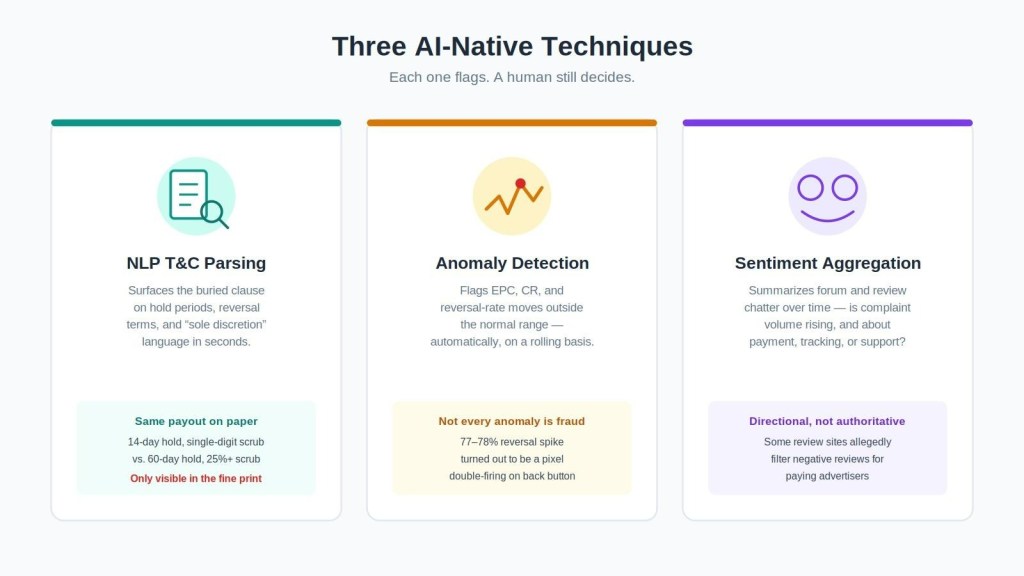
- The three AI-native techniques that actually add value here are NLP parsing of T&C documents for buried clauses, statistical anomaly detection on EPC/CR/reversal trends, and sentiment aggregation from forum and review threads. None of these are magic, and all three need a human to interpret the flag.
- A four-dimension score (payment reliability, financial red flags, compliance/creative risk, operational fit) gives you a repeatable way to rank offers, but the weights below are a starting point to tune against your own vertical, not a validated formula.
- iGaming carries its own risk layer on top of generic network risk: regulatory geo-shifts, KYC-driven conversion drop-off, and payout models where “deposit-based” and “registration-based” produce very different real-world hold and reversal exposure.
- Build this on infrastructure you already run: Keitaro or Binom for tracking, n8n for pulling EPC/CR trends and T&C text, an LLM call for flagging anomalies. You don’t need a data science team to get a working version in a weekend.
Why a Payout/EPC Spreadsheet Breaks the Moment You Scale
Every media buyer starts the same way: a Google Sheet with columns for network, offer, payout, EPC, CR, hold period, maybe a “trust” column where you write “seems ok” after skimming two forum threads. It works fine at three or four networks. It stops working somewhere around network twelve, when you’re running fifteen offers across six verticals and you genuinely cannot remember which network changed its minimum payout threshold last month, or which one has been quietly padding its Net-30 into Net-45.
The deeper problem isn’t volume, though. It’s that the numbers in that spreadsheet are lagging indicators. They tell you what a network did last month, not what it’s about to do. The clearest illustration of this in the industry’s own history is Neverblue, one of the largest CPA networks of its era. In April 2012, Neverblue’s parent company at the time, Velo Holdings, filed for Chapter 11 bankruptcy protection, listing debts in the range of $500 million to $1 billion. In the days around the filing, Neverblue emailed affiliates directly, describing the business as financially strong and promising affiliates that payments would keep going out on the usual schedule. Nothing in the payout or EPC data affiliates were tracking predicted the filing. The network’s own internal comms were reassuring people the same week the bankruptcy notice went public. Affiliates who were watching payout velocity and EPC alone had no early warning at all; the actual signal was buried in parent-company financial filings nobody in the affiliate community was reading in real time.
A milder but more common version of the same failure is what happened with COPEAC, another CPA network that, by industry accounts, kept presenting offers and maintaining a public storefront for years after it had effectively stopped doing real business with advertisers, before formally shutting down around 2012. No serious advertiser worked with them anymore. The listing pages, the offer feeds, and the affiliate manager contacts all stayed up, because there was no cost to maintaining the illusion, and a spreadsheet built from public-facing data had no way to detect that the network was already a shell.
You don’t need decade-old case studies to make the point, either. This is a live pattern. On BlackHatWorld, affiliates have documented a case involving AdBlueMedia where reported earnings appeared to shift in real time on refresh, with a user logging one balance and seeing a lower figure moments later with no corresponding change in traffic or conversions on their end. Whether that’s a caching bug or something more deliberate, it’s exactly the kind of thing a static end-of-week spreadsheet pull will never catch, because by the time you export the numbers, the discrepancy has already smoothed itself out of the average.
The risk that actually kills a campaign isn’t visible in the columns you’re tracking. It’s visible in the rate of change of those columns, in the language buried in the T&C you skimmed once at signup, and in what other affiliates are saying in real time on forums you don’t have open right now. A spreadsheet is a photograph. You need something closer to a live feed.

What AI Actually Does Here (and What It Doesn’t)
Strip away the marketing language and there are three distinct techniques worth using, each solving a different part of the visibility gap.
NLP parsing of T&C documents for buried conditions. Affiliate agreements and network T&Cs are long, they change without much notice, and the clause that matters (the one redefining what counts as a “valid lead,” or extending the hold period for a specific GEO, or adding a new chargeback clawback window) is usually a single paragraph in a document nobody rereads after onboarding. An LLM prompted specifically to extract payout terms, hold periods, reversal/chargeback conditions, and any language around “sole discretion” or unilateral term changes will surface that paragraph in seconds instead of you scanning ten pages. This is pattern extraction, not judgment. The model tells you where to look; you still decide if the clause is a dealbreaker. One industry evaluation of CPA networks running iGaming and Forex offers made this concrete: two networks advertising an identical payout on paper produced very different real economics once you read the fine print. One approved on first deposit with a 14-day hold and a modest single-digit scrub rate. The other required a first trade before approval, held funds for 60 days, and scrubbed over a quarter of conversions as “low quality” with no per-conversion explanation. That difference lives entirely in text most affiliates don’t parse carefully before they’ve already sent traffic.
Statistical anomaly detection on EPC, CR, and reversal trends. This is the least exotic and most useful piece. You’re not doing anything more sophisticated than flagging when a metric moves outside its normal range for that offer, that GEO, that traffic source, but doing it automatically, on a rolling basis, instead of noticing three weeks later when you finally open the tracker dashboard. A widely cited example from outside the CPA-network world, but instructive on the mechanic: an eBay Partner Network publisher reported an 80% month-over-month EPC drop in August with no change on their end, no acknowledgment of a platform-side change from eBay, and months of unhelpful support back-and-forth. An anomaly detector watching daily EPC against a 30-day rolling baseline would have flagged that shift on day two or three, not month two. The important caveat: not every anomaly is fraud. Affiliate marketer Tricia Meyer documented a case where reversal rates on two programs spiked to 77–78%, which looked catastrophic, until she contacted the affiliate manager and learned it was a shopping-cart tracking glitch that double-fired the pixel on the back button. The AI’s job is to flag the deviation. Yours is still to make the phone call.
Sentiment aggregation from public discussion. Forums like AffiliateFix, BlackHatWorld, and the (now rebranded) STM community, which folded into Affiliate World Forum under the same ownership and remains the highest-signal paid community for media buyers, generate a constant stream of unstructured complaint and praise. An LLM can pull recent threads mentioning a network name and summarize sentiment shift over time: is complaint volume about a specific network rising this quarter versus last, and what are the complaints actually about (payment delay vs. tracking accuracy vs. support responsiveness)? This is directional, not authoritative. Forum sentiment is noisy, sometimes coordinated by competitors, and review sites in this space have their own credibility problems. AffPaying, one of the more visible CPA network review aggregators, has faced a recurring accusation from its own user base, documented in a BlackHatWorld thread and echoed in later Trustpilot reviews, that negative reviews get filtered out while five-star reviews sail through, which several posters attributed to networks paying for premium listings. If you’re going to use a review-aggregation site as an input signal, that pattern is worth knowing before you treat a 4.8-star rating as gospel. For what it’s worth, a specific forum sometimes referenced in this niche as “PPH” didn’t turn up as a currently active, independently identifiable review platform in the course of researching this piece. If you know it under a different name, treat that as one more reason to verify a source before building an automated pipeline around it.
The Four-Dimension Scoring Model
None of the weights below are a proven formula. They’re a reasonable starting allocation based on where the actual loss events in this industry tend to originate, and you should tune them against your own vertical mix and risk tolerance.
| Dimension | Weight | What It Measures | Primary Data Sources |
|---|---|---|---|
| Reputation & Payment Reliability | 35% | Track record of on-time payment, consistency of hold periods, responsiveness of affiliate managers, years in business | Payment proof threads, tracker postback timing vs. stated terms, forum sentiment trend |
| Financial Red Flags | 25% | Parent company stability, ownership transparency, sudden changes to minimum payout thresholds, unexplained EPC/reversal anomalies | T&C diffs over time, anomaly detector output, corporate registration lookups where available |
| Compliance & Creative Risk | 25% | Licensing status for the vertical/GEO, whether the network enforces its own creative approval process, exposure to ad-platform policy shifts | Regulator/licensing databases, network’s stated compliance docs, ad platform policy changelogs |
| Operational Compatibility | 15% | Tracker integration quality (postback reliability), API/reporting access, GEO and traffic-source restrictions that match your actual setup | Your own tracker logs, network API docs, direct testing |
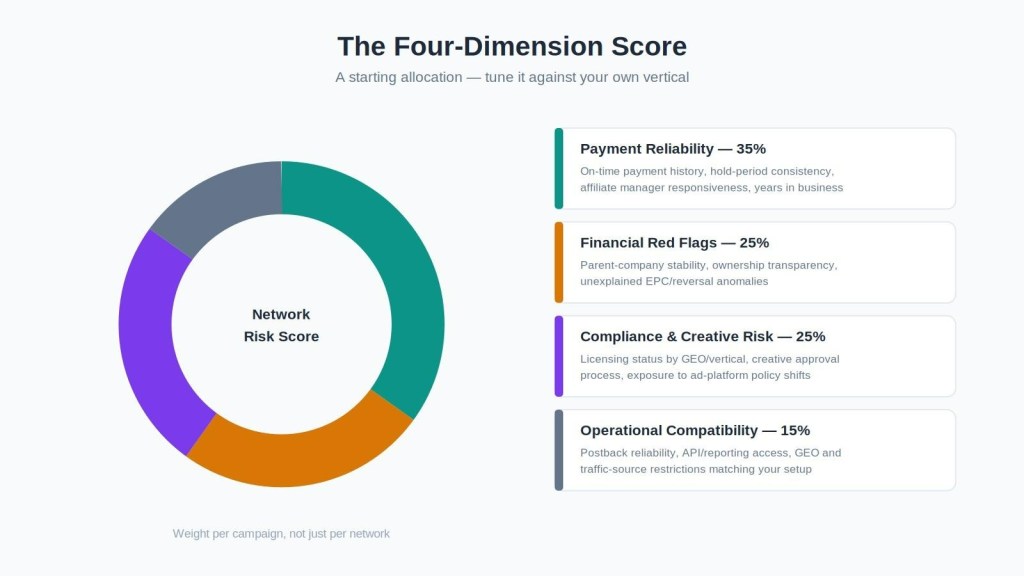
Weight these per campaign, not just per network. A network can score well overall and still be a bad fit for a specific high-risk GEO or vertical you’re about to run.
Building the Pipeline: What Actually Sits Where
You don’t need new infrastructure for this. If you’re already running Keitaro or Binom, the tracker is your source of truth for the metrics that matter (EPC, CR, reversal rate, hold-to-payment lag), and everything else wraps around it.
- Tracker layer (Keitaro/Binom). Continues doing what it already does: logging clicks, conversions, postbacks, and reversal events per offer and per network. This is your ground truth for anomaly detection; nothing downstream should override what the tracker actually recorded.
- n8n as the orchestration layer. A scheduled workflow pulls EPC/CR/reversal data from the tracker’s API on a rolling basis (daily is usually enough, hourly if you’re running high-spend iGaming or Finance campaigns where a delayed signal is expensive), computes rolling averages and standard deviations per offer, and flags anything outside a defined threshold (two or three standard deviations from the 30-day baseline is a reasonable starting point).
- LLM call for T&C parsing. When onboarding a new network, or on a scheduled recheck of existing ones (quarterly is reasonable; T&Cs don’t usually change weekly, but they do change), feed the current T&C text to an LLM with a structured extraction prompt: payout terms, hold period by vertical/GEO, chargeback/reversal conditions, any “sole discretion” or unilateral-change language, minimum payout threshold. Store the output as structured data so you can diff it against the previous version and catch silent edits.
- LLM call for anomaly interpretation and forum sentiment. When the anomaly detector flags something, or on a scheduled sweep, a second LLM call summarizes recent forum/review mentions of the network (pulled via search or a scraping step, respecting each platform’s terms of use) into a short sentiment note: rising complaint volume, specific complaint category, any resolution reported.
- Scoring aggregation. A final step combines the four dimensions into a single score per network, weighted per the table above (or your tuned version), and pushes it into whatever you use to track network status: a database, an Airtable, or just a dashboard.
The whole thing is a handful of n8n workflows and two or three well-structured LLM prompts. The value isn’t in exotic modeling. It’s in running the check automatically and consistently instead of when you remember to.
A few build notes that save time if you’re setting this up yourself. First, keep the anomaly thresholds per-offer, not global. A 20% EPC swing on a low-volume test offer with fifty clicks a day is noise; the same swing on a scaled offer running thousands of clicks a day is a real signal, and a single global threshold will either bury you in false alarms or miss the real ones. Second, store every T&C extraction with a timestamp and keep the history, not just the latest version. The value of parsing terms isn’t the current snapshot, it’s being able to diff this quarter’s extraction against last quarter’s and catch the network that quietly moved its “valid lead” definition without an announcement. Third, don’t let the LLM’s sentiment summary auto-adjust the score without a review step. A burst of complaints can be one dissatisfied affiliate posting under three usernames, or it can be the start of a real pattern. The summary should surface the shift and let a person decide which one it is before it moves your network’s ranking.

Good Signal vs. Bad Signal: A Practical Checklist
| Category | Good Signal | Bad Signal |
|---|---|---|
| Payment history | Consistent Net-7 to Net-15 held for 12+ months, verified by multiple independent payment-proof posts | Payment terms quietly extended, “processing delay” excuses recurring across multiple affiliates in the same window |
| Reviews and reputation | Payment proofs and complaints both visible on independent forums, not just the network’s own review page | Only five-star reviews visible on a review-aggregator profile where the network is also a paying advertiser |
| Stat behavior | EPC/CR movements correlate with traffic changes you actually made | EPC or reversal rate swings with no corresponding change on your end, and no explanation offered when you ask |
| T&C stability | Terms are static, or changes come with real advance notice | Silent edits to minimum payout thresholds, hold periods, or the definition of a “valid” lead |
| Company transparency | Named leadership, findable business registration, multi-year public track record | Anonymous ownership, network launched under six months ago with no operating history |
| Support responsiveness | Dedicated affiliate manager responds within a business day, escalations get resolved | Generic ticket queue, escalated issues go quiet, or you’re routed to a different rep every time |
| Compliance posture | Network enforces its own creative approval process and discloses licensing status by GEO | No creative review process at all, vague or unverifiable claims about which markets are licensed |
iGaming-Specific Risk Layer
Generic network risk is only half the picture in iGaming. The vertical carries regulatory volatility that can invalidate an entire GEO’s worth of offers overnight, plus payout mechanics that behave very differently depending on whether the operator pays on registration or on first deposit.
Regulatory geo-shifts are not theoretical. Google’s own Ads policy documentation shows how fast the ground can move under a gambling-adjacent campaign: on October 28, 2025, Google reclassified sweepstakes and social casino products, ending what the industry had been calling the social-casino loophole and pushing those operators into full online-gambling certification requirements most of them didn’t hold. In November 2025, Google expanded its offline gambling ad restrictions to 35 additional countries. Then, effective March 23, 2026, Google introduced account-level “policy health” requirements for any advertiser seeking gambling certification, extending enforcement to the manager accounts overseeing certified advertisers. A further expansion of that same certification standard to all gambling and games categories is scheduled for September 14, 2026. An affiliate running paid traffic to an operator that loses certification mid-flight doesn’t get a grace period; the account gets flagged, and if you’re the one who bought the traffic, you eat the wasted spend.
Brazil is the clearest recent case of licensing volatility translating directly into affiliate risk. Brazil’s regulated betting market went live under Law 14.790/2023 on January 1, 2025, run by the SECAP (Secretaria de Prêmios e Apostas). The market started 2026 with 113 licensed operators. By Q3 2026, that number had dropped to 87. SECAP revoked or suspended 26 operators for failing to complete compliance requirements within their grace period, with the first enforcement wave landing in February 2026. If you were running affiliate traffic to any of those 26 brands, the offer didn’t just underperform, it disappeared, and depending on timing, pending commissions on it became a much harder conversation. EU advertising rules add another layer of divergence rather than convergence: Italy’s Decreto Dignità imposes a near-total ban on gambling advertising and sponsorship, Spain restricts TV gambling ads to a narrow overnight window and bans celebrity endorsements, and the Netherlands and Belgium both moved to near-total bans on untargeted mass advertising starting in 2023. A network or offer that’s compliant in one EU market can be flatly illegal to promote in the next one over.

KYC conversion drop-off is a real and underestimated cost. Casino and sportsbook operators in regulated markets are required to verify player identity before a deposit or, in some jurisdictions, before registration counts as a qualifying event at all. That verification step is a conversion killer. Players abandon at KYC more than at almost any other funnel stage, and it means the raw registration number you see in your tracker can meaningfully overstate what actually converts to a paid, commissionable player. Score networks partly on how transparently they report post-KYC conversion rates, not just raw registration CR.
Deposit-based vs. registration-based payout carries very different reversal exposure. A registration-based CPA offer pays faster and holds shorter, but it’s also the model most exposed to bonus-hunting and multi-accounting fraud, which is exactly the kind of traffic that gets clawed back weeks later once the network’s fraud review catches up. A deposit-based or hybrid model with a delayed LTV-verification window — commonly around 30 days in iGaming programs — pays less upfront and holds longer, but the numbers you’re paid on have already survived a fraud filter. Neither is objectively better; the point is that identical-looking CPA numbers on two offers can carry very different real payout probability depending on which model sits underneath them, and that distinction belongs in your scoring model’s financial-red-flags dimension, not just in your head.
For scoring purposes, this means an iGaming offer’s raw CPA figure is close to meaningless on its own. Two things need to sit next to it before it’s comparable to another offer: the actual hold period to first payment, and the network’s disclosed or observed scrub rate on that specific vertical and GEO. A $250 CPA with a 14-day hold and a 6% scrub rate is a materially better offer than a $250 CPA with a 60-day hold and a 28% scrub rate, even though they look identical in a basic offer-wall listing. The second one is paying you on roughly 72 cents of every advertised dollar, six weeks later than the first. If your scoring pipeline isn’t pulling hold period and historical scrub/reversal rate into the same view as payout, it’s comparing numbers that aren’t actually comparable, and that gap is exactly where iGaming budgets quietly bleed out.

FAQ
What is AI-powered affiliate offer scoring, in one sentence?
It’s a system — usually a tracker feeding an automation tool feeding one or more LLM calls — that continuously reads payout data, T&C text, and public sentiment for a network or offer and turns them into a weighted risk score, so you catch problems before you’ve scaled spend into them.
Is this different from just checking a network on AffPaying before signing up?
Yes, in two ways. First, it’s continuous rather than a one-time check at onboarding — networks change terms and start missing payments well after the initial signup review. Second, it pulls in your own tracker data, not just third-party reviews, and third-party review sites in this space have documented credibility issues of their own, so treating them as one input among several is safer than treating them as the final word.
Can AI actually predict a network is about to stop paying?
Not reliably, no — and be skeptical of anyone who claims it can. What it can do is surface the leading indicators faster than a human checking manually: an EPC or reversal rate that’s drifted outside its normal range, a T&C clause that changed without announcement, a spike in complaint volume on forums you don’t check daily. Those are correlated with trouble, not proof of it.
Do the scoring weights in this article apply to every vertical?
No. The 35/25/25/15 split is a reasonable starting point for CPA-heavy, high-hold-period verticals like iGaming and Finance. If you’re running e-commerce revenue-share offers with short hold periods and low fraud exposure, operational compatibility and payment reliability probably deserve more relative weight than compliance risk.
Does this replace manual due diligence entirely?
No, and treating it that way is how people get burned. The anomaly detector flags; you still call the affiliate manager. The sentiment summary surfaces forum chatter; you still read the actual thread before deciding it’s meaningful. This is a way to make sure you don’t miss the signal that was already there, not a substitute for judgment.
What’s the minimum viable version of this if I don’t want to build a full pipeline?
A single n8n workflow that pulls your tracker’s EPC/CR/reversal numbers weekly, flags anything outside a simple percentage threshold versus the prior four-week average, and sends you a Telegram or Slack alert. That alone catches most of the “I didn’t notice for three weeks” failures, and you can layer T&C parsing and sentiment aggregation on top once that’s running reliably.



Leave a Reply