
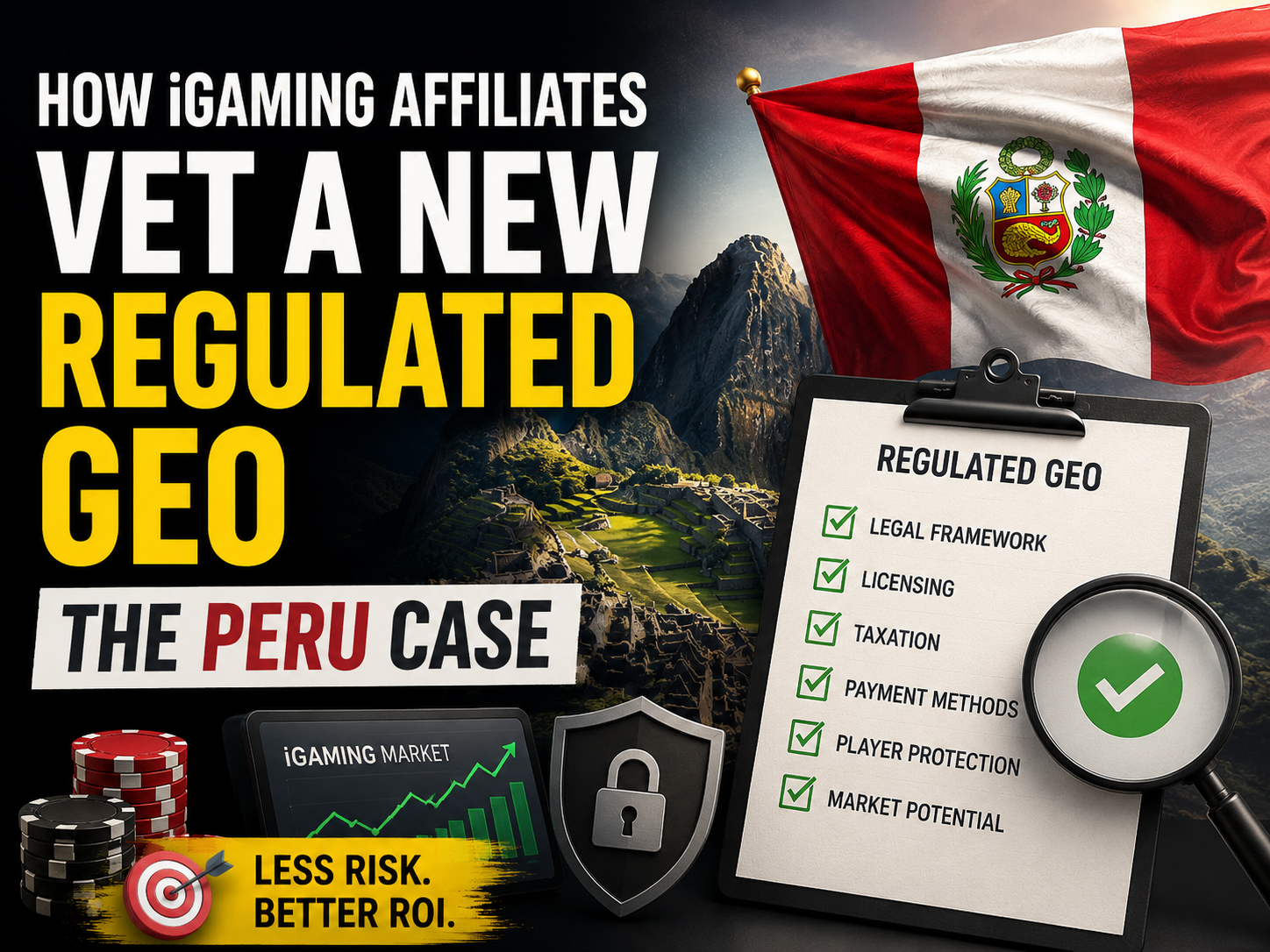
A regulated iGaming GEO changes the media-buying equation before you buy the first click. The question is not simply whether gambling is legal. You need to know who licenses operators, what can be advertised, how players deposit and verify themselves, whether affiliates have their own obligations, and whether the regulator actually enforces the rules.
Peru is a useful case study because its remote-gaming framework has been fully operational since 2024 and has an identifiable regulator, public licensing information and an active enforcement track. But the checklist below is designed for any newly regulated gambling market.
TL;DR
- Identify the regulator and the exact legal framework before treating a GEO as open.
- Verify operator licenses independently rather than trusting an affiliate network’s geo label.
- Map advertising restrictions onto your own creatives, pre-landers and traffic sources.
- Check payments, KYC, self-exclusion and other funnel friction before estimating conversion rates.
- Find out what enforcement actually looks like: domain blocking, payment restrictions, fines, referrals or action against promoters.
- Treat unresolved affiliate-specific legal questions as unresolved; do not turn silence in public guidance into a “no.”
1. Start With the Regulator, Not the Affiliate Network
The first question for a new regulated GEO is simple: who can authorize, suspend and revoke the operator? Write down the regulator, the relevant directorate, the governing law and the implementing regulation.
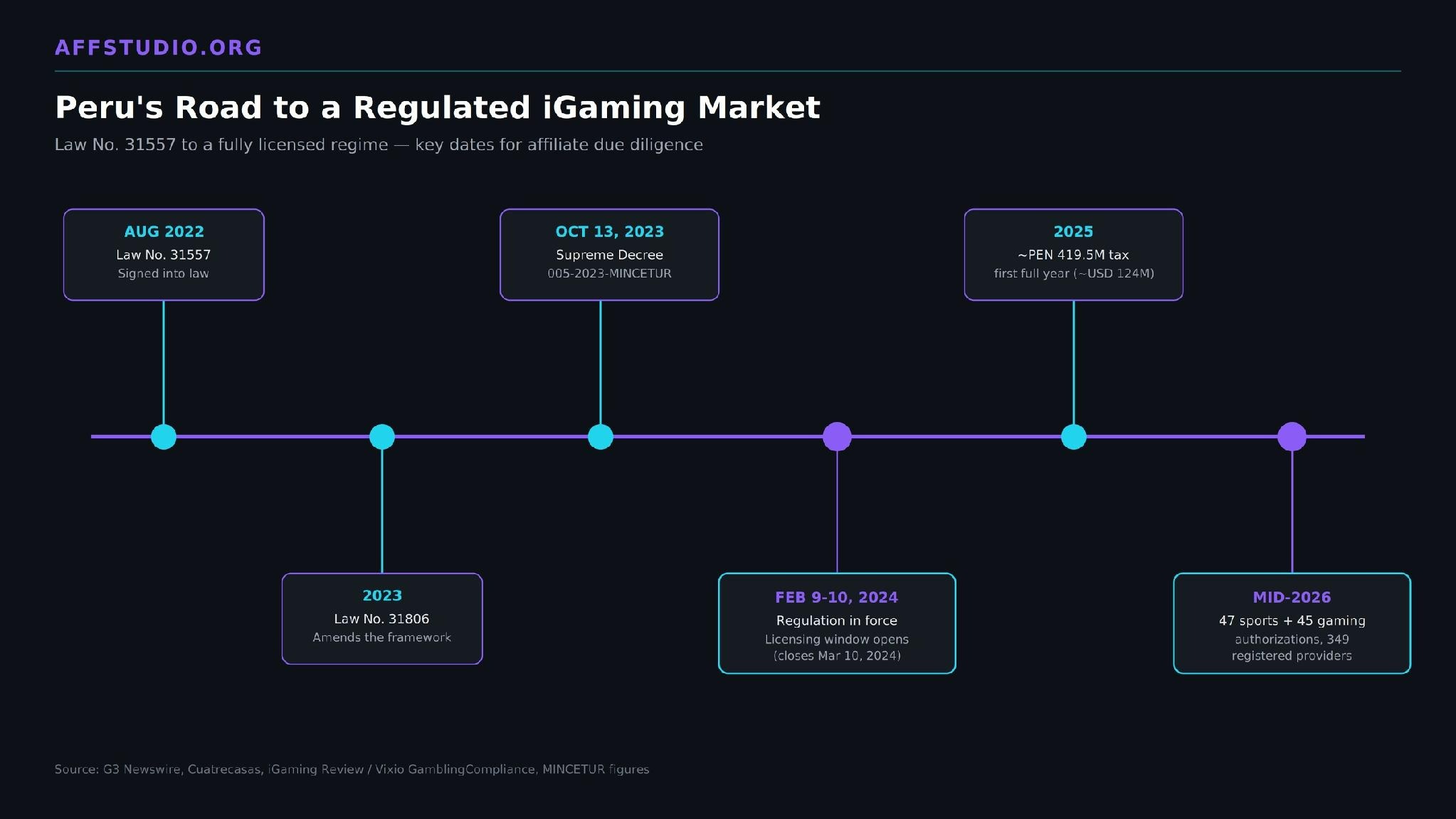
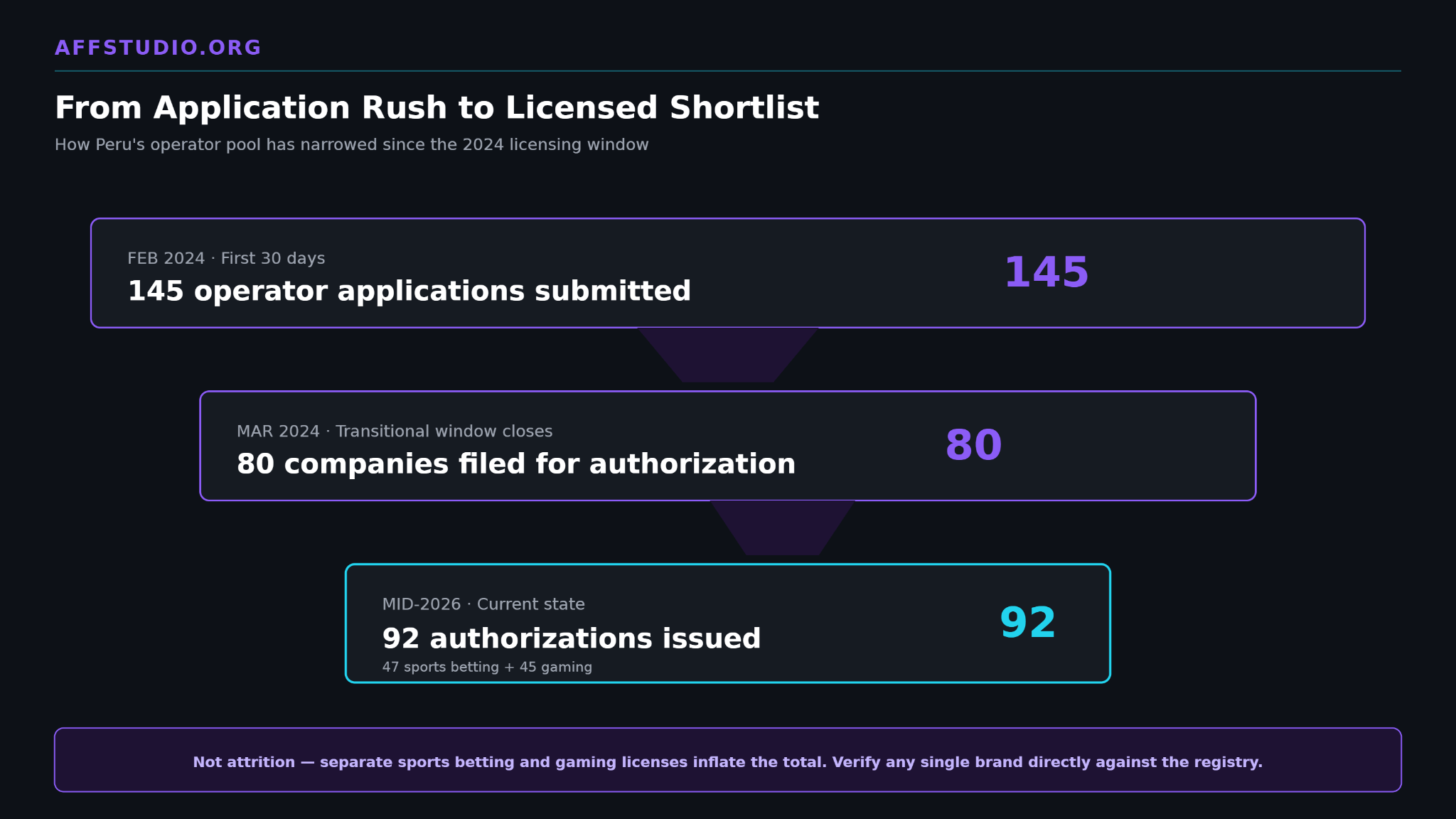
Peru is administered by MINCETUR through the DGJCMT. Law 31557 established the remote-gaming framework, Law 31806 amended it, and Supreme Decree 005-2023-MINCETUR supplied the implementing rules. The framework became operational in February 2024.
That distinction matters because a law can exist for years while practical licensing rules, technical standards and enforcement procedures remain incomplete. A media buyer needs to know whether the market is actually operational, not merely whether a statute has been published.
2. Verify How Licenses Are Actually Checked
A useful regulated GEO has a verification path you can reproduce. Ideally, the regulator publishes authorized operators or another authoritative record.
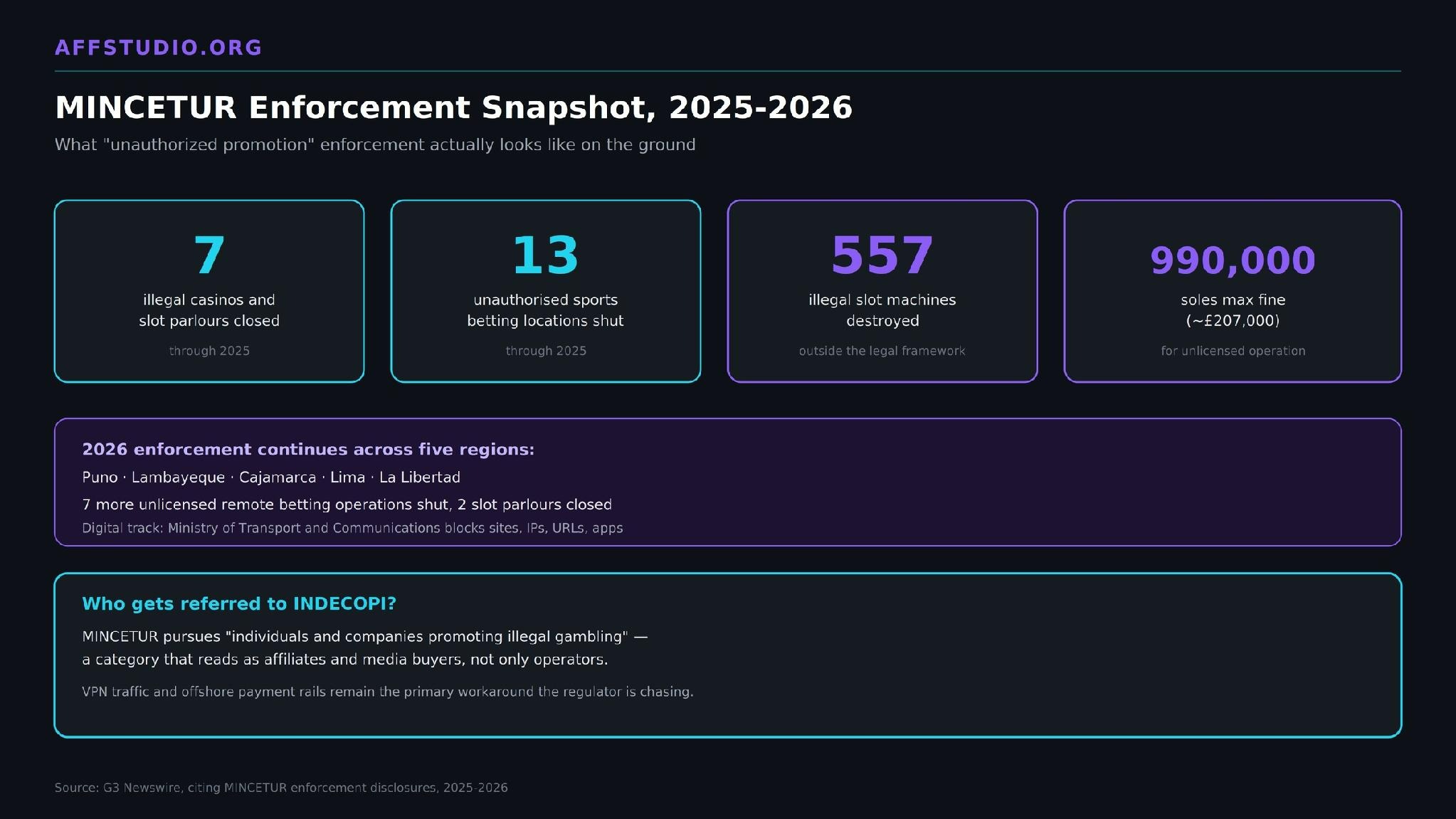
For Peru, the practical check is the DGJCMT/MINCETUR authorization record. Ask the network for the operator’s legal entity and authorization details, then cross-check them yourself.
Do not substitute branding for verification. Domain extensions, “licensed” badges, a familiar operator name or a network’s country filter are all weaker evidence than the regulator’s own record.
3. Map the Advertising Rules Onto Your Own Funnel
A common mistake is to read the operator’s compliance page and assume the media buyer is finished. That is not how a regulated acquisition funnel works.
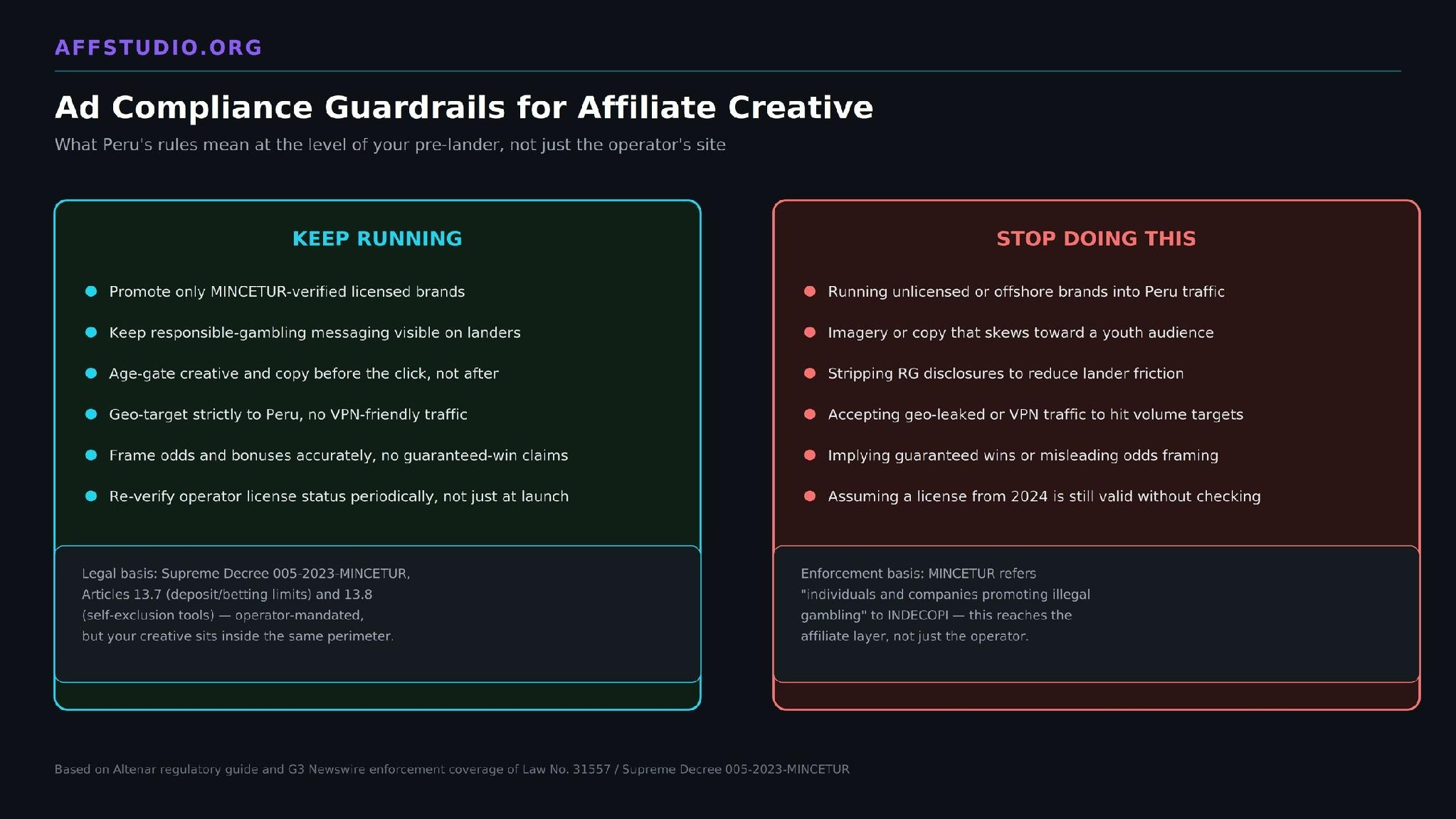
Check whether the market restricts:
- targeting or imagery involving minors;
- claims about guaranteed winnings or misleading promotions;
- where gambling ads may appear;
- responsible-gambling messaging;
- affiliate and influencer disclosures;
- traffic from specific channels, devices or locations;
- creative formats or landing-page elements.
Then translate those rules into a campaign checklist. A restriction that looks harmless in legislation can become a rejected ad, a blocked landing page or a compliance dispute once it reaches a real traffic source.
4. Find Out Whether Affiliates Have Their Own Registration Duty
Do not assume that “the operator is licensed” answers the affiliate question.
Regulated markets often have separate categories for service providers, advertising partners, affiliates, suppliers or platform vendors. The terminology is not consistent between jurisdictions.
Peru illustrates the problem. MINCETUR maintains a registered service-provider framework, but the public material reviewed for this guide does not establish a simple universal rule that every pure traffic or affiliate entity must register separately. That is an unresolved legal question rather than evidence that registration is unnecessary.
For meaningful spend, ask a qualified local lawyer or the regulator. Keep the question documented and do not rely on an affiliate manager’s informal interpretation of local law.
5. Check Enforcement, Not Just the Statute
A regulated GEO becomes materially different when the regulator actually uses its powers.
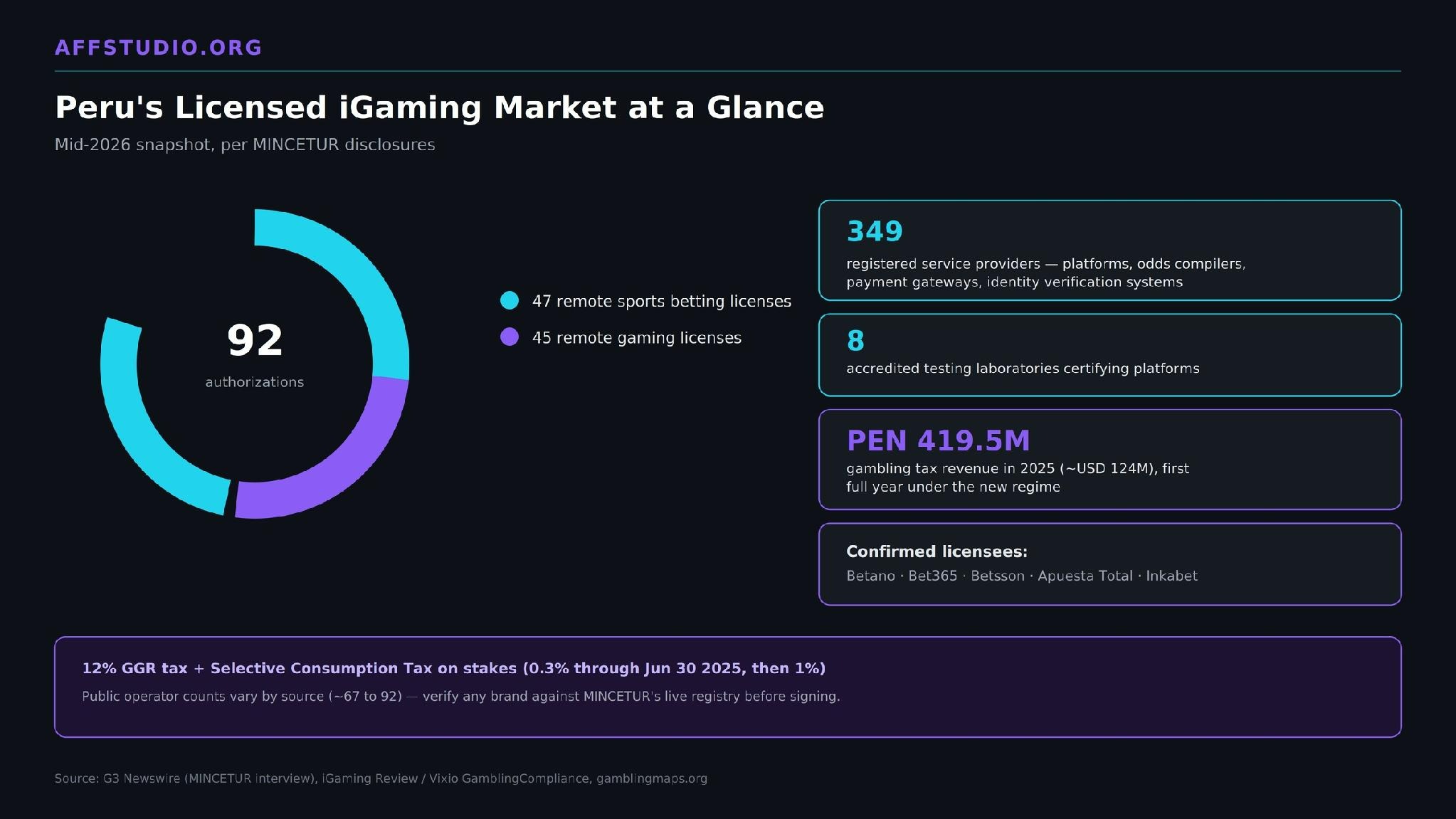
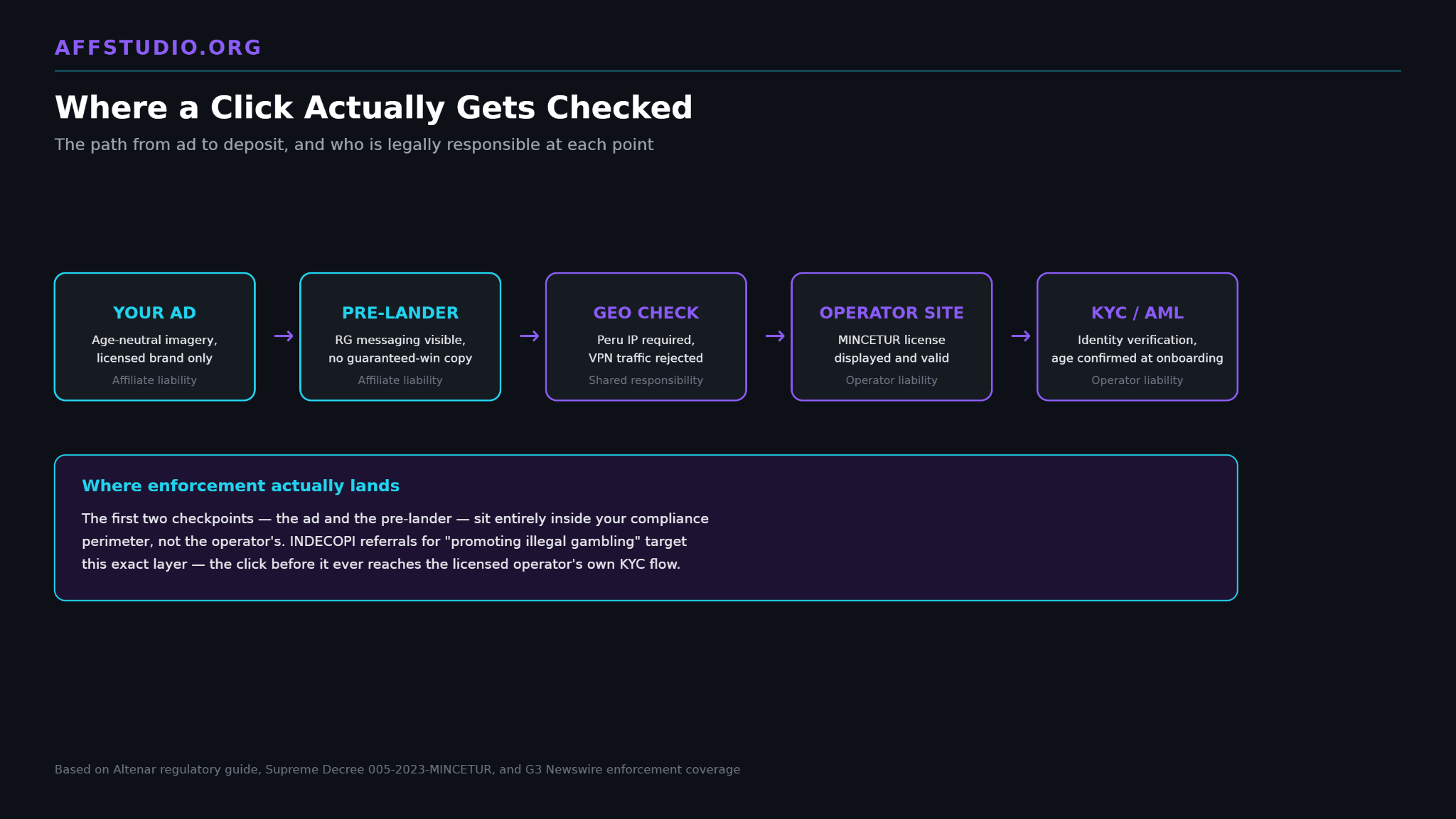
For Peru, enforcement has included action against unauthorized gambling operations and digital measures involving websites, IPs, URLs, applications and payment channels. The ministry has also indicated that promotion of illegal gambling can enter the consumer-protection enforcement track.
For your due diligence, record four things:
- what gets blocked;
- which authority orders the block;
- whether payment providers are involved;
- whether enforcement can reach promoters or only operators.
This tells you whether a bad offer merely creates a payout problem or can also create advertising, account and legal exposure for the traffic side.
6. Audit the Payment Stack
A market can be legally open and commercially unusable for your funnel if the cashier does not match local behavior.
For each new GEO, check:
- the dominant local payment methods;
- minimum deposit and withdrawal amounts;
- deposit and withdrawal processing times;
- cash-based payment options;
- wallet availability;
- card acceptance;
- currency and localization;
- payment methods prohibited by the local rules.
Peru is a good example of why this matters. Yape, Plin and PagoEfectivo can be important parts of the local payment experience, while crypto is not a substitute for the regulated fiat rails available to licensed operators. The point is not to memorize Peru’s cashier. It is to make payment mapping a standard part of GEO research.
7. Model KYC and Player-Protection Friction
A registration is not necessarily a monetizable player.
Find out when identity verification occurs, what documents are required, whether deposit or betting limits apply, and how self-exclusion works. Then reflect that friction in your funnel assumptions.
In Peru, licensed operators have player-verification and responsible-gambling obligations. For an affiliate, this means the conversion path can contain mandatory steps that are outside the control of the pre-lander or ad creative.
8. Build a Regulatory Due-Diligence Table
| Check | Question | Evidence to collect |
|---|---|---|
| Regulator | Who licenses and enforces? | Official regulator and directorate |
| Legal basis | What law and implementing rules apply? | Law, decree and effective date |
| License verification | How can an operator be independently verified? | Public register or regulator confirmation |
| Advertising | What can affiliates and advertisers say or show? | Advertising rules and operator requirements |
| Affiliate status | Does a traffic entity need registration or approval? | Regulator guidance or local legal advice |
| Payments | Can players deposit and withdraw through local rails? | Live cashier test |
| KYC | Where does identity verification enter the funnel? | Operator onboarding flow |
| Enforcement | What happens to unauthorized operators and promoters? | Recent regulator actions |
| Traffic restrictions | Which sources, locations or formats are restricted? | Network terms + regulator rules |
| Commercial terms | Can the operator economics support the acquisition model? | CPA/RevShare, qualification and hold terms |
Peru as the Case Study
Peru shows why the framework needs to be broader than “find licensed operators.” The market has a formal licensing regime, a regulator with a public verification path, local payment requirements, player-verification rules and active enforcement against unauthorized gambling.
At the same time, some affiliate-specific questions require more caution than the operator rules. Public guidance does not resolve every possible obligation for a pure traffic entity. That is exactly the kind of gap a due-diligence framework should expose instead of hiding.
For the actual Peru licensing and registry workflow, use our Peru iGaming Affiliate Guide. For the commercial checks after you have found an offer, use How to Vet a Peru iGaming Offer Before You Buy Traffic.
Regulated vs. Gray: What Actually Changes
| Dimension | What to expect in a gray market | What to investigate in a regulated GEO |
|---|---|---|
| Offer availability | Often broad but unstable | Restricted to the licensed supply |
| License risk | Often unclear | Can usually be checked against a regulator |
| Advertising | Network rules may dominate | Local law can apply directly to marketing |
| Payments | Processor availability is often the main constraint | Local payment and regulatory rules both matter |
| KYC | Varies widely | Usually more formal and documented |
| Enforcement | May be fragmented | Can include licensing, blocking and payment measures |
| Affiliate obligations | Often defined mainly by network policy | May involve local advertising or registration rules |
A Better Launch Sequence
- Map the regulator. Identify the authority, law, implementing rules and effective date.
- Verify the operator. Get the exact legal entity and license evidence.
- Map advertising rules. Turn legal restrictions into creative and traffic-source checks.
- Map payments and KYC. Test the real player journey.
- Check enforcement. Look for recent blocks, payment restrictions and actions against promotion.
- Clarify affiliate obligations. Escalate unresolved questions instead of guessing.
- Only then model the offer. Use CPA/RevShare, qualification, holds and traffic costs to build the campaign economics.
- Run a controlled test. Measure the actual funnel before scaling.
FAQ
What is the first thing to check in a newly regulated iGaming GEO? Identify the regulator and determine whether there is an authoritative way to verify the operator’s current license.
Can I trust an affiliate network’s GEO list? Use it for discovery, not as your only regulatory evidence. Independently verify the operator and the current traffic terms.
Why are payment methods part of regulatory due diligence? Because local payment rules and player behavior affect both compliance and conversion. A legally available offer can still have a funnel that does not fit the market.
Do affiliates always need a local gambling license? There is no universal answer. Some jurisdictions regulate operators only; others impose separate requirements on advertising, affiliates or service providers. Check the local rules rather than generalizing from another GEO.
Should a new regulated GEO be treated as safer than a gray market? Regulation creates a formal framework and a verification mechanism, but it does not remove campaign risk. Licensing, advertising, payments, KYC and enforcement still need to be checked.
Bottom Line
The mistake with a newly regulated iGaming GEO is starting with the offer list. Start one level higher: regulator, law, license verification, advertising rules, payments, KYC and enforcement. Once those are mapped, the affiliate offer becomes a commercial problem you can actually model.
Peru is a useful case because the framework is mature enough to study but still exposes the gaps that appear when a market moves from offshore activity to formal licensing. Use the same due-diligence sequence before entering the next regulated GEO.




Leave a Reply