
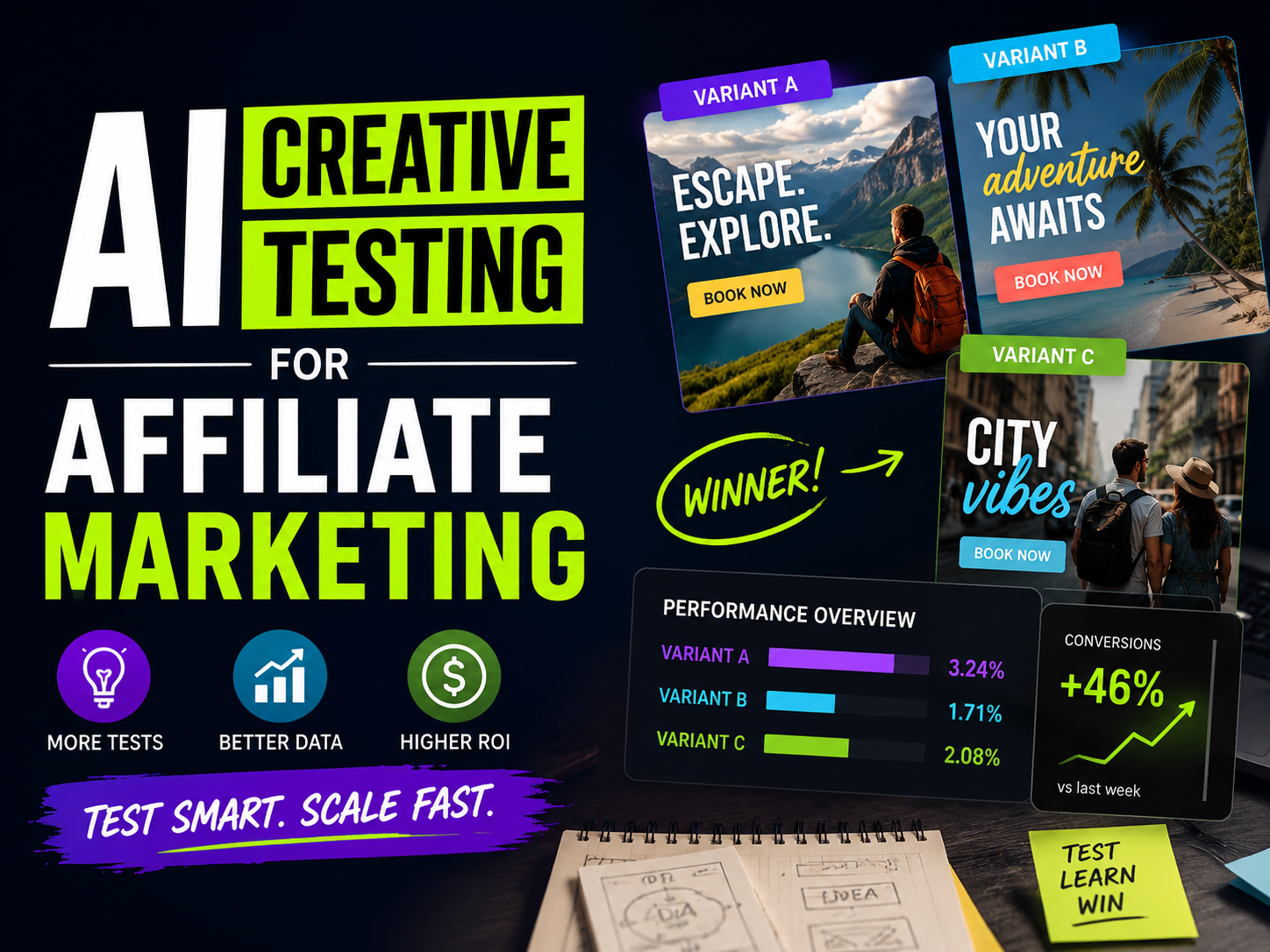
You have 30 creatives running. Five have a decent CTR. Two are actually getting conversions. One looks like a winner. But if someone asked you right now why it’s winning, could you answer? Not “the CTR is good” — the actual reason. What’s the angle. What’s the hook doing. Why this promise, for this audience, right now.
Most teams can’t answer that. They can tell you which creative is winning. They can’t tell you what made it win. And that gap is the reason so much affiliate creative testing produces a pile of assets instead of any real learning.
This is the core problem AI hasn’t fixed, and honestly, can’t fix by itself: a winner is useful only when you know what made it win. Generate 200 variations with an image model and you still have the same problem, just at higher volume. More outputs. Same blind spot.
So this isn’t an article about producing more ads with AI. It’s about using AI as an analytical layer — something that helps you form angle hypotheses before you generate anything, and helps you read performance data after, so each test actually teaches you something. Variation is not the same thing as experimentation. Keep that line in your head; it’s going to come up a lot.

What Actually Makes a Creative “Win”?
A creative isn’t one variable. It’s a stack of decisions, and a “winner” is really a specific combination of them landing right:
Audience problem → Angle → Promise → Hook → Proof → Format → Execution → CTA
The angle is the emotional or narrative frame — pain relief, social proof, curiosity, contrarian take, whatever. The hook is what makes someone stop scrolling in the first second or two. The promise is the specific outcome you’re claiming. Proof is why they should believe it. Format is UGC vs. static vs. carousel vs. talking-head video. Execution is the visual and copy craft layered on top of all of it.
A US-based ad-angle framework guide that maps competitor creative by argument rather than by brand puts it well: group ads as problem-led, proof-led, lifestyle-led, education-led, or offer-led, and the underlying angle becomes visible even when the surface execution changes constantly. The test they suggest for whether an angle is actually clear is blunt — can you state the target belief in one sentence and the central argument in one sentence? If either one runs long or starts branching into “and also,” the angle isn’t clear yet, it’s still a pile of claims.
Here’s why the distinction between angle and execution matters practically:
Same angle, different creative. Two ads can both run a pain-relief angle — one as a UGC testimonial, one as a static before/after image. If both convert, the angle is validated, not the visual style.
Similar creative, different angle. Two UGC-style videos can look nearly identical in format and still be testing completely different things — one framed as a discovery story, one as social proof. If only one converts, you’ve learned something about the story, not the format.
Confuse these two and you’ll draw the wrong conclusion from every test you run.
Why Most Affiliate Creative Tests Don’t Teach You Anything
Ask most affiliates what they learned from their last batch of 20 creatives and you’ll get a shrug or “the third one worked.” That’s not a test — that’s a lottery with extra steps. Here’s where it usually breaks:
Testing too many variables at once. New hook, new visual, new CTA, new format — all in the same creative, launched against the last winner. If it wins, you don’t know which change did it.
Testing random creatives instead of hypotheses. “Let’s throw a few more at it” isn’t a plan. Every creative should be attached to a specific question you’re trying to answer.
Calling a winner too early. A day-one spike is not a pattern. One widely cited paid-media fatigue-detection framework flags real signals only once several conditions line up together — CTR dropping 20%+ from its 7-day peak over three consecutive days, CPA rising 15%+ from baseline, or frequency exceeding 3.0 on prospecting campaigns — not a single early wobble. The same caution applies in reverse to early wins.
Looking only at CTR. More on this below — it’s common enough to deserve its own section.
Ignoring downstream conversions. A creative that gets clicks but not qualified traffic isn’t a creative win, it’s a traffic cost.
Mixing GEOs and traffic sources. A creative that performs in one market can flop in another with the same offer, same budget, same everything else — cultural fit and local trust signals aren’t optional variables, they’re part of the test.
Testing tiny segments. Statistically, nothing.
Killing creatives after one bad day. An ad that dies on day two of a rough delivery week isn’t necessarily a bad ad; it may just be an ad that hasn’t cleared Meta’s learning phase or hit a stable audience yet.
Scaling winners that aren’t repeatable. A single-zone or single-day spike that collapses the moment you push volume through it wasn’t a real signal.
Motion’s 2026 Creative Benchmarks report, based on data across its advertiser base, puts a number on how rare real winners actually are: roughly 4–8% of creatives become genuine winners depending on account size, while 50–53% are discarded as losers before they even reach 28 days of spend. That’s the honest base rate — most of what you test will not work, and the point of a structured test is to make sure the ones that do teach you something.
A good creative test should reduce uncertainty. If you run it and you’re just as confused afterward, the test failed — regardless of what the dashboard says.
Start With Angle Research — Before You Generate Anything
Here’s the actual differentiator most “AI for creatives” advice skips: don’t ask AI for 50 ad ideas. Give it evidence and ask it to find patterns first.
Before any generation, feed a model the material that already exists: landing page copy, customer reviews, Reddit and forum threads, comments under competitor ads, Meta Ad Library entries, old winning creatives, past objections your affiliate manager or support team has flagged. Ask it to surface pains, desires, objections, proof points, recurring language, misconceptions, and emotional triggers — not ad copy yet, just patterns in what real people already say and want.
A recurring finding from New Engen, a US performance marketing agency, is worth sitting with: across more than 100 brand conversations it ran between February and May 2026, creative volume and quality gaps came up as the second-most consistent pain point for three reporting periods in a row. The recurring issue wasn’t a lack of production — brands were producing plenty of content. Their teams had exhausted the same formats and concepts without a framework for genuine conceptual diversification. More output on a thin set of underlying ideas doesn’t fix that; better research upstream does.
Build an Angle Map, Not a List of Ad Ideas
A list of 15 ad ideas tells you nothing about which underlying angle each one represents. An angle map fixes that:
| Angle | Audience Problem | Promise | Proof | Risk | Competition |
|---|---|---|---|---|---|
| Pain relief | Chronic discomfort, tried other products | Noticeable relief in days | Reviews, before/after | Overpromising = compliance issue | High in health/wellness |
| Social proof | Skepticism about unfamiliar brand | “Others like you already succeeded” | Testimonials, screenshots | Feels generic if overused | Very high |
| FOMO | Fear of missing a deal or window | Limited-time access | Countdown, scarcity framing | Slides into clickbait fast | Medium-high |
| Curiosity | Boredom with familiar offers | “There’s something you don’t know yet” | Reveal in the creative or landing page | Can feel like bait-and-switch | Category-dependent |
| Contrarian | Distrust of standard claims | “Everyone’s doing X wrong” | Logic or expert framing | Needs strong backing or it reads as noise | Low-medium |
None of these angle types is universally best. The map’s job is to make explicit which angle each creative actually represents, so that six months from now you can look back and say this angle worked in this GEO, not just this image worked.
Use AI to Find Gaps in Competitor Creative
This is where AI earns its keep as an analytical tool rather than a content firehose. Pull competitor creatives from the Meta Ad Library or a similar tool, and ask a model to cluster them by angle — not by visual style, by underlying emotional frame.
Illustrative example. Say the clustering shows 70% of competitor creatives in a category running a price/discount angle, 20% running social proof, and 10% running convenience. That’s a visible pattern: heavy saturation on price, thin coverage on convenience.
The gap is not automatically the answer, though. An unused angle is not automatically a good angle. It is only a hypothesis worth testing. Maybe convenience is underused because nobody’s found the right proof mechanism for it yet. Maybe it’s underused because it doesn’t actually move this audience. You don’t know until you test it — but now you’re testing a specific, reasoned hypothesis instead of a random idea.
How to Design the First Creative Test
The instinct is to jump straight to 20 visual variations. Resist it. On the first pass, test angles, not executions — otherwise you can’t tell whether a loss was the angle or just weak art direction.
A workable first test needs: 4–6 meaningful angle hypotheses, a comparable audience, the same offer, the same landing page where possible, stable tracking, and comparable traffic conditions across variants. That’s it. Everything else is noise you’re choosing to introduce.
On budget: there’s no honest universal number here. Test budget should be based on conversion economics, expected volume, and acceptable learning cost — not an arbitrary “$20 per creative” rule. A campaign converting at a low unit cost buys a very different sample size than a campaign with a $40 payout per conversion, on the same total budget. Size the test to the data you actually need, not to a round number that feels safe.
What to Hold Constant — and What to Change
| Test | Change | Keep Constant |
|---|---|---|
| Angle test | Angle | Format, offer, landing page |
| Hook test | Hook | Angle, format |
| Format test | Format | Angle, hook |
| Visual test | Visual execution | Angle, hook |
| CTA test | CTA | Core message |
Change five things at once and you’ve turned a test into noise generation. If Creative B beats Creative A, and B has a new hook, a new visual, a new CTA, and a new format all at once, you’ve learned that something about B is better — and that’s a very expensive way to learn nothing actionable.
Meta’s own creative guidance for its Andromeda-era ranking system draws roughly the same line from the platform side: creative iteration, changing the hook, is not the same as creative variation, changing the underlying concept. An ad library that’s actually diverse should look more like a small film festival than a casting call for the same idea in different outfits.
Which Metrics Actually Decide a Creative Winner?
Metrics form a ladder, and each rung tells you something different:
Impression → CTR → CPC → Landing-page engagement → CVR → CPA → EPC → ROI/Profit
Early signals (CTR, CPC) tell you whether the creative stops the scroll. Mid-funnel signals (landing-page engagement, click-to-lead) tell you whether the promise and the landing page agree with each other. Business signals (CVR, CPA, EPC, ROI) tell you whether any of this actually makes money.
The mistake is stopping at the first rung. A high-CTR creative is not automatically a winning creative.

The High-CTR, No-Conversions Trap
Illustrative example.
| Creative A | Creative B | |
|---|---|---|
| CTR | 3.8% | 2.1% |
| CPC | $0.40 | $0.65 |
| CVR | 0.5% | 3.2% |
Assume a $40 payout per conversion and 10,000 clicks bought at each CPC.
Creative A: 10,000 clicks × 0.5% CVR = 50 conversions. Spend = 10,000 × $0.40 = $4,000. Revenue = 50 × $40 = $2,000. ROI: -50%.
Creative B: 10,000 clicks × 3.2% CVR = 320 conversions. Spend = 10,000 × $0.65 = $6,500. Revenue = 320 × $40 = $12,800. ROI: +97%.
Creative A looks like the winner on the ad dashboard. Creative B is the one that actually makes money.
This isn’t a hypothetical shape, either. A real thread in a Shopify merchant community describes an advertiser who put several hundred thousand dollars into Meta ads, half of it through Advantage+, and ran into exactly this: high click-through rates paired with very low conversion rates. Other advertisers responding in that thread pointed at a mismatch between what the ad promised and what the landing page actually delivered, sometimes made worse by Advantage+ blurring the targeting signals that would normally show who was clicking and why.
Two named consultants quoted on the same underlying problem, in an industry piece collecting practitioner views on high-CTR-low-conversion campaigns, made similar points from different angles. Ricci Masero of White Rabbit Consultancy in the UK put it directly: the most common reason for high CTR and low conversions on any campaign comes down to landing page UX — page speed, trust signals like reviews and certifications, and a checkout flow that doesn’t create friction. Minesh J. Patel of The Patel Firm in the US framed it from the targeting side: a low conversion rate paired with a high CTR usually means the ad is reaching the wrong consumers, or the landing page needs work, and mistargeting is often the more likely culprit once the landing page itself checks out.
That’s the trap in one sentence: high CTR tells you the hook worked. It tells you nothing about whether the promise matched the offer, or whether the people clicking were ever going to convert.
How AI Should Read Creative Performance
Once you’re past the “did it get clicks” stage, AI’s job shifts from generator to analyst. Feed it a structured dataset — creative ID, angle, hook, promise, format, visual style, GEO, device, placement, source/sub-ID, spend, clicks, conversions, CVR, CPA, EPC, ROI — and ask it a specific question:
What patterns separate profitable creatives from unprofitable creatives?
Not “which creative is best.” That question invites a single ranked answer and hides the reasoning. The pattern question forces the model to surface why, which is the only part of this that’s reusable on the next test.

Build a Creative Performance Dataset
| Creative ID | Angle | Hook | Format | GEO | Placement | Spend | CTR | CVR | CPA | EPC | ROI |
|---|---|---|---|---|---|---|---|---|---|---|---|
| CR-014 | Social proof | “3,200 people did this” | UGC | US | Feed | $420 | 2.4% | 2.8% | $14.20 | $1.02 | +18% |
| CR-015 | Pain relief | Question hook | Static | US | Feed | $380 | 3.1% | 0.6% | $61.30 | $0.24 | -71% |
| CR-016 | FOMO | Countdown | Carousel | UK | Feed | $260 | 1.9% | 3.5% | $9.80 | $1.44 | +52% |
Illustrative row values. Without semantic tagging like this — angle, hook, and format as their own columns, not buried in a filename — six months from now you’ll know which creative ID won, but not why. That’s the whole argument for the dataset structure: it’s the difference between a spreadsheet of IDs and an actual body of knowledge you can query.
The AI Prompt for Creative Pattern Analysis
Here’s a prompt structure that pushes a model toward analysis instead of a popularity ranking:
You are analyzing affiliate creative performance data. Using the dataset provided (creative ID, angle, hook, format, GEO, placement, spend, CTR, CVR, CPA, EPC, ROI):
- Identify the top 3 and bottom 3 performers by ROI, not CTR.
- Compare the winners against the losers on every tagged dimension (angle, hook, format, GEO, placement).
- Group results by angle and by format separately — tell me if the pattern is angle-driven or format-driven.
- Explicitly separate creatives that won on CTR from creatives that won on conversion. Flag any that won on one but lost on the other.
- Identify any recurring pattern across 3+ creatives — do not report a pattern based on 1–2 data points.
- Flag any group with fewer than [X] conversions as too small to draw a conclusion from.
- State explicitly where you are inferring correlation vs. where the data supports causation — and say when you can’t tell the difference.
- Propose 3–5 next-test hypotheses based on the patterns found, each tied to a specific angle, hook, or format change.
- List what data would have made this analysis more reliable (e.g., missing landing-page engagement, missing device breakdown).
- Do not state a conclusion the data doesn’t support — if the sample is too thin to say anything, say that instead of guessing.
Illustrative AI output.
Top performers by ROI are CR-016, CR-021, and CR-009 — all use a FOMO or urgency-based angle, regardless of format (carousel, static, and video respectively). Bottom performers (CR-015, CR-011, CR-004) share a pain-relief angle paired with a question-hook, despite two of them having above-average CTR. This suggests the pain-relief + question-hook combination in this dataset is a CTR winner but a conversion loser — likely a message-match issue between hook and landing page rather than a targeting problem, though the dataset doesn’t include landing-page engagement data to confirm this. Sample size for the UK GEO subgroup is under 15 conversions per creative — treat any GEO-specific claim there as directional, not confirmed.
That’s the shape of a genuinely useful output: specific, hedged where it should be, and pointed at a next action.
From One Winner to the Next 10 Tests
Winner → Extract winning ingredients → Lock what worked → Change one variable → Build next variant → Test → Compare → Update the hypothesis
Illustrative example. Say your winning creative is: problem-focused angle + UGC format + female narrator + question hook. The next round of tests, each changing exactly one thing:
- Same angle, new hook (statement instead of question)
- Same hook, different narrator (male voice, same script)
- Same angle, testimonial-based proof instead of narrator opinion
- Same concept, static format instead of UGC video
- Same angle, stronger/more direct CTA
Each of these answers a specific question about the winner. None of them throw away what already worked.
Mirella Crespi, a DTC creative strategist whose ad-production workflow is documented by the analytics platform Motion, frames the discipline behind this simply: every ad creative is a hypothesis that needs to be tested, and whenever budget goes behind a creative, the team should know exactly what it’s learning from that spend. That’s the difference between iteration with a purpose and just shipping more assets.
When the Winner Starts Dying — AI and Creative Fatigue
Eventually the winner slows down. The instinct is to assume fatigue and refresh the creative. Sometimes that’s right. Sometimes it isn’t.
CTR down does not automatically mean creative fatigue. Detection frameworks used by paid-media practitioners describe a fairly consistent signature: CTR strong for the first several days, then declining gradually while CPA holds because the algorithm compensates by bidding higher, then frequency climbing and CPA visibly rising, then a sharper drop. The distinguishing signal is CTR decline while impressions stay stable — meaning the platform is still showing the ad, but people have stopped clicking it, which points at fatigue rather than a delivery or targeting problem. On the threshold side, frequency crossing roughly 2.5 to 3.5, alongside at least one other metric moving the same direction, is a commonly cited line between normal variance and real fatigue.
But the same symptoms can come from somewhere else entirely — traffic quality drifting, or the offer itself changing underneath you.
Creative Fatigue vs. Bad Traffic vs. Bad Offer

These are diagnostic patterns, not proof of causation. Cross-check them, don’t treat a single matching row as confirmation. If every creative you’re running dropped at once and nothing in your GEO or placement mix moved, that points away from a single fatigued creative and toward something upstream — a network change, a device shift, or the offer itself.
The Angle-to-Offer Match Most Affiliates Skip
Ad promise → Landing page → Offer promise → Conversion
Illustrative example. Ad says “Save $500 a month.” Landing page says “Compare your options.” Offer is a free trial. Nobody in that chain lied, exactly — but the ad promised savings, the landing page pivoted to comparison, and the offer delivered neither. That’s a message mismatch, and it’s invisible in CTR. It only shows up as conversions that don’t happen.
A strong click can still be a bad click if the ad promise and the offer don’t match. AI is genuinely useful here — feeding it the creative claim, the landing-page headline, the CTA copy, and the offer terms side by side, and asking it to flag mismatches, is a fast, cheap sanity check most teams skip entirely.
How to Test AI-Generated Creatives Without Creating AI Slop
Generative tools make it trivially easy to produce something that looks like a new test and isn’t one. Changing a background is not a new test. Changing five words is not a new hypothesis. And even a genuinely new angle isn’t automatically enough if the landing-page promise stays mismatched underneath it.
The practical issues with AI-generated creative are specific enough to test for directly: unstable visual quality from one generation to the next, detail overload that makes the brain work harder to decode the image before it even registers the message, an uncanny-valley effect from oddly perfect symmetry, distorted text and small elements, and logical mismatches between the generated visual and the actual offer. These aren’t vague AI-skepticism — they’re testable failure modes that show up in real campaigns.
There’s a well-documented behavioral reason overproduced variation backfires beyond the platform-signal problem. Research by Sheena Iyengar and Mark Lepper on choice overload found that when people face too many options, they become less likely to make a decision at all — not the same situation as ad scrolling, but a related pattern. And Nielsen Norman Group’s research on banner blindness has repeatedly found that users learn to ignore anything that visually reads as an advertisement, regardless of its relevance, once it starts to look templated and familiar. Distinctive, recognizable creative — the opposite of a pile of near-identical AI variations — is what the marketing-science literature on brand assets (notably the Ehrenberg-Bass Institute’s work on distinctive brand assets) consistently ties to actual recall and response.
One real, documented case worth knowing: the US ice cream brand Häagen-Dazs faced exactly the fatigue problem this article keeps warning about — ads burning out fast, engagement declining, and a production team that couldn’t manually produce enough fresh variations to keep up. Working with the AI ad-generation platform AdCreative.ai, the brand generated over 150 variations per product, had them scored automatically, and only put the strongest performers into live testing. The reported result was a meaningful engagement lift — more than 11,000 “Get Directions” clicks in a single month — alongside a $1.70 reduction in CPM. The lesson isn’t “generate 150 variations and you’ll win.” It’s that the volume only paid off because it was paired with automated scoring that filtered out the weak ones before they reached real traffic — production speed plus a filter, not production speed alone.
AI Creative Testing Workflow for Affiliates
Offer research → Audience research → Angle map → AI hypotheses → Creative production → Structured test → Tracker data → AI pattern analysis → Winning angle → Controlled iteration → Scale → Fatigue monitoring → Next test

What You Should Automate — and What You Shouldn’t
| AI can help with | Human still decides |
|---|---|
| Pattern detection | Whether the pattern actually matters |
| Clustering competitor creative | Whether the angle is strategically worth pursuing |
| Ranking hypotheses | Whether to act on a ranking |
| Summarizing performance | Whether the underlying data is trustworthy |
| Generating next-test ideas | Compliance, budget, and scaling decisions |
The logic here isn’t “AI is untrustworthy.” It’s that pattern detection and judgment are different jobs. A model can tell you that pain-relief angles cluster on the losing side of your dataset. It can’t tell you whether that’s because the angle is genuinely weak or because your landing page undercuts it — and it definitely shouldn’t be the one deciding to pull budget from a live campaign on a thin sample.
A Practical 7-Day Creative Testing Sprint
Day 1 — Research and build the angle map. Day 2 — Turn the map into 4–6 hypotheses. Day 3 — Produce creative for each hypothesis. Days 4–6 — Run the controlled test. Day 7 — Analyze and write next-round hypotheses.
The calendar is fixed; the statistical decision isn’t. Low-volume campaigns will often need longer than seven days to reach a sample worth trusting — don’t force a conclusion on day 7 just because the calendar says so. And don’t promise a winner in 48 hours; the fatigue and sample-size dynamics above make that an unreliable bet even when it occasionally pays off.
What Experienced Buyers Actually Look For
A few recurring positions worth naming, drawn from documented practitioner sources rather than a single voice:
Some prioritize conversion quality over raw CTR from the start. The consultants cited earlier on the high-CTR-low-conversion problem — Ricci Masero and Minesh J. Patel — both treat CTR as a screening signal at best, with the real verdict coming from landing-page behavior and audience match, not the ad platform’s own click metric.
Some insist on testing new creative only against other new creative, not against an established winner, precisely because older ads carry pixel optimization and historical data new ads haven’t earned yet — a distinction laid out in a testing framework published by the performance agency Ben & Vic, built from work across thousands of client ads.
Some separate creative fatigue from traffic quality as a matter of habit rather than instinct, cross-checking GEO and placement mix before assuming the creative is the problem — exactly the discipline behind the fatigue-vs-traffic-vs-offer matrix above.
Some insist on tagging creatives by angle from day one, specifically so the six-months-later question — what actually won, and why — has an answer. Motion’s benchmark data on how few creatives actually become winners is itself an argument for this: if only 4–8% of what you test will work, the tagging discipline is what turns that small number into a repeatable playbook instead of a lucky accident.
Common Creative Testing Mistakes
- Testing everything at once instead of one variable per test.
- Optimizing for CTR only, ignoring what happens after the click.
- Declaring a winner before the sample size supports it.
- Ignoring GEO, device, and placement effects on the same “creative.”
- Testing on segments too small to mean anything.
- Scaling a one-day spike as if it were a proven pattern.
- Using AI to generate endless surface variations with no new hypothesis behind them.
- Forgetting to check the landing page and offer against the ad promise.
- Failing to tag the underlying angle, hook, and format on every creative.
- Killing a winner before testing whether it’s repeatable across zones or GEOs.
Affiliate Creative Testing Checklist
Define the business metric the test is actually optimizing for.
Identify the single variable being tested.
Build distinct, specific hypotheses — not just “more creatives.”
Keep every non-test variable stable.
Tag every creative by angle, hook, and format.
Track downstream conversions, not just clicks.
Separate CTR performance from profit performance.
Check sample size before drawing a conclusion.
Segment results by GEO, device, and placement.
Compare the ingredients of winners against losers directly.
Ask AI to find patterns, not to pick a single “best” creative.
Turn every finding into the next testable hypothesis.
Monitor fatigue signals on anything already scaled.
Scale only once a result has proven repeatable.
Common Trade-offs Worth Naming Honestly
None of this is free. A few real tensions worth sitting with rather than papering over:
More creatives vs. more meaningful tests. Volume buys you more shots on goal; it also dilutes the signal each shot produces. Motion’s benchmark data shows top-spending accounts do ship more creative per week than smaller accounts, and their hit rate is also higher — but that’s paired with more rigorous tagging and analysis, not volume by itself.
Faster production vs. lower creative quality. AI cuts production time dramatically. It also introduces its own failure modes — the uncanny-valley effect, distorted text, logical mismatches with the offer — that a human designer wouldn’t produce in the first place.
AI scale vs. creative sameness. When everyone uses the same generative tools, outputs start to converge. Distinctive brand assets and creative style play a real role in recognition, and that recognition erodes when everything starts to look like the same polished AI aesthetic.
CTR optimization vs. revenue optimization. These sometimes point the same direction and sometimes actively conflict, as the Creative A/B example above shows starkly.
Automation vs. human control. Meta’s own platform trajectory is moving toward fewer manual controls and more AI-driven optimization across campaign types. That’s convenient right up until a brand-sensitive claim or a regulated message needs a human to catch it before it ships.
Speed vs. statistical confidence. The 7-day sprint above is a real, workable cadence — but it’s a default, not a law. Thin traffic needs more time, not a shorter deadline.
If any of this sounds universally true and conflict-free, that’s usually a sign the framing has been oversimplified. Experienced buyers disagree with each other on plenty of this — how much to trust AI-generated angle ideas, when a stylistic risk is worth taking, how long to let a test run — and that disagreement is a feature of a mature discipline, not a gap in the research.
Final Takeaway
The goal of AI creative testing isn’t to produce more ads. It’s to learn faster.
Every test should answer a question. Every winner should give you something specific to test next. And every AI recommendation — a pattern, a cluster, a next-hypothesis list — should be treated as exactly that: a hypothesis, until the campaign data proves it.
FAQ
What is AI creative testing?
It’s using AI as an analytical layer in creative testing — helping surface angle hypotheses from existing data before production, and finding patterns in performance data after a test runs — rather than only using AI to generate more ad variations.
How do affiliates test ad creatives?
By isolating one variable at a time (angle, hook, format, visual, or CTA), running it against a comparable audience with stable tracking, and reading results against a business metric like CPA or ROI rather than CTR alone.
What should you test first: angle, hook, or format?
Angle first. If you test hooks or formats before confirming the angle resonates, a loss could mean the angle is wrong, the execution is wrong, or both — and you won’t know which.
How many ad creatives should you test at once?
There’s no fixed number, but most structured testing frameworks work with a small, distinct set of concepts rather than dozens of shallow variations of the same idea — enough to cover real angle diversity without fragmenting the data.
What is a winning angle in affiliate marketing?
An angle that reliably drives profitable conversions for a specific audience and GEO, not just clicks. A winning angle in one market or category can fail entirely in another with the same offer.
How do you know if an ad creative is actually a winner?
Check it against downstream metrics — CVR, CPA, EPC, ROI — not just CTR, and confirm the result holds across more than one day, zone, or small segment before calling it proven.
Is CTR enough to judge an affiliate creative?
No. CTR tells you whether the hook stopped the scroll. It says nothing about whether the traffic converts or the campaign is profitable.
How can AI analyze ad creative performance?
By working from a structured, tagged dataset (angle, hook, format, GEO, placement, and performance metrics) and being asked to find patterns that separate profitable creatives from unprofitable ones, rather than simply ranking creatives by a single metric.
Can AI predict which ad creative will win?
Not reliably in advance. AI scoring tools can flag visual and attention issues before launch, and pattern analysis after a test can explain why something won — but predicting a winner ahead of real traffic data isn’t something current tools can do with confidence.
How do you test AI-generated ad creatives?
Screen for AI-specific issues first (distorted text, uncanny visuals, offer mismatch), score the survivors if you have access to an automated scoring tool, then A/B test the finalists on real traffic exactly as you would human-made creative.
How do you detect creative fatigue?
Watch for CTR declining while impressions stay stable, frequency climbing past roughly 2.5–3.0 on prospecting audiences, and CPA that doesn’t improve with bid adjustments — ideally two or more of these moving together, not just one.
Why does a high-CTR ad sometimes have a low conversion rate?
Usually a mismatch somewhere downstream — the ad promise doesn’t match the landing page or offer, the audience clicking isn’t the audience ready to convert, or the creative is technically misleading about what happens next.
How do you turn one winning creative into multiple variations?
Lock what’s working (angle, hook, or format — whichever is confirmed), then change exactly one element at a time — a new hook, a new proof mechanism, a new format, a new narrator, or a stronger CTA — and test each separately.
What data should I give AI for creative analysis?
At minimum: creative ID, angle, hook, format, GEO, placement, spend, CTR, CVR, CPA, EPC, and ROI. The more consistently creatives are tagged by angle and hook rather than just filename, the more useful any AI analysis becomes.



Leave a Reply