

On January 2, 2026, Indonesia closed the one gap in its gambling law that had survived for years. Before that date, the Criminal Code required an act of gambling to happen in a “public place” to count as an offense — which meant playing on your phone at home, alone, technically sat in a grey zone. That zone is gone. Private online gambling now carries the same penalties as public gambling: up to ten years in prison and fines reaching IDR 1 billion. There was no transition period and no grandfathering. The law simply stopped distinguishing between a casino floor and a bedroom.
That closure is a useful entry point into a market that gets misread constantly by affiliates coming from Latin America or the rest of Southeast Asia. Indonesia isn’t a grey market waiting for a regulator to show up, and it isn’t a country debating whether to legalize. It’s a comprehensive criminal ban that has existed for decades, is currently being enforced with more resources and more automation than at any point before, and still generates an estimated $8 billion a year in capital flowing to offshore operators. This guide is about what that combination actually means if you’re the one sending the traffic.

A steady escalation, not a single crackdown moment
Why Indonesia Isn’t a “Grey Market” — It’s a Total Ban
Every other GEO guide in this series has had a regulator to point to. Peru has MINCETUR. Colombia has Coljuegos. The Philippines has PAGCOR. India, as of this year, has OGAI. Indonesia has none of that, because there’s nothing to license. The prohibition runs through the Criminal Code (Articles 303 and 303 bis), Law No. 7 of 1974 on Gambling Control, and the 2024 update to the Electronic Information and Transactions (ITE) Law, none of which carve out an exception for skill games, land-based venues, or foreign operators serving Indonesian users from abroad. Indonesia is the world’s largest Muslim-majority country, and its gambling ban applies under Sharia-influenced law to locals and foreigners alike, with no licensing mechanism anywhere in the system.
That absence changes the entire shape of the compliance question. In a regulated market, the affiliate’s job is to check whether a specific operator holds a specific license. In Indonesia, there’s no license to check, because holding one isn’t a legal category that exists.
| Indonesia | Typical regulated LatAm/Asia GEO | |
| Regulator | None — no licensing body exists | MINCETUR, Coljuegos, PAGCOR, or equivalent |
| License path for operators | None, under any circumstance | Available, with defined application process |
| Promoter/affiliate liability | Criminal offense, same statute as operators | Usually civil or consumer-protection law |
| Who gets prosecuted | Promoters, operators, and players | Mostly operators and unlicensed platforms |
The January 2026 Loophole Closure
The mechanics of the amendment matter more than the headline. For years, enforcement against individual gamblers depended on proving the act happened somewhere public — a shift that let home-based online play exist in a legal grey area even while the underlying activity was illegal in principle. The revision that took effect January 2, 2026 removed that requirement entirely. Playing at home now carries the identical penalty structure as playing in a public place: up to ten years imprisonment, fines up to IDR 1 billion.
This wasn’t a standalone move. It landed inside a broader enforcement pattern that had already blocked 3.7 million gambling-related websites and pieces of content since October 20, 2024, and frozen more than 38,000 suspected bank accounts by mid-2026, of which roughly 32,500 had actually been closed. The home-gambling amendment removed the last structural gap in a system that was already treating the activity as a national priority, not a routine policing matter.
The Personal Risk: Promotion Is Prosecuted, Not Just Operation
This is the section that separates Indonesia from every other GEO in this series, including India. In India, PROGA’s enforcement machinery is aimed primarily at operators and the banks and payment facilitators processing their transactions — a media buyer running creative faces advertising-law exposure, but the criminal prosecutions target the money and the platform. Indonesia doesn’t draw that line. Promotion and facilitation of gambling are themselves criminal offenses under Indonesian law, independent of who operates the platform being promoted, and the enforcement record backs that up: Indonesian police arrested 1,164 individuals on gambling-related charges in the first half of 2026 alone, seizing roughly $105 million in assets, and a single raid in Jakarta in May 2026 detained 321 foreign nationals — 228 Vietnamese and 57 Chinese citizens — running 75 betting platforms out of one office building.
For an affiliate, that reframes the entire risk calculation. An operator-ranking site, a comparison page, or a promotional funnel aimed at Indonesian traffic isn’t adjacent to the legal exposure — it’s squarely inside the same statute that puts operators in prison. This is a market where the enforcement target list includes the person writing the landing page copy.
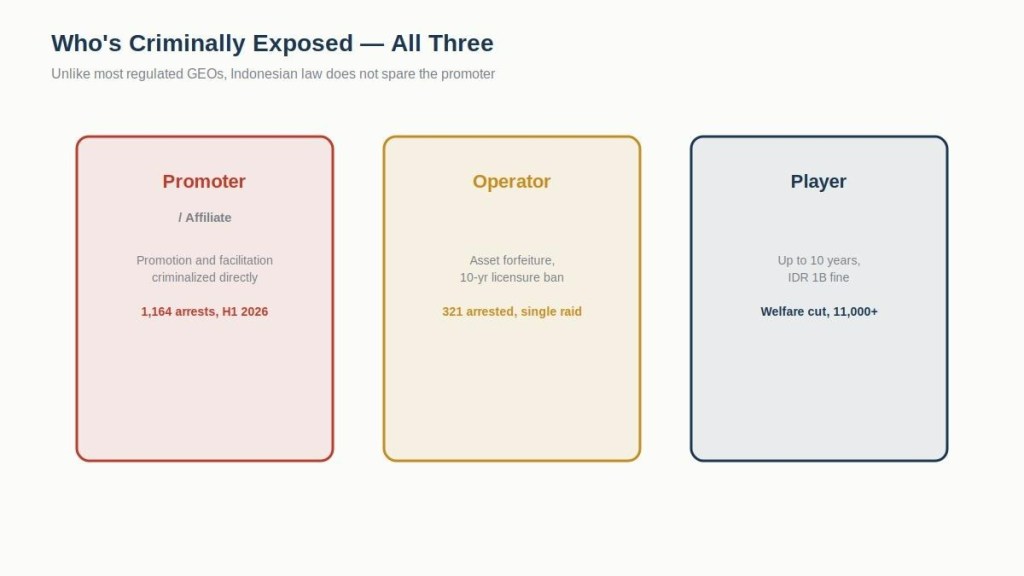
All three tiers face criminal, not civil, exposure — including the affiliate
The Welfare Weapon: Targeting Demand, Not Just Supply
Indonesia has also built a demand-side enforcement tool that has no real equivalent in the other GEOs covered here. The Financial Transaction Reports and Analysis Center (PPATK) cross-references gambling-linked transactions against the social-assistance rolls, and where a match turns up, the household loses its welfare payments. On May 12, 2026, Social Affairs Minister Saifullah Yusuf confirmed that the government had already removed more than 11,000 beneficiaries after detecting gambling-linked use of public welfare funds, and PPATK had identified roughly 600,000 similar cases across 2025 alone.
The mechanism runs on the same AI-driven transaction monitoring that PPATK and the Financial Services Authority (OJK) use to flag suspicious banking activity generally, now pointed specifically at a population the government considers most vulnerable to gambling-related harm. It’s a policy lever aimed squarely at reducing player demand rather than operator supply, and it’s one more signal that Indonesia’s approach treats gambling as a social-harm problem to be eliminated, not a market to be shaped.
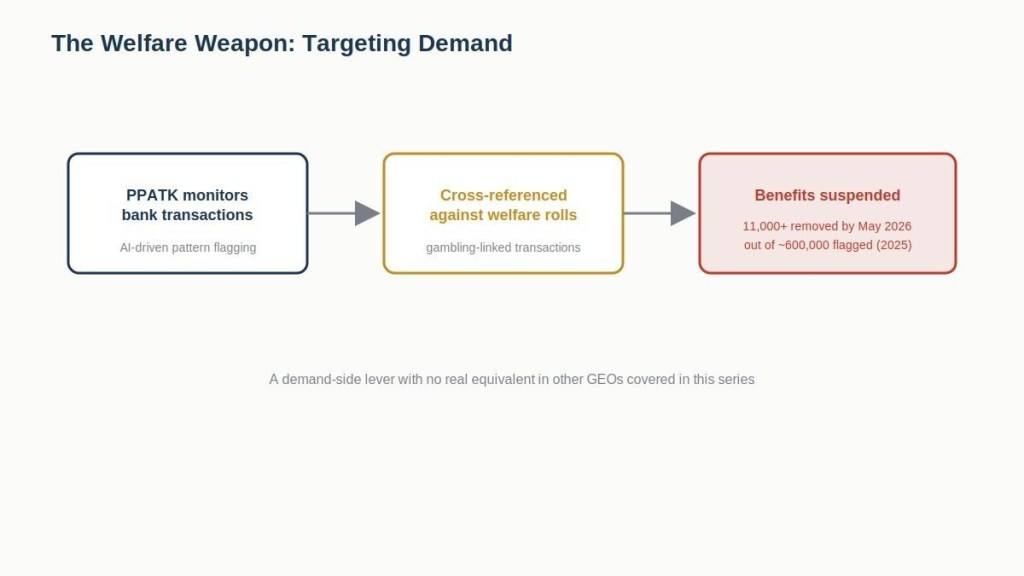
A demand-side lever with no real equivalent in other GEOs covered in this series
Whack-a-Mole: Why the Market Survives 3.7 Million Blocked URLs
None of this enforcement has come close to eliminating the market, and the numbers explain why. Online gambling transaction volume did fall sharply — from roughly IDR 359 trillion ($21.4 billion) in 2024 to about IDR 155 trillion ($9.2 billion) through the third quarter of 2025, according to figures cited during the crackdown — but a market moving from $21 billion to $9 billion is still a $9 billion market, and President Prabowo Subianto has separately cited an estimate of $8 billion in annual capital outflow to offshore gambling networks as an ongoing figure, not a historical one.
Independent tracking backs up the picture of persistence rather than collapse. Blask, a market-intelligence platform that estimates user interest and revenue across gambling brands from search and engagement signals, recorded its Indonesia index falling from 8.89 million in August 2025 to 6.11 million in September, coinciding with an intensified enforcement push on financial channels and content takedowns — then climbing back to 8.85 million by March 2026. Authorities themselves have publicly claimed as much as a 56% reduction in the size of the gambling economy since the campaign intensified, a figure from the government’s anti-money-laundering committee rather than an independently audited number — worth noting as attribution, not as a confirmed fact.
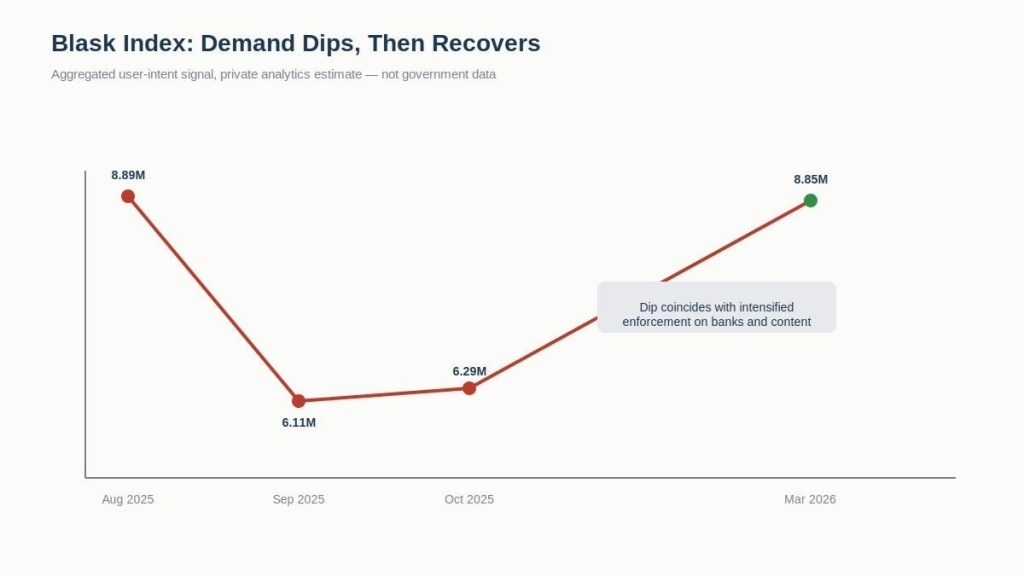
Demand dips during enforcement pushes, then recovers within months
The reason the market keeps functioning despite 3.7 million blocked URLs is structural: platforms move faster than enforcement can follow. A blocked domain reappears under a new registration within hours in many cases, and the enforcement agencies themselves have described the pattern as a “whack-a-mole problem” — a phrase that shows up in coverage of the crackdown often enough to be treated as the accepted description of the dynamic, not a critic’s characterization.

A cycle, not a funnel — this is why blocking alone hasn’t worked
Crypto and Prediction Markets Aren’t a Loophole Either
Affiliates who’ve watched other GEOs treat cryptocurrency as the workaround for blocked banking rails should adjust their expectations for Indonesia specifically. The ban was extended to cover crypto-based bets in 2026, and the government demonstrated its willingness to enforce that extension in May 2026 by blocking access to Polymarket, the crypto-based prediction market. Indonesia’s Ministry of Communication and Digital Affairs classified Polymarket as illegal online gambling under local law, with officials stating explicitly that using cryptocurrency or blockchain technology doesn’t change the underlying nature of a platform that lets users wager on uncertain outcomes. The timing wasn’t incidental — the block followed a Polymarket contract asking whether President Prabowo would leave office before his term ends, which drew significant attention on Indonesian social media in the days before the ban.
Indonesia joined more than 30 jurisdictions that have restricted Polymarket by that point, but the specific reasoning matters for affiliates: the government pre-emptively closed a category of product — crypto-settled prediction markets — before it had time to become a meaningfully monetized traffic vertical inside the country.
Payment Rails Under Direct Attack
Banking has been the primary enforcement target since the crackdown intensified, but it isn’t the only rail under pressure. OJK has mandated that banks integrate “Cyber Patrol” modules into core banking systems specifically to detect mule accounts through patterns of atypical, high-frequency, low-value transactions — the signature of gambling deposits routed through intermediary accounts. In response, gambling operators have migrated activity toward e-wallets and less traceable payment gateways, and regulators have followed: enforcement efforts have specifically targeted the e-wallet platforms OVO, GoPay, and DANA by blocking transactions tied to identified gambling merchant codes, rather than blocking the wallets themselves outright.
That distinction matters operationally. Targeting merchant codes rather than platforms means the block is only as good as the list of known codes, and one independently reported audit found that as of June 2026, all five gambling operators tested still accepted OVO, GoPay, and DANA deposits despite the targeted enforcement — evidence that the payment-rail crackdown, like the URL-blocking campaign, is running behind the operators it’s chasing rather than ahead of them.

Three rails, three different levels of enforcement — none fully closed
What This Means If You’re Running or Considering Indonesia Traffic
Put together, Indonesia isn’t a “high risk but it works” GEO in the way that phrase gets used for offshore-friendly markets elsewhere. The risk isn’t confined to the operator or the payment processor — it extends by statute to the person doing the promoting, and the enforcement record shows that isn’t theoretical. At the same time, the demand is real and, by the government’s own numbers, still measured in billions of dollars a year, moving through channels that regulators are actively working to shut down but haven’t managed to close.
This isn’t a guide to finding the current workaround, because workarounds here get closed faster than in most GEOs — the Polymarket block within days of the contract going viral is the clearest example of how quickly this regulatory environment reacts. Anyone weighing Indonesia traffic should treat the personal legal exposure as the first variable in the decision, not a footnote after the offer economics.
Vetting Checklist Before You Send a Single Click
- Understand that promotion is its own criminal offense here, not a downstream risk that only touches the operator.
- Don’t treat crypto as a safe rail by default — the ban was extended to cover it, and Polymarket’s blocking shows enforcement moves quickly against new crypto products.
- Assume any domain has a short shelf life. A funnel built around one landing page isn’t a sustainable model in a market with 3.7 million blocked URLs and counting.
- Check whether a payment flow depends on specific e-wallet merchant codes under active OJK monitoring, not just the wallet brand generally.
- Use demand indicators like the Blask Index as a read on real market size — but recognize it’s a private analytics estimate, not government data, and weigh it against the personal-liability question first.
Key Takeaways
Indonesia has no licensing regime for gambling of any kind — the prohibition is total, running through the Criminal Code, a 1974 gambling law, and the 2024 ITE Law update, with no carve-outs for skill games or land-based venues. A January 2, 2026 amendment closed the last structural gap by removing the “public place” requirement, making home-based online gambling as criminal as public gambling. Unlike India or most regulated LatAm markets, Indonesia’s enforcement explicitly targets promoters and affiliates as a matter of statute, not just operators — over 1,100 arrests and $105 million in seized assets in the first half of 2026 alone back that up. A welfare-suspension program adds a demand-side enforcement tool with no real equivalent elsewhere in this series. Despite blocking 3.7 million URLs and freezing tens of thousands of bank accounts, the underground market persists at an estimated $8-9 billion annually, because platforms migrate and re-register faster than enforcement can track them — a dynamic regulators themselves describe as whack-a-mole. Crypto and prediction-market products aren’t a reliable workaround; the ban was extended to cover them, and Polymarket’s May 2026 blocking shows how fast new categories get closed.
FAQ
Is online gambling legal in Indonesia in 2026?
No, in any form. Indonesia bans all gambling — online and land-based — under the Criminal Code, Law No. 7 of 1974, and the 2024 ITE Law update. There is no licensing authority and no legal path for operators, promoters, or players.
What changed in Indonesian gambling law in January 2026?
An amendment effective January 2, 2026 removed the legal requirement that gambling occur in a “public place” to count as an offense. Private, home-based online gambling now carries the same penalties as public gambling — up to ten years in prison and fines up to IDR 1 billion.
Can affiliates be prosecuted for promoting gambling offers in Indonesia?
Yes. Unlike jurisdictions where enforcement targets mainly operators and payment processors, Indonesian law criminalizes promotion and facilitation directly. Documented arrests of promoters, not just operators, confirm this is actively enforced, not a theoretical risk.
Does using cryptocurrency avoid Indonesia’s gambling restrictions?
No. The ban was extended to cover crypto-based betting in 2026, and Indonesia blocked the crypto prediction market Polymarket in May 2026, explicitly stating that using blockchain or cryptocurrency doesn’t change the gambling classification of a platform where users wager on outcomes.
Why does Indonesia’s illegal gambling market still exist despite blocking millions of websites?
Enforcement has blocked roughly 3.7 million websites and pieces of content since October 2024, but operators re-register blocked domains faster than authorities can track them — a pattern officials themselves describe as a whack-a-mole problem. Independent tracking shows demand dipping during enforcement pushes and recovering within months.
Are e-wallets like GoPay or OVO safe payment rails for Indonesia gambling traffic?
Not reliably. Regulators target specific merchant codes linked to gambling rather than blocking the wallets outright, and at least one 2026 audit found all three major e-wallets still processing gambling deposits despite the targeted enforcement — meaning the rail works today but is under active, if incomplete, attack.
What happens to Indonesian welfare recipients who gamble online?
The government cross-references gambling-linked bank transactions against social-assistance rolls through PPATK, and matched households lose their welfare payments. Over 11,000 beneficiaries were removed by May 2026, out of roughly 600,000 flagged cases identified during 2025.




Leave a Reply