

A buyer we’ll call the composite case — because half the affiliate community has lived some version of this — spent late 2025 scaling a casino offer into Mexico. The World Cup buzz was everywhere, Caliente and Codere were dominating traffic charts, and every network rep kept repeating the same pitch: 128 million people, low competition compared to Brazil, room to run. He pushed hard through December, right past the second quincena of the year, and margins looked genuinely good.
Then January 1, 2026 happened.
The federal excise tax on gambling — the IEPS — jumped from 30% to 50% of gross gaming revenue overnight, and for the first time it explicitly named offshore operators serving Mexican players without a local establishment. Within two weeks, two of his four operator partners quietly cut CPA rates by a third. A third partner didn’t cut rates — it just stopped answering account manager pings, and its landing pages started geo-blocking Mexican IPs a few days later. He wasn’t running anything illegal. He wasn’t even running anything unusual. He just got caught in a regulatory shift that had been telegraphed for months in Spanish-language finance press and completely ignored in the English-language affiliate world.
That’s the thing about Mexico as a GEO. It’s not that it’s a scam or a dead market — it’s the opposite. It’s real, it’s huge, and it’s genuinely underserved. But it runs on a legal and fiscal foundation that’s being rewritten in real time, and the gap between “what the market looks like from a media buyer’s dashboard” and “what’s actually happening at the regulatory level” is wide enough to swallow a campaign whole.
The frustrating part, if you talk to buyers who’ve actually been through it, isn’t that the change was hidden. It wasn’t. Mexican finance ministry officials had been floating the tax hike since September 2025, and it went through committee, then the Chamber of Deputies, then the Senate, in full public view for weeks before it took effect. It just never made it into the English-language affiliate Telegram channels until operators started quietly repricing deals, at which point it read like a surprise instead of the scheduled event it actually was.
Why Mexico Even Matters Here
Strip away the population-of-128-million talking point for a second, because that number alone doesn’t tell you anything useful. What matters is the gap. Mexico’s licensed iGaming market is valued at roughly $970 million as of 2025-2026, on track toward something near $2 billion by the early 2030s — solid growth, but nowhere near what a market this size should be producing.
The reason is the other number: by most industry estimates, somewhere around 60% of the online betting activity available to Mexican players runs through platforms that never got anywhere near a SEGOB permit. That’s not a rounding error, that’s a majority. Whenever the illegal or gray-market share of a vertical is that large, it usually means demand has completely outrun the legal supply chain — and that gap is exactly where a media buyer with the right funnel, the right payment stack, and the right creative angle gets to operate.

The Regulation Isn’t “Confusing.” It’s Specific — and the Specifics Bite
Every operator-facing article about Mexico repeats the same five facts about the Federal Law of Games and Raffles of 1947 and calls it a day. That’s not useful to you. What’s useful is knowing exactly where people trip.

Myth: “Get a SEGOB license and you’re compliant.” Reality — there’s no such thing as a standalone online gambling license in Mexico, and there never has been. Every legal online operation runs as an extension of an existing land-based permit issued by SEGOB’s gaming directorate, DGJS. For years, the workaround was the “operador” model: an existing permit-holder would sub-license a slice of their authorization to a third party, who’d run the actual online product. This is what most agencies were quietly selling as “getting licensed in Mexico” through most of the 2020s. A presidential decree in November 2023 killed that model outright. Existing arrangements got grandfathered — but only until the host permit expires, with no renewals. So when someone tells you their brand is “SEGOB licensed,” ask when the underlying permit expires, because that license is running on borrowed time by design, not by accident.
Myth: “Online is a gray zone, so enforcement is basically theoretical.” Half true, and the half that’s false is the expensive half. The same 2023 decree that ended sub-licensing also tried to ban slot machines outright — but federal courts suspended enforcement for a chunk of operators while the constitutionality question sits unresolved, and the Supreme Court hasn’t ruled. So you’ve got a patchwork: the ban applies wherever there’s no injunction, and doesn’t where there is, and this has been the state of play for more than two years with no resolution date in sight. Meanwhile the IEPS jump to 50% at the start of 2026 was drafted specifically to reach foreign, non-established operators serving the Mexican market — meaning the “we’re offshore so it doesn’t touch us” assumption a lot of buyers ran on through 2024 and 2025 is no longer accurate, and enforcement teeth around it (site-blocking triggered by non-payment) are already being discussed in trade press.
What rookies actually confuse most: treating a Curacao or Anjouan license as automatically meaning “this brand can legally target Mexico.” It doesn’t. The license that matters here is the local permit chain, and increasingly, whether the brand is set up to actually remit the new 50% excise tax rather than just quietly ignore it and hope nobody blocks the domain.
There’s also a smaller, dumber confusion that costs people real money: assuming state-level rules are uniform. They aren’t. Casino operations are flatly prohibited in a handful of states — Baja California Sur, Coahuila, Guanajuato, Nuevo León, and Tlaxcala among them — which mostly matters for land-based licensing, but it bleeds into how conservatively certain operators geo-target their online funnels within the country. A national campaign that ignores this can end up burning spend on traffic an operator’s own compliance team refuses to accept, and you won’t find that out until the deposits start bouncing back as declined or the account gets flagged.

On top of all that, SEGOB’s own head announced in September 2025 that a full rewrite of the 1947 gambling law was in the works, with submission to Congress expected sometime in 2026. Nobody outside the ministry knows yet whether that rewrite finally creates a real standalone online license or just formalizes the current patchwork with better paperwork. Either way, anyone locking in a long-term content or funnel strategy around “how Mexico works today” should build in the assumption that the rulebook gets rewritten again before the ink dries.
Payments: Forget the Method List, Think in Buyer Scenarios
Nobody converts better because they read a table of six payment logos. They convert better because the checkout matches how the person actually handles money — and in Mexico, that split is sharp.
Scenario A — mass-market casino, low ticket size. Your player very likely doesn’t have a bank account they’re comfortable putting into a gambling checkout, or doesn’t have one at all. This is where OXXO Pay does the heavy lifting: the player generates a payment code online, walks into any of the roughly 20,000+ OXXO convenience stores blanketing the country, and pays cash. No card, no bank login, settlement usually inside 5-30 minutes. Casinos generally don’t charge a fee on top of it either. The catch that kills a lot of first-time-depositor funnels: OXXO is deposit-only. Nobody’s cashing out through a convenience store counter. If your landing page and onboarding flow don’t clearly set up the player for a SPEI withdrawal from the very first session, you get a support-ticket bottleneck at exactly the moment the player is trying to pull a win — which is the worst possible moment to confuse someone.
Scenario B — higher AOV, sportsbook-leaning, digitally banked player. Here SPEI is the whole game: Mexico’s interbank instant-transfer rail, funded straight from the player’s own bank app, both directions. It’s faster than OXXO and it’s the only realistic option for withdrawals regardless of scenario. It does carry more chargeback exposure than cash-based OXXO, which is one reason a lot of Mexican banks are visibly cooler toward card transactions tagged with gambling merchant codes than toward OXXO or SPEI, which read to the bank as ordinary retail or transfer activity.
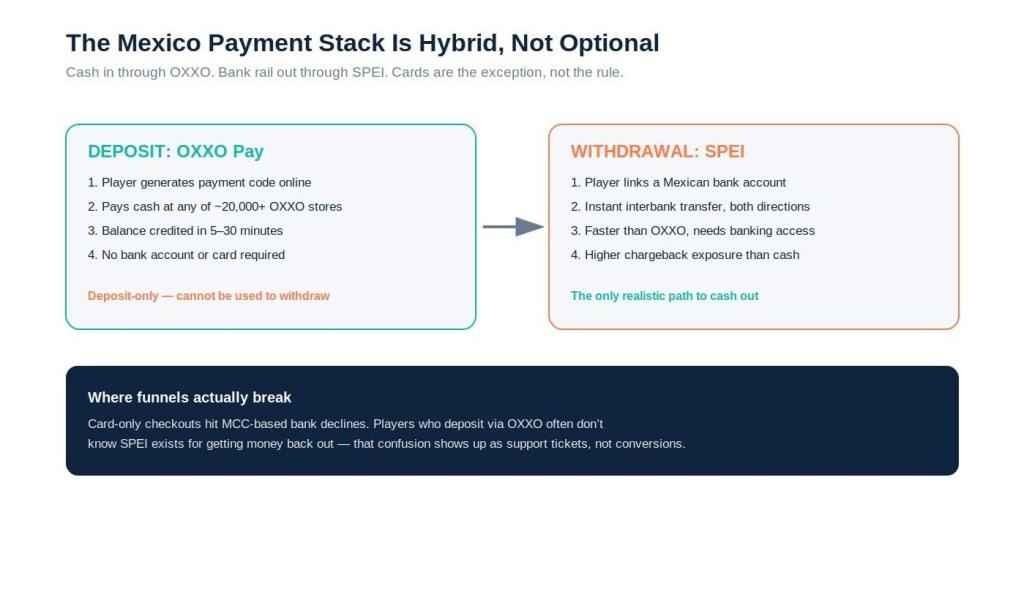
Where the funnel actually rips apart, in both scenarios, isn’t the deposit — it’s the moment a card-only checkout hits a bank-level decline because of MCC filtering, or a player who deposited via OXXO has no idea SPEI even exists for getting money back out. I’ve seen buyers blame “bad traffic” for a conversion collapse that was actually a payment-stack mismatch the whole time — worth ruling out before you touch your targeting.
There’s a third, quieter scenario worth flagging too: the crypto-adjacent player who’s already using something like a Binance-linked card funded through OXXO cash deposits, treating crypto as a bridge rather than a destination. That segment is small relative to Scenarios A and B, but it skews toward exactly the kind of tech-comfortable, higher-frequency player who’s more forgiving of a slightly rougher onboarding flow — useful if you’re running an offer where the operator’s KYC is heavier than average and a chunk of mainstream OXXO users bounce off it.
One more practical wrinkle: OXXO’s own settlement fee, usually somewhere in the $9-15 peso range depending on the transaction, is typically absorbed by the operator rather than passed to the player — but not always, and a landing page that doesn’t clarify this up front creates exactly the kind of last-second hesitation that kills a deposit at the confirmation screen. It’s a tiny detail. It’s also the kind of tiny detail that shows up in abandoned-cart data if you actually go looking for it.
Ask a Buyer
The optimist, from the kind of thread you’d find on any arbitrage forum discussing LatAm expansion: “Everyone’s chasing Brazil right now and the competition there is brutal. Mexico’s got almost the same population and way less saturation on the buyer side — the demand’s just sitting there.”
The skeptic, usually a few posts down in the same thread: “Ran it hard through Q4, then the tax thing hit in January and two of my operators just… changed the deal on me. Nobody warned me this was coming even though it had been in the Mexican press since September.”
The technical one, further into the thread once someone asks about actual setup: “If your checkout is card-only you’re leaving half the country on the table. And don’t sleep on the PWA side either — banking apps and gambling-adjacent domains get flagged and blocked more than people expect, so you want a funnel that survives a domain swap without losing your install base.”
None of these are quotes from a real person — they’re a fair composite of the sentiment that shows up over and over in community discussion whenever Mexico comes up as a GEO.
Traffic and Creative: The Two Things That Actually Move the Needle
The single most useful piece of cultural information for this GEO has nothing to do with gambling at all. It’s the quincena — Mexico’s near-universal biweekly payday, landing on or near the 15th and the 30th of every month. Whole sectors of Mexican retail plan around it; ATM lines visibly spike, restaurants get busier, and — not coincidentally — this is when disposable income for a deposit actually exists. A creative push, a bonus reset, or a new lander variant timed to land in the 24-48 hours after quincena will consistently outperform the exact same asset dropped on a random Tuesday. It’s a small thing, and it’s the kind of small thing that separates buyers who “get” the GEO from ones who don’t.

Seasonally, Día de Muertos (late October into November 1-2) is the obvious creative hook nobody should skip — but the mistake I see constantly is buyers treating it as a skin-deep visual theme (marigolds, skulls, done) instead of tying it to an actual promotional mechanic players recognize as generous rather than gimmicky. The bigger 2026 opportunity, obviously, is the World Cup — Mexico co-hosts, with the tournament opening at Estadio Azteca on June 11 — and sportsbook-adjacent creative around that window has a ceiling most other calendar events in this GEO simply don’t.
The mistake that costs the most money, though, is lazier than a missed holiday: taking creative that worked in Brazil or Colombia and running it in Mexico with a find-and-replace on the currency symbol. The slang doesn’t transfer, the tone doesn’t transfer, and — this is the part people underrate — a Mexican audience that’s been reading headlines about a 50% gambling tax hike and a frozen licensing system all year is a little more skeptical of “guaranteed win” energy than a market with a cleaner regulatory story. Copy that leans into transparency and straightforward mechanics tends to outperform copy that leans into hype, at least right now. That’s a read, not a law of physics, and I could be wrong about how long that skepticism window lasts.
Device behavior is worth a paragraph of its own, too. Mexico skews heavily mobile-first, and a meaningful share of that traffic sits on lower-end Android hardware with inconsistent connectivity outside the major metro areas — which makes a bloated, image-heavy lander a much bigger conversion tax here than it would be running the same creative into, say, Chile or urban Brazil. PWA-based funnels earn their keep in this GEO specifically because domain churn from gambling-adjacent blocking is a real, recurring cost of doing business, not a theoretical risk — losing an install base every time a domain gets flagged is expensive in a way that a lighter, app-like wrapper mitigates.
Where We’d Have Screwed This Up Ourselves
Nobody gets this GEO right the first time, so here’s the honest version of what trips people up, us included if we’re being straight about it:
Assuming “SEGOB licensed” on an operator’s compliance page means the same thing it meant in 2022. It might mean a permit that’s grandfathered and quietly counting down to expiration, and the operator isn’t necessarily volunteering that detail.
Building a card-first checkout because that’s the default in most affiliate tooling, then wondering why deposit rates in Mexico look worse than every other LatAm GEO on the same campaign.
Timing a bonus reset around a generic “start of the month” calendar instead of the actual quincena dates — a genuinely dumb mistake to make once you know about it, and an easy one to make before you do.
Pricing a deal in Q4 2025 based on operator payout terms that assumed the old 30% tax rate, then getting blindsided in January when the economics on the operator side changed and the CPA offer quietly followed.
A Small, Uneven Case
A mid-tier buyer running push and Meta traffic put $2,847 into a casino offer over three weeks in February 2026, timed deliberately around the 15th and the end-of-month quincena dates rather than spread evenly. Landing page ran OXXO as the primary deposit call-to-action, with SPEI positioned explicitly as “how you get paid” rather than buried in a payments FAQ nobody reads.

First week, spend was light — around $612 — mostly testing two creative angles, one hype-driven and one transparency-driven (“here’s exactly how withdrawals work, no surprises”). The transparency angle pulled in noticeably more completed first deposits per click, not by a landslide, but enough to matter once it scaled. By week two, post-quincena, deposit volume on the winning angle jumped sharply enough that the buyer shifted almost the entire remaining $1,940-odd budget into it. Final numbers came out to roughly 380 FTDs, an effective CPA a fair bit lower than the buyer’s Brazil benchmark for the same operator vertical, and — this is the part that matters more than the headline number — a payout structure that held steady because the operator relationship had been renegotiated in January with the new 50% IEPS math already priced in, instead of getting blindsided by it mid-campaign like the buyer in our opening story.
Not a dramatic case. No 10x. Just a campaign that worked because the timing and the payment logic matched how Mexican players actually behave, rather than how a generic LatAm playbook assumes they behave. Worth noting the counterfactual too: the same creative and the same budget, run flat across three weeks with no quincena timing and a card-first checkout, is the version of this campaign that produces the mediocre, shrug-worthy numbers most people quietly stop reporting on in their team chat.
So, Where Does That Leave You
Mexico isn’t a trap and it isn’t a goldmine — it’s a market that punishes buyers who show up with last year’s assumptions and rewards the ones who bother to check whether the ground shifted under a specific operator’s license or a specific tax line since the last time they looked. Given how fast the regulatory picture has moved in the past two years, “check again before you scale” isn’t caution, it’s basically the entry fee.
How’s Mexico actually running for you right now — worth the friction, or are you steering budget elsewhere until the dust settles on the tax reform?
FAQ: Mexico as an iGaming Affiliate GEO
Is online gambling legal in Mexico?
It’s legal in a specific, narrow sense: only operators holding, or acting under, a land-based SEGOB permit through DGJS can run online gambling lawfully. There’s no standalone online gambling license — no such thing exists in the current framework — and the underlying law dates to 1947, so “legal” here means “permit-tied,” not “openly regulated” the way it is in markets like Colombia or Peru.
What license do operators actually need to run in Mexico?
A DGJS permit issued by SEGOB, tied to a land-based casino or sportsbook authorization. The old workaround — a licensed permit-holder sub-licensing a slice of that authorization to a third-party online operator — was shut down by a presidential decree in November 2023. Existing sub-licensed arrangements are grandfathered only until their host permit expires, with no renewals, so a lot of what’s marketed today as “SEGOB licensed” is running on a countdown.
How much tax do gambling operators pay in Mexico?
The federal excise tax (IEPS) on gambling jumped from 30% to 50% of gross gaming revenue effective January 1, 2026, and the new rate explicitly covers offshore online operators serving Mexican players without a local establishment — closing off the old assumption that being based outside Mexico kept a brand outside the tax’s reach.
What payment methods actually convert for Mexican iGaming traffic?
OXXO Pay for deposits — cash paid at any of roughly 20,000+ OXXO convenience stores, no bank account needed, usually credited within 5 to 30 minutes — and SPEI for withdrawals, since OXXO can’t be used to cash out. Cards exist but convert less reliably, partly because some Mexican banks are more cautious about approving card transactions tagged with gambling merchant codes than they are about OXXO or SPEI activity.
What is the quincena and why does it matter for affiliate campaigns?
The quincena is Mexico’s near-universal biweekly payday, landing on or around the 15th and the last day of each month. Disposable income — and deposit activity — visibly spikes in the day or two after each one. Timing creative resets and bonus pushes around those dates consistently outperforms spreading the same spend evenly across the month.
Are there states in Mexico where online casino traffic doesn’t work?
Casino operations are banned outright at the state level in Baja California Sur, Coahuila, Guanajuato, Nuevo León, and Tlaxcala. That’s primarily a land-based licensing rule, but more cautious operators mirror it in how tightly they geo-target their online funnels within the country, which can quietly cap a nationwide campaign’s reach.
Is Mexico still worth running given all the regulatory uncertainty?
For buyers who build their funnel and their deal terms around the current rules rather than last year’s — yes, mainly because roughly 60% of the online betting activity in the country still runs through unlicensed platforms, meaning legal supply hasn’t come close to catching up with demand. The risk isn’t that the market is bad; it’s that the rules move fast enough to blindside anyone pricing a deal on stale assumptions.

Leave a Reply