

Project Costs, Hourly Rates & Retainers
If you’ve searched “n8n automation agency pricing” hoping for a single number, here’s the uncomfortable truth: the market doesn’t have one. A search-and-Slack-alert workflow can run $250. A multi-system automation backbone with AI reasoning baked in can run $80,000. Both are legitimately called “n8n automation.”
That range isn’t a pricing failure. It’s the market correctly pricing very different problems that happen to be built with the same tool.
This isn’t another “what is n8n” explainer. If you’re reading this, you probably already know what n8n does — you’re trying to figure out what to charge for it, or what you should expect to pay someone else to build it. So let’s get into the actual numbers: what n8n itself costs, what agencies and freelancers charge, where those numbers come from, and how to build a quote that doesn’t leave money on the table or scare off a client who was ready to say yes.
n8n’s price and an n8n project’s price are two different numbers
This is the confusion that trips up almost everyone new to this, on both sides of the table.
n8n Cloud pricing starts at €20/month for the Starter plan, which buys 2,500 workflow executions a month, unlimited users, and every integration in the catalog. Pro is €50/month for 10,000 executions. Business jumps to €667/month for 40,000 executions plus SSO, SAML, and self-hosted deployment options. Enterprise is custom, quoted directly by n8n’s sales team.
Self-hosting the Community Edition is free — no license fee, no execution cap. You’re only paying for the server it runs on.
None of that tells you what it costs to have someone build you an automation. n8n’s subscription buys you the engine. It says nothing about the architecture, the integration work, the error handling, the testing, or the six months of maintenance after launch that keeps the thing running when an API you depend on quietly changes its response format.
Conflating these two numbers is, honestly, the single most common mistake freelancers make when they’re new to pricing this work — and the most common reason clients push back on a quote that looks “too expensive” for what they assumed was a €20/month tool.
What n8n projects actually cost in 2026
Based on what’s publicly visible across freelance marketplaces, agency price pages, and n8n’s own partner directory, here’s roughly where the money sits by project type. These are planning ranges pulled from public sources below, not a fixed rate card — treat them as a starting anchor, not gospel.
| Project type | Publicly observed range | What’s typically involved |
| Simple integration | $200–$600 | One trigger, a handful of nodes, no branching, no AI |
| Standard workflow | $400–$1,200 | Conditional logic, 1–2 real integrations, basic error handling |
| Advanced / AI agent workflow | $1,200–$3,500+ | AI reasoning, tool-calling, memory, human-approval steps |
| Multi-system business automation | $3,000–$80,000+ | Several core systems wired together, custom architecture |
| Enterprise automation | $80,000–$100,000+ | Governance, compliance, dedicated infrastructure, ongoing support |
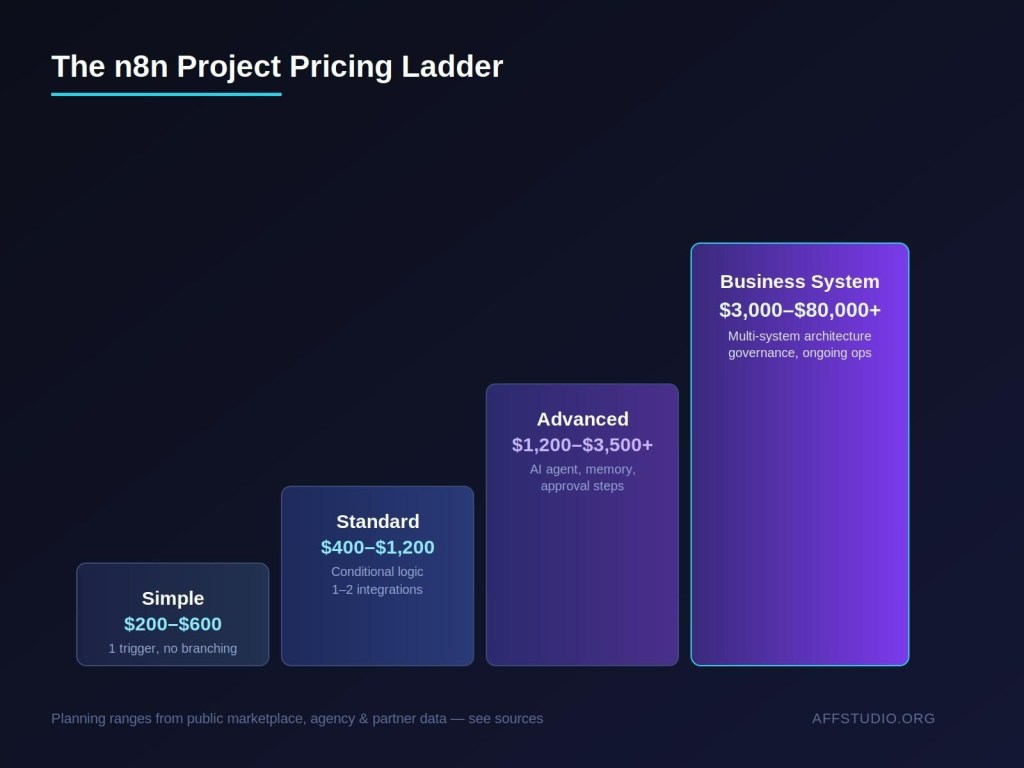
The n8n project pricing ladder — AFFStudio original
Marketplace rates: what Upwork actually shows
Upwork’s own n8n hiring guide publishes a project-cost breakdown that’s worth quoting directly, because it’s about as close to real marketplace data as you’ll find in public view:
| Work type | Typical cost | Level |
| App-to-app workflow connection | $200–$600/project | Entry to mid |
| Custom integration development | $800–$2,500/project | Mid to senior |
| Multisystem automation pipeline | $3,000+/project | Senior/specialist |
| Ongoing optimization and support | $800–$3,000/project | Mid to senior |
| Strategic automation consulting | $2,000–$5,000+/project | Expert |
Upwork also states that hourly rates for n8n experts on the platform run roughly $40 to $100, comparable to other DevOps-adjacent freelance roles. Browsing actual listed freelancer profiles on the platform, that range checks out in practice — you’ll see people quoting $10–20/hour who are clearly still building a portfolio, up through senior specialists at $49/hour and above with enterprise client history.
This is marketplace pricing. It reflects what’s currently listed and bid on Upwork specifically — it isn’t the same thing as what a boutique agency charges off-platform, and it skews toward smaller, more clearly-scoped work because that’s what tends to get posted as a job.
What real n8n agencies publish
The n8n Expert Partner Directory — n8n’s own official listing of certified service partners — is genuinely useful here because partners self-select into published project-budget bands when they list their profile. Across the roughly 48 partners currently listed, the budget filter spans five bands: $1,000–$5,000, $5,000–$10,000, $10,000–$80,000, $80,000–$100,000, and $100,000+.
That’s not one agency’s price list — it’s the spread the entire directory uses to categorize itself, from boutique solo consultants to enterprise system integrators with hundreds of employees. 2V Automation, a New York-based, SMB-focused partner with a 5.0 rating across seven reviews and Clutch recognition, sits at the smaller end of that spectrum by focus even though the full band range applies to the directory. One of their published client reviews describes a project that removed roughly 230 hours of manual work a month and cut a payment cycle from two weeks to two days — the kind of outcome that explains why a client pays five figures instead of shopping for the cheapest Fiverr gig.
What that spread actually tells you: the n8n services market isn’t pricing “a workflow.” It’s pricing wildly different classes of business problem that all happen to route through the same tool. A five-person e-commerce brand connecting Shopify to a spreadsheet is not buying the same thing as Deutsche Telekom’s enterprise team building agentic AI ops across a telecom network — and both are listed in the same directory.
For a more transparent, published example of packaged agency pricing, Goodspeed’s public pricing breakdown lays out three real tiers: a free structured audit, a $5,000 fixed-price “Automation Accelerator” that delivers up to four production workflows plus training and documentation, and an ongoing “automation team” retainer starting at $10,000/month for companies treating automation as infrastructure rather than a one-off project. That’s one agency’s actual published rate card — worth reading in full if you want to see how a mid-size shop structures its offer, but it’s one data point, not an industry average.
How much should you charge per hour?
Marketplace evidence (Upwork’s own published range) puts freelance n8n hourly rates roughly between $40 and $100, with newer freelancers building a portfolio sometimes listing lower and senior specialists with enterprise case studies charging at or above the top of that band. That’s consistent with what shows up across independent pricing guides tracking the space in 2026 — one detailed breakdown of real project examples put entry-level “starter tier” work (a single trigger, no branching, no AI) at $150–$400 per project, standard multi-step workflows at $400–$1,200, and complex AI-agent builds involving memory and tool-calling at $1,200–$3,500 and up.
But here’s the part that trips people up: your hourly rate and your project price are not the same number, and they shouldn’t move in lockstep. Someone charging $75/hour might still quote a fixed project at $3,000 — not because the math says 40 hours, but because a fixed price rewards them for getting faster instead of punishing them for it. Bill a well-defined lead-routing workflow hourly, and the third time you build one (in 90 minutes instead of the four hours it took the first time) your income for solving the exact same problem drops. That’s backwards, and it’s the core argument for pricing the outcome rather than the clock once scope is genuinely known.
If you’re weighing your own rates against what other n8n freelancers report earning overall — not just per-project — that’s a separate question worth reading up on with real earnings numbers rather than guesses.
Fixed price, hourly, or retainer — and when each one makes sense
| Model | Works well for |
| Hourly | Troubleshooting, consulting calls, poorly defined scope, legacy workflow fixes, genuine discovery work |
| Fixed project | Defined scope, known integrations, predictable deliverables |
| Retainer | Monitoring, maintenance, continuous small improvements, multiple recurring small requests |
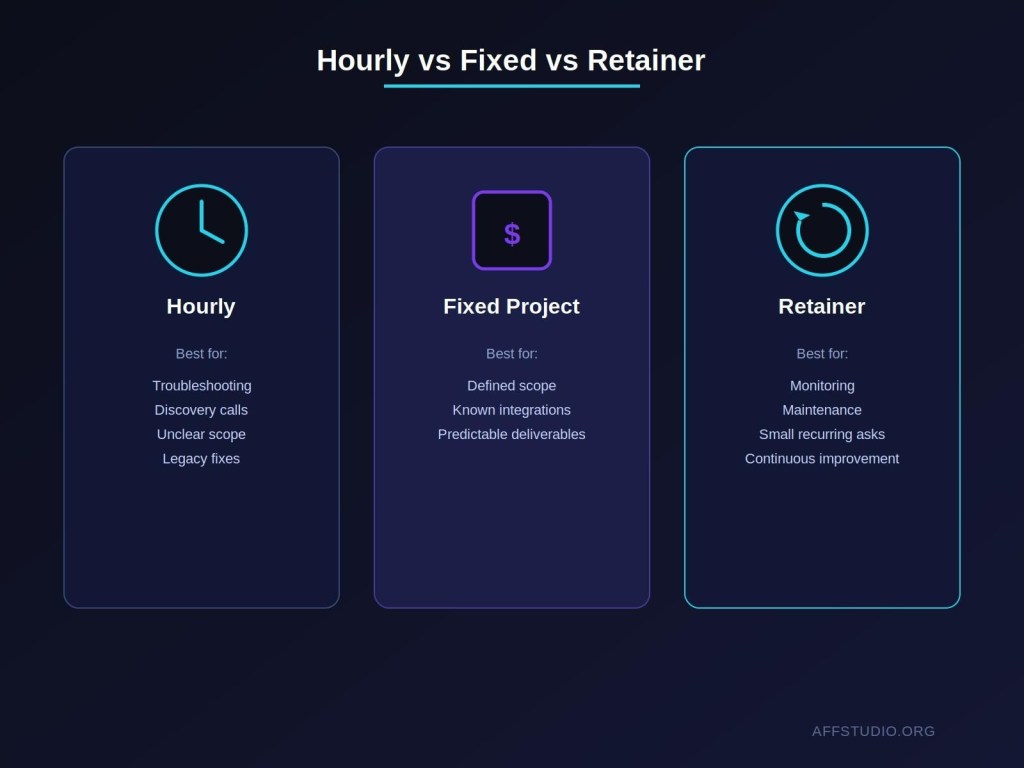
Hourly vs. fixed vs. retainer — AFFStudio original
The practical exception on the hourly side is real discovery work — the first call or two where the scope genuinely isn’t clear yet. It’s reasonable to bill a small hourly block, or a flat discovery fee, for that phase specifically, then convert to a fixed price the moment you actually know what you’re building.
The model that a lot of freelancers and small agencies converge on in practice is a hybrid: discovery → fixed implementation → monthly maintenance. As a purely illustrative example (not a market benchmark): a $300 paid discovery call, a $2,000 fixed implementation once scope is locked, and a $300/month maintenance retainer once it’s live. Adjust every number to your own market and project — the structure is what matters, not these specific figures.
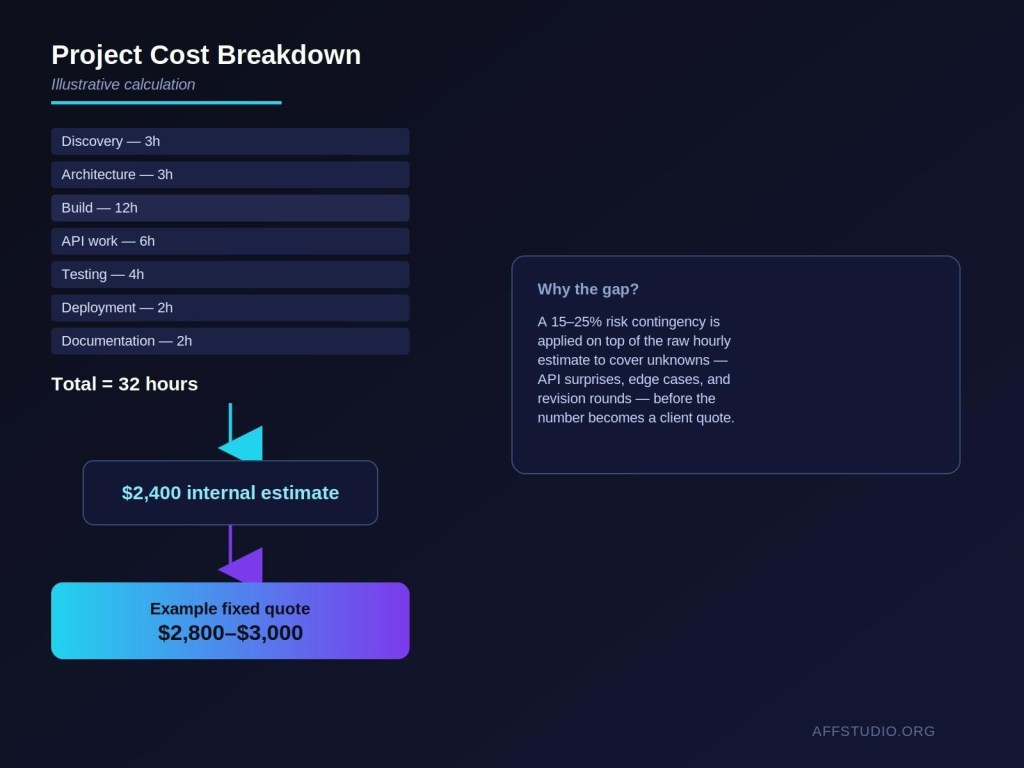
Project cost breakdown — illustrative calculation, AFFStudio original
What a client is actually paying for
This is worth saying plainly, because it’s the argument that justifies charging more than “someone who connects nodes for a living”: the client isn’t buying node placement. They’re buying:
- Discovery — understanding the current process, the pain points, and what “done” actually means
- Architecture — trigger design, data flow, API selection, authentication, fallback logic
- Development — the actual workflow build, integrations, data transformations, custom code, any AI components
- Production readiness — error handling, retries, logging, monitoring, a deployment that survives contact with real data
- Handover — documentation, credential ownership, training so the client isn’t dependent on you forever unless they choose to be
A workflow with no error handling and a workflow with retry logic and Slack alerts on failure are two different deliverables built on the same node count. Quote them differently, and say so explicitly — that’s not upselling, that’s accurately describing risk.
Update — September 24, 2026: After this article was published, a reader raised another scoping issue that is easy to miss when pricing an automation project: safe re-runs and idempotency.
A workflow can look like a standard build until the client needs to safely replay yesterday’s data, a source system retries a webhook, or a partial failure forces the workflow to run again. Without the right deduplication logic, that can turn into duplicate records or repeated actions in the client’s systems.
One reader described exactly this kind of situation: a webhook batch was retried after the automation had already been running successfully for months, resulting in hundreds of duplicate CRM records. The eventual fix wasn’t another n8n node — it was a deduplication key in the database.
That’s a useful pricing lesson: “safe to re-run” is part of the scope when an automation is expected to run in production. Basic idempotency may belong in the base production-ready build, while more complex replay, recovery, rollback, or historical reprocessing requirements should be scoped and priced separately.
What actually drives an n8n project’s price up
Node count is a genuinely bad proxy for price, and it’s worth being direct about why: ten complicated nodes can be harder than fifty basic ones. A Google Sheets–to–Slack connection and a CRM-to-Stripe-to-Postgres-to-AI-to-email pipeline might look superficially similar in a workflow canvas screenshot. They are not similar projects.

What drives project price — AFFStudio original
- API complexity. OAuth flows, pagination, rate limits, webhook reliability, and undocumented or poorly documented APIs all add real hours that don’t show up in a node count.
- Data transformation depth. Mapping field A to field B is trivial. Deduplication, normalization, and enrichment across inconsistent data sources is not.
- Error handling. Production automation has to survive API failures, timeouts, duplicate events, rate limits, and malformed data without silently breaking or silently duplicating an action.
- AI components. Model and API costs, prompt design and testing, structured output validation, hallucination handling, fallback paths, and ongoing monitoring all add scope that a single “AI node” in the canvas doesn’t visually represent.
- Security and compliance. Credential handling, client data, PII, and production system access all raise the bar — and the stakes if something goes wrong.
- Hosting model. Whether you’re responsible for uptime on a self-hosted instance or the client owns their own n8n Cloud account changes your liability, which should change your pricing.
- Maintenance reality. APIs change. Data shapes drift. Someone has to notice before the client does — that’s what a retainer is actually pricing.
A more useful pricing logic than node count: business complexity + technical risk + required outcome. That’s harder to explain in a one-line quote than “we charge $X per node,” but it’s the honest version of how experienced consultants actually think about it.
Real project examples, worked through
These are illustrative worked examples, not case studies of named clients — useful for seeing how the reasoning actually plays out.
Lead capture. Website form → webhook → CRM entry → Slack alert → confirmation email. Single trigger, no branching, minimal error handling needed. This sits at the low end of Starter tier — genuinely fast to build once you’ve done a few, and a reasonable first project to price competitively while building reviews.
AI lead qualification. Website form → CRM → n8n → LLM scoring against actual client criteria → CRM tag update → sales notification with a drafted reply for human review. The reasoning layer and the approval-step design work push this into Complex/AI-agent tier even if the node count looks similar to something simpler — this is also where retainer conversations naturally start, since AI-driven behavior benefits from monitoring in the first weeks live.
E-commerce order automation. Shopify webhook → per-line-item inventory check → fulfillment routing → short-stock items forked to a backorder flow with automatic customer notice → reporting. Multiple integrations, real branching logic, and consequence if it fails silently (a customer thinks their order shipped when it didn’t) — solidly Standard-to-Advanced tier depending on how many downstream systems are involved.
Multi-system business automation. CRM + ERP + email + database + AI + reporting, all wired together as one coherent layer rather than scattered scripts. This is where projects move from four figures into five figures — not because there’s a magic $5,000 threshold, but because the number of systems, the criticality of each connection, and the ongoing governance requirements all compound.
What real n8n case studies show automation is actually worth
It’s worth being clear about what these numbers demonstrate and what they don’t: they’re not pricing benchmarks for a small business project. They’re evidence for why a company rationally pays real money for automation that touches meaningful labor or operational cost.
Huel, the nutrition brand, moved to n8n Enterprise and within nine months had saved roughly 1,000 hours of manual work and cancelled more than £100,000 in annual SaaS licenses by replacing several single-purpose tools with custom n8n workflows — scaling from 75 live workflows in the first six months to nearly 200.
Vodafone used n8n to rebuild its cybersecurity threat-intelligence and SOAR processes, launching 33 workflows since August 2024. The reported result: 5,000+ person-days saved, £2.2 million in costs avoided, and roughly £300,000 in continued monthly savings through 2025.
The Stepstone Group, one of Europe’s largest job platforms, runs 700+ active production workflows (more than triple the count from a year earlier) that parse 2–3 million job-related documents every month, after outgrowing a self-hosted Community instance and moving to Enterprise.
None of that is what an SMB should expect to spend or save. It’s context for why a mid-market or enterprise client will sign off on a five- or six-figure automation engagement without blinking, if the labor or cost math genuinely supports it.
How to actually price a project, step by step
A concrete framework, walked through with an illustrative example — not a claim about what the market pays, just a way to get from “I don’t know” to a defensible number.
- Step 1 — Estimate hours. Break the build into phases: discovery, architecture, build, API work, testing, deployment, documentation. Say that comes to roughly 32 hours total for a mid-complexity integration project.
- Step 2 — Apply your internal hourly rate. 32 hours × $75/hour = $2,400.
- Step 3 — Add a risk buffer. Complex API work, unfamiliar systems, or anything with production consequences deserves a 15–25% contingency on top of the base estimate.
- Step 4 — Turn it into a client-facing fixed quote. Internal estimate of $2,400, contingency applied, rounds to a fixed quote in the $2,800–$3,000 range.
That’s a worked example, not a claim about what any specific project should cost — your own hourly rate, your risk tolerance, and the actual complexity of what you’re building are the real inputs.
How much should you charge for n8n AI automation specifically?
AI components — lead qualification, email processing, document processing, retrieval-augmented generation, autonomous agents, scraping-plus-AI pipelines, content automation — add real scope, but not on a fixed multiplier. What actually increases the work: model selection and testing, prompt engineering and iteration, structured output validation, evaluation of accuracy, hallucination handling, fallback logic when the model gets something wrong, and ongoing monitoring once it’s live and behavior can drift.
Resist the temptation to say “AI automatically adds 30% to the price.” A simple AI summarization step bolted onto an otherwise trivial workflow doesn’t deserve Complex-tier pricing. A multi-tool AI agent with memory, human-approval gates, and real financial or reputational consequence if it hallucinates absolutely does.
n8n maintenance pricing
Three common shapes for the recurring side of the business:
- Pay-as-you-go hourly support for occasional fixes and small requests
- A maintenance retainer covering monitoring, bug fixes, small modifications, and API-change adaptation — commonly seen in the roughly $150–$600/month range for a single-workflow-scale engagement based on published freelancer pricing guides, though this scales up considerably for multi-workflow business systems
- Managed automation as a more comprehensive monthly relationship, closer to the “automation as infrastructure” positioning agencies like Goodspeed describe at their $10,000+/month tier
Don’t call any single number “industry standard” — the spread between a solo freelancer’s $200/month retainer and an agency’s five-figure monthly infrastructure engagement is enormous, and both are legitimate for what they cover.
Who pays for hosting and API costs?
Three common models, and the important part is picking one explicitly rather than leaving it ambiguous:
- Client-owned infrastructure — the client pays for n8n, the server or Cloud plan, and any AI API usage (OpenAI, Claude, etc.) directly
- Agency-managed infrastructure — you manage everything and roll the cost into your commercial model
- Hybrid — infrastructure and usage costs billed separately and transparently, service fee on top
Usage-based costs that fluctuate — AI API tokens especially — should almost always be billed separately or run through the client’s own account rather than absorbed into a flat fee. An AI agent build that quietly eats increasing token costs inside a fixed price you quoted six months ago is a margin problem waiting to happen.
Writing the actual proposal
A minimal structure that covers what a client needs to say yes:
- Project — name it clearly (“Lead Qualification Automation”)
- Goal — the actual business problem being solved, not the technical steps
- Deliverables — a numbered list (webhook, CRM integration, AI qualification, Slack notification, error handling, documentation)
- Timeline — realistic, with milestones for anything beyond a few days of work
- Price — the fixed project price
- Excluded — explicitly: additional integrations, major scope changes, third-party API fees, ongoing maintenance beyond a defined support window
- Support period — exactly how long post-launch support runs and what it covers
That “excluded” section does more to protect margin than almost anything else in the document.
How to avoid losing money on the project you already priced correctly
Even a well-priced project bleeds margin through a handful of predictable patterns:
- Unlimited revisions. Define the number of revision rounds included. Two is standard and fair; unlimited quietly converts a fixed-price project into hourly work you never agreed to bill for.
- “It’s just one more integration.” This is scope creep wearing a friendly voice. If a client says it, stop and check it against the written scope before touching anything.
- The client doesn’t actually know what they want yet. That’s a real cost — charge for discovery explicitly rather than absorbing it inside a project price you quoted before scope was clear.
- A third-party API breaks. Define responsibility for this in writing before it happens, not during the incident.
- Missing credentials or access. Don’t let the project clock quietly run while you wait on a client to grant API access — build that dependency into the timeline explicitly.
- “Lifetime support.” Define exactly what post-launch support means and for how long. Vague promises here are the single easiest way to turn a profitable project into an unpaid part-time job.
When to say no to an n8n project
Some red flags are worth walking away from rather than pricing around:
- API requirements that are technically impossible or undocumented to the point of guesswork
- Unclear ownership of the finished automation
- No access granted to the systems that actually need to be touched
- Deadlines that don’t match the real scope, stated upfront
- Production-sensitive work (payments, PII, compliance-relevant data) without proper requirements gathering
- A client who wants unlimited revisions on a fixed price
- A client who expects “lifetime support” without a retainer
- A client who refuses discovery but wants a guaranteed fixed price anyway
None of these are dealbreakers individually in every context — but a client hitting two or three of them at once is telling you something about how the rest of the relationship will go.
How agencies actually increase their prices
Not “charge more” as an abstract instruction — concrete ways the value of the offer genuinely goes up:
- Sell the outcome the client cares about, not the node count
- Include architecture and documentation as a visible, named line item rather than an invisible cost you absorb
- Offer monitoring and training, not just a handover call
- Build reusable components across clients so delivery gets faster without cutting corners on any single build
- Specialize in a vertical — SaaS, e-commerce, agencies, real estate, finance, or (relevant to a lot of AFFStudio’s own audience) affiliate and performance marketing — so pricing conversations start from “you understand our problem” rather than “convince me you can do this”
- Package discovery as its own paid step rather than a free sales call
- Offer managed automation as an ongoing relationship rather than only one-off projects
A quick ROI model before you quote
A simple way to frame value for a client who’s on the fence:
10 hours/week saved × $30/hour loaded labor cost × 52 weeks = $15,600/year in theoretical labor value
That’s a model, not a guarantee — the assumptions matter more than the formula. Whether those saved hours translate into real cost reduction depends on implementation cost, ongoing software and API spend, maintenance, and whether the team actually adopts the new process instead of quietly reverting to the old one. Present it as a planning tool, not a promise.
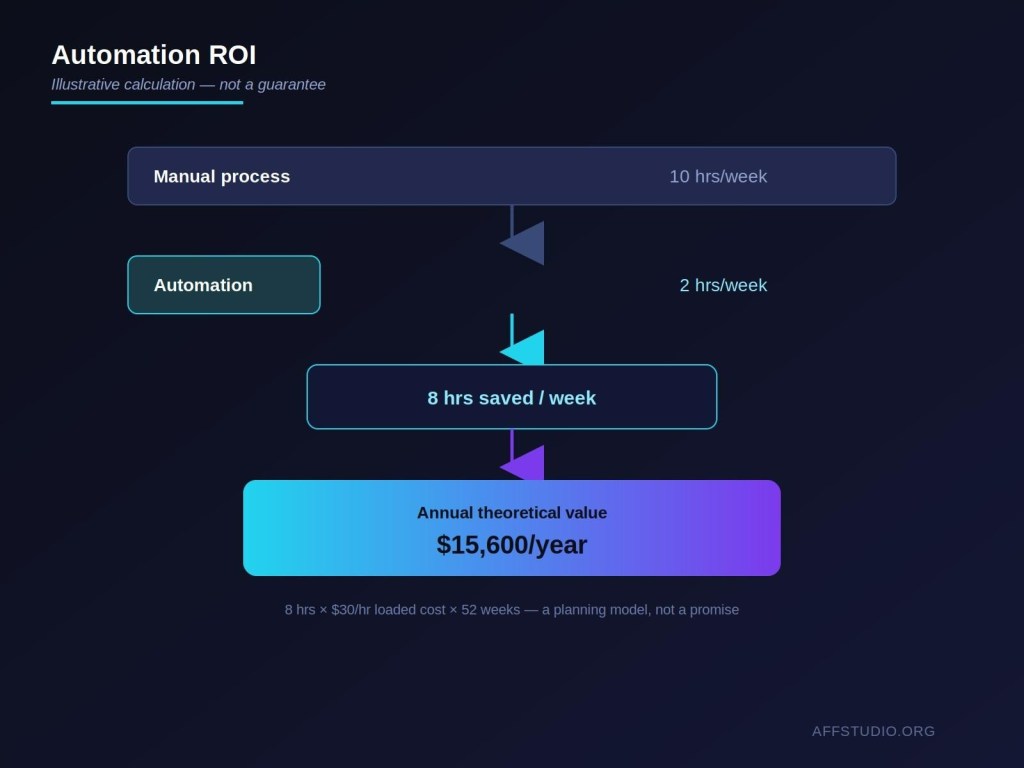
Automation ROI — illustrative calculation, AFFStudio original
The practical 2026 pricing framework
| Service | Pricing model | Planning / observed range |
| Simple automation | Fixed | $200–$600 |
| Standard workflow | Fixed | $400–$1,200 |
| Advanced / AI agent automation | Fixed | $1,200–$3,500+ |
| Multi-system business automation | Fixed | $3,000–$80,000+ |
| Consulting | Hourly | $40–$100/hour, specialist-dependent |
| Maintenance | Retainer | $150–$600/month (single-workflow scale) up to five figures/month at agency-managed scale |
| Enterprise automation | Custom | $80,000–$100,000+ |
These are planning ranges based on publicly visible marketplace, agency, and partner pricing — not an official industry rate card. Verify current figures against the linked sources before quoting, since pricing in this space moves quickly.
FAQ
How much does n8n automation cost?
Depends entirely on scope. Publicly visible ranges run from roughly $200 for a single simple integration up to six figures for enterprise-scale multi-system automation. n8n’s own subscription (€20–€667+/month) is a separate cost from the implementation work.
How much does an n8n automation agency charge?
Real published examples range from a $5,000 fixed-scope starter engagement up to $10,000+/month for an ongoing automation team, based on agencies that publish their own pricing. The n8n Expert Partner Directory shows project bands from $1,000 up to $100,000+ across its full roster.
How much should I charge for n8n automation?
Use project complexity — not node count — as your anchor. A well-defined single-trigger workflow reasonably sits in the low hundreds; a multi-system business automation with AI reasoning and production stakes reasonably sits in the thousands to tens of thousands.
What’s the hourly rate for an n8n expert?
Roughly $40–$100/hour based on Upwork’s published marketplace data, with senior specialists at or above the top of that range.
How much do n8n consultants charge?
Strategic consulting (roadmap development, process analysis, architecture design) tends to sit at the higher end of hourly-equivalent pricing — Upwork’s own breakdown puts this around $2,000–$5,000+ per engagement.
Is n8n cheaper than Zapier for agencies?
n8n bills per workflow execution rather than per task/step, which tends to make it meaningfully cheaper at scale for multi-step workflows — a 10-step workflow costs one execution on n8n versus potentially 10 billed operations on a per-task competitor. The actual total cost still depends on your specific usage pattern and implementation choices, so it’s worth checking current pricing on both platforms for your volume before assuming which is cheaper.
How much does n8n AI automation cost?
No fixed multiplier over non-AI work — it depends on the complexity of the reasoning layer, not the presence of an AI node. A simple AI summarization step adds little; a multi-tool autonomous agent with memory and approval gates pushes a project into the $1,200–$3,500+ complex tier.
How much does n8n maintenance cost?
Commonly $150–$600/month for a single-workflow-scale retainer based on published freelancer pricing guides, scaling well beyond that for multi-workflow business systems managed by an agency.
Should I charge hourly or per project for n8n?
Hourly for genuine discovery and open-ended troubleshooting; fixed price once scope is actually known, so your income doesn’t drop as you get faster at solving the same problem.
Who pays for n8n hosting?
Depends on the agreed model — client-owned infrastructure, agency-managed infrastructure rolled into the price, or a hybrid with infrastructure and usage costs itemized separately. Usage-based AI API costs should almost always be billed separately or run through the client’s own account.
Can you make money building n8n automations?
Yes — the market clearly supports it, from Fiverr gigs in the low hundreds up through agency retainers in five figures a month. The freelancers and agencies earning real income aren’t the cheapest ones in the search results; they’re the ones who can explain, in one sentence, why their price matches what they’re actually building.
Is n8n good for an automation agency?
The market data suggests yes — n8n’s own partner directory lists roughly 48 certified service partners ranging from solo consultants to enterprise system integrators, and its execution-based pricing model tends to favor agencies building complex, multi-step workflows for clients.



Leave a Reply