
The real question is how much evidence you need before you keep testing, optimize, kill or scale.
Picture the usual sequence. $50 spent, no conversions. $100, still nothing. $200, and one weak result that looks nothing like the payout math you did before launch. Do you keep going, change something, or stop?
Affiliate forums are full of fixed-dollar answers to that question, and they don’t agree with each other. In a 2018 AffiliateFix thread, a newcomer with $20 spread over four pop campaigns and zero conversions asked how much to spend before judging an offer. One reply said testing costs a few hundred dollars and that 500–1,500 click-throughs make a reasonable sample. Another said high-payout offers such as nutra or casino on deposit need at least $500 just to test the waters. A third recommended a 3-day rule for SOI and sweepstakes offers [1].
Two years later, in another AffiliateFix thread about Facebook, one member said the only honest answer is some multiple of the payout, perhaps 3–5x. Another said they recommend around $2,000 per new offer and traffic source, because you’re testing demographics, creatives and landers at the same time, not just the offer [3].
These answers can all be right, because they answer different questions. The useful question isn’t how much money to spend. It’s how much evidence you need before the next decision. This article is built around that: test, measure, diagnose, then decide to kill, optimize or scale. Nothing below is a universal rule, and every example is labeled as documented, opinion or hypothetical.
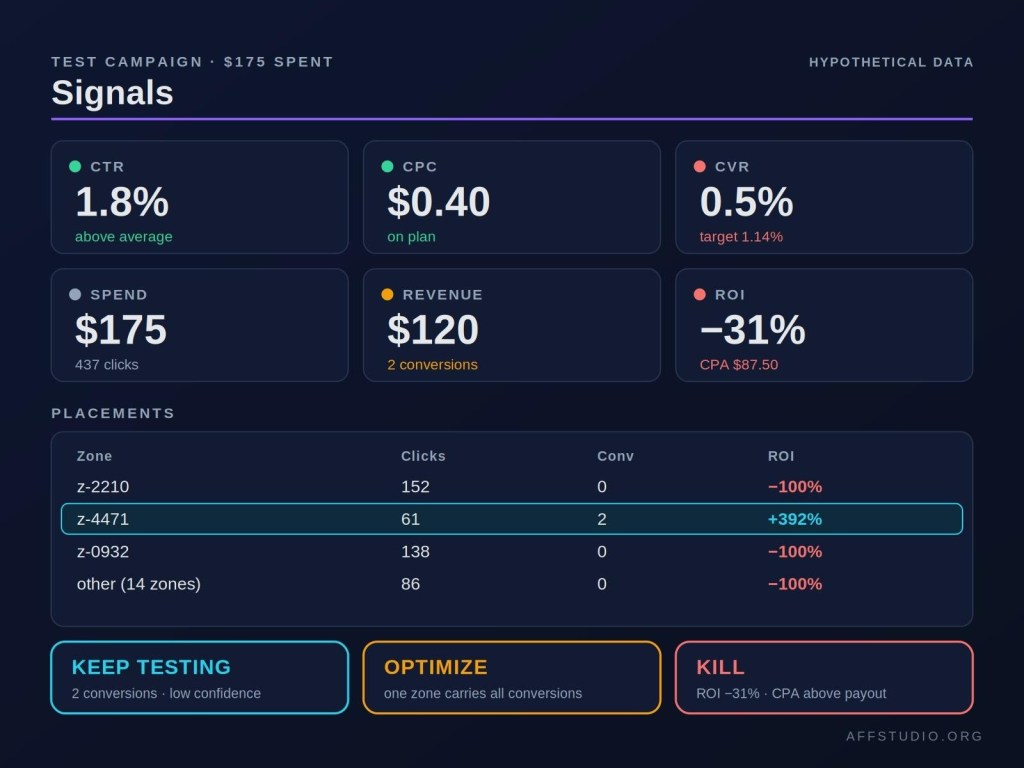
Figure 1. Hypothetical dashboard: each decision has some evidence behind it, which is exactly why the call is hard.
How Much Does It Cost to Test an Affiliate Campaign?
Start from the economics, not from a round number. Payout is what the advertiser pays; target CPA is what you’re willing to pay for a conversion. The gap has to cover tracker fees, creative work, failed tests and some margin. The planning formula is simple:
Test budget ≈ target CPA × required conversion volume
The hard part is “required conversion volume”. It’s a judgment about how much evidence you need, and it’s where practitioners diverge.
PRACTITIONER OPINION Payout multiples. In a 2023 AffiliateFix thread, a member described two schools: spend 1x the payout per ad set and kill it without a sale (a method he attributed to PPC Coach), or spend 3x the payout per zone (which he said a PropellerAds sweepstakes guide recommends). One reply argued that without your own historical conversion ratio, a multiple is a calculated risk that mostly tests someone else’s claim [2]. Vendors publish similar multiples: RevBoost suggests 3–5x payout [11], Remoby calls 3x target CPA a common threshold before killing a placement [8], and PushGround’s template cuts an offer with no conversions after 3x payout [9].
PRACTITIONER OPINION Conversion volume. Flighted argues for at least 3 conversions at target CPA per concept and calls Meta’s 50-conversion guidance unrealistic for almost all budgets [10]. AdManage recommends gating: cheap signals first, then 25–100 conversions per concept for real proof, depending on the confidence you need [13].
Why the disagreement? A payout multiple is a hidden conversion count. If a campaign converts exactly at break-even, spending 3x the payout buys about three conversions. If it converts at a CPA equal to 60% of payout, the same spend buys about five. So “3x” isn’t a statistical threshold; it’s a small sample expressed in dollars, and it moves with your CPC and CVR.
The offer type moves it too. Sub-dollar app installs, $60 lead offers and deposit-level nutra or casino payouts produce very different numbers of conversions per dollar, which is why forum answers for one don’t transfer to another. And keep the deposit separate from the test budget: ROIads points out that a network’s minimum deposit only lets you launch and may not cover a full test [12].
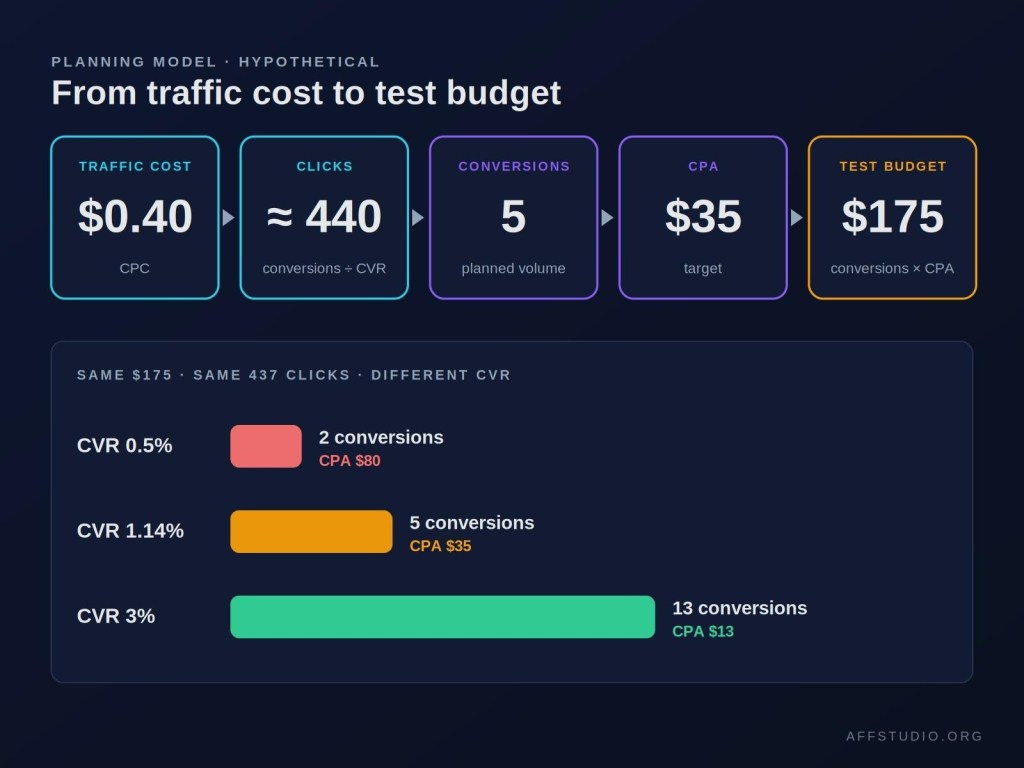
Figure 2. Hypothetical planning model: the same $175 buys very different evidence depending on CVR.
How Many Clicks Do You Need Before Judging an Affiliate Campaign?
Required clicks ≈ required conversions ÷ expected CVR
The same 100 clicks mean different things at different conversion rates. At a 1% CVR you expect one conversion, and seeing none happens about 37% of the time. At 8% you expect eight, and seeing none happens roughly 0.02% of the time (both figures are simple binomial calculations). Zero conversions in 100 clicks is nearly meaningless in the first case and alarming in the second.
Click-count rules deserve the same scrutiny. Remoby suggests blacklisting zones with 500+ clicks and no conversions [8]. That’s sensible for a funnel converting at 3%, where 500 clicks should produce about 15. At a 0.5% CVR, 500 clicks produce about 2.5 conversions, and zero is still an outcome of roughly 8% by chance alone.
Clicks also have to be read against money. CPC is what you pay, EPC (revenue per click) is what you earn, and CPA is the outcome. RevBoost suggests EPC should be at least 2–3x CPC to survive testing costs and off days [11]. And clicks are not conversions:
DOCUMENTED REAL EXAMPLE Mobidea’s André Martins described an Indonesia–Indosat segment (payout €0.31) that spent €2.80, nine times the payout, and produced one conversion in ten days. His point wasn’t that the multiple had been reached. It was that a single conversion gives you nothing to segment: you can’t cut a placement, browser or OS on one data point. He stopped it after 12 days, two weekends and €3.39 for one signup [5]. (These are 2016 numbers; the logic is what transfers.)
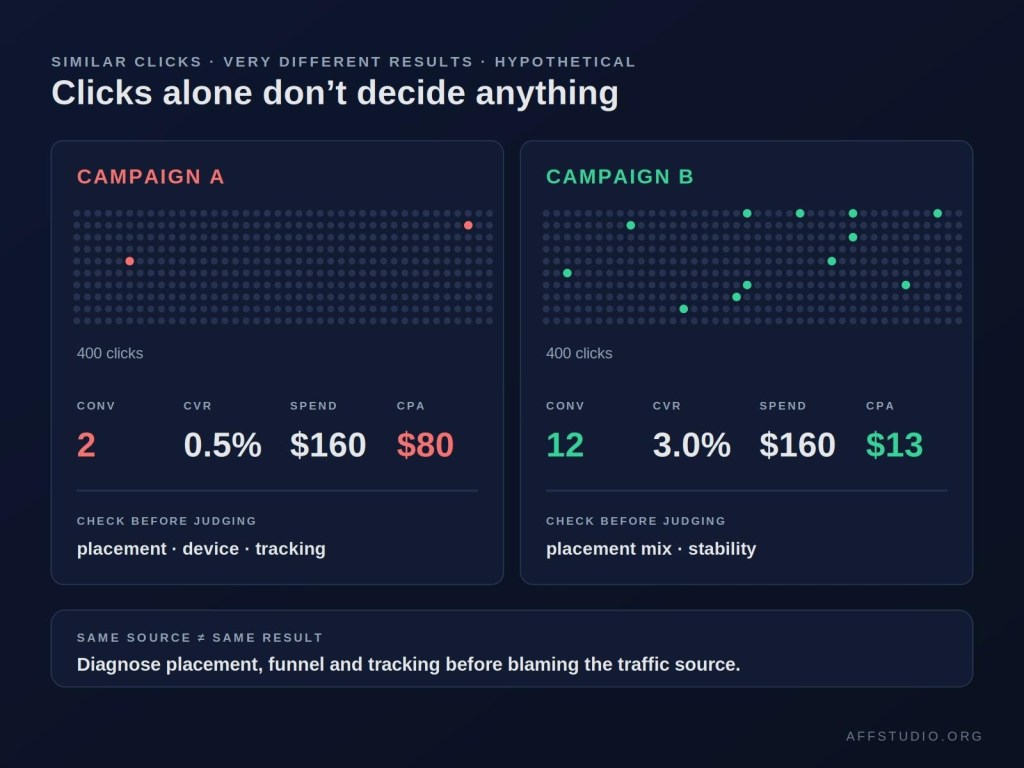
Figure 3. Hypothetical: two campaigns with the same 400 clicks and very different conversion results.
How Long Should You Test an Affiliate Campaign?
“Test for seven days” is a proxy for volume. Partnerkin’s guide recommends at least 5–7 days for a new offer [15]. Media buyer Mark Chino writes on Medium that a campaign should run 48–72 hours before you start tweaking it [14]. The 3-day rule from the AffiliateFix thread is, by definition, three days [1]. The answers differ because they assume different traffic velocity.
Time does two useful jobs: it lets delivery stabilize, and it covers the weekly cycle if your GEO or source has one. Martins ran the Indosat test through two weekends because they’re the most active days for that segment [5]. But days aren’t evidence. His Paraguay–Claro segment (payout €0.07) ran 14 days, spent €0.41 (about €0.03 a day) and produced no conversions. The problem was volume, and no calendar would have fixed it [5].
Seasonality cuts the same way. The AffiliateFix sweepstakes case in [6] was built around a holiday (Buen Fin 2021), so its numbers may not transfer to an ordinary week. A better rule than a fixed number of days: define the duration in expected conversions and traffic velocity, then add days only to cover a weekly pattern you have reason to believe in.
When Should You Kill an Affiliate Campaign?
Kill when the evidence is sufficient and the diagnosis says the problem isn’t fixable at a reasonable cost. Concrete signals:
- You have enough conversions to see the shape, and economics stay negative after you’ve cut clear losers (zones, devices, creatives).
- Volume is too low to ever produce a readable sample, as in the Paraguay segment.
- The best CPA you can reach, even with the best segments isolated, sits above payout.
- Tracking can’t be trusted. RevBoost advises against relying only on a network’s numbers and suggests a third-party tracker for independent data [11]. Conclusions built on broken postbacks are noise.
- The offer, not the traffic, is losing to competitors on the same placement.
DOCUMENTED REAL EXAMPLE Martins’ Thailand–AIS segment on ZeroPark (payout €0.70) is the most useful case. He raised bids, cut sources that spent more than twice the payout, and tried lower and higher bids; the gap between revenue and cost didn’t close, so he stopped the campaign. He then built a whitelist from the best targets and reported more than €5 a day in profit [5]. The campaign died. The traffic source didn’t. That’s why one failed placement never justifies dropping an entire source.
DOCUMENTED REAL EXAMPLE In another case (Brazil–TIM on Ero-Advertising, payout about €0.41), a competitor held the top position and Martins assumed they had a better offer, landing page or banners. Whatever he bid, results stayed poor, so he advised talking to the account manager about a better-fitting offer [5]. Same source, same placement: the offer was the variable.
The opposite mistake exists too. His India–Vodafone segment on TrafficStars (payout about $0.50) turned negative for two days, but it had many conversions and therefore data to optimize; it was positive by the 13th [5]. The number of conversions, not the red ROI, separated it from the dead segments.
Written loss floors help enforce this. PushGround’s template stops an offer when the total loss passes about 5x payout and ROI is worse than −25%, and a single feed when it passes −1x payout at the same ROI [9]. Treat that as an example of writing the line down, not as the line.
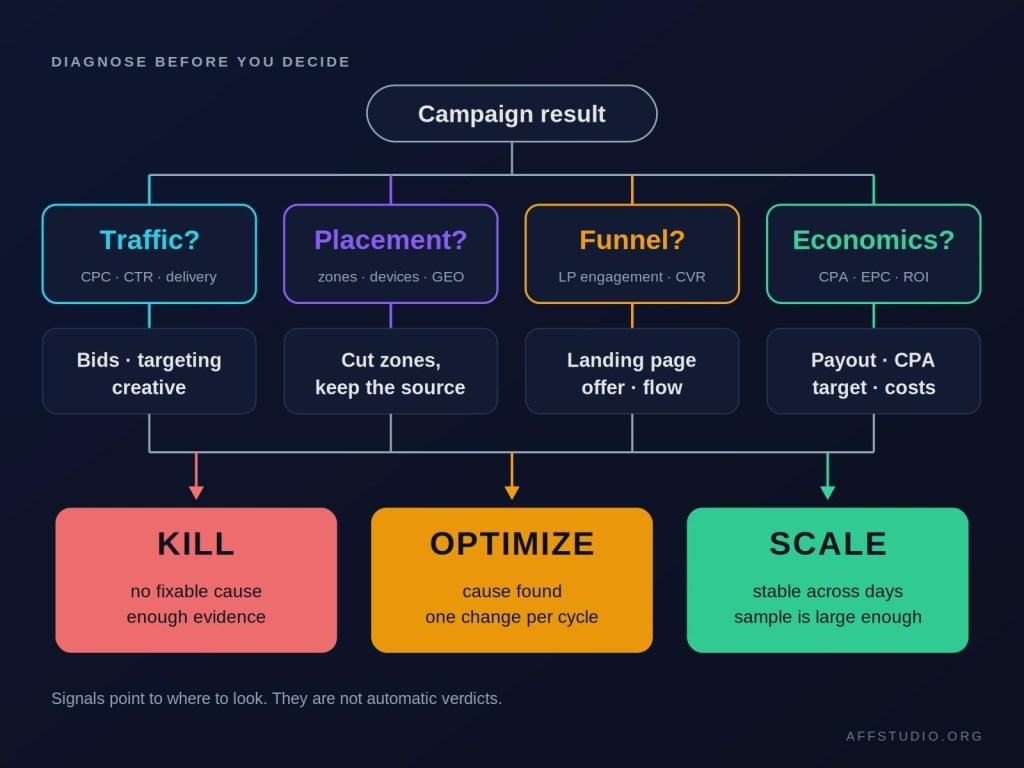
Figure 4. Diagnose the layer first; the decision follows from what you find.
When Should You Optimize Instead of Killing?
Break the funnel apart before deciding. Each signal points at a place to look. None is an automatic verdict.
| Signal | Look at | Typical checks |
|---|---|---|
| Low CTR | Creative / targeting | Angle, format, audience, placement mix |
| Good CTR, poor LP engagement | Landing page / message match | Promise in the ad vs. page, load speed, device |
| Good LP engagement, poor CVR | Offer / funnel | Form steps, offer terms, conversion event, GEO fit |
| Good CVR, expensive CPA | Traffic cost / bidding | Bid level, competition, cost per placement |
| Good CPA, poor ROI | Payout / downstream economics | Payout changes, rejections, lead quality, caps |
DOCUMENTED REAL EXAMPLE An AffiliateFix case study by a media buyer split a Spanish-language sweepstakes campaign by device. Desktop went negative and was turned off. Mobile ran near zero profit, but its 1.86% CVR was enough to justify more work, and an Android-only targeting layer lifted it to 3.29% [6]. This is self-reported, and the author also promotes a push-monetization add-on in the same write-up, so treat the exact figures cautiously. The pattern (split by device, then narrow) is the useful part.
Change one thing per cycle. Remoby lists changing GEO, creative, bidding and landing page in the same window as a classic beginner error, followed by blaming the traffic source [8]. If three things change and CVR moves, you’ve learned nothing.
When Should You Scale an Affiliate Campaign?
A small profitable sample is the most expensive kind of good news. Three conversions on 60 clicks can be a real winner or a lucky streak, and the two look identical for the first few days. Flighted treats three conversions at target CPA as enough to graduate a creative into a scaling campaign [10], but that’s a promotion to more testing, not proof of the campaign.
DOCUMENTED REAL EXAMPLE A BlackHatWorld case study (self-reported, adult traffic) shows the shape of a scale decision. After three days the buyer had spent $175.42 for $154 of revenue. Instead of killing the campaign, he cut three of five banners. By day nine one banner looked like the winner, and he scaled hard, refining targeting through day 22 for totals of $37,689.99 spend, $46,385.50 revenue and $8,686.15 profit. He also notes it ran until it began to burn out [7]. The numbers can’t be verified, but the sequence matters: a slightly negative early result was a creative problem, and profit came from continuous pruning.
Before scaling, check that results are consistent across days, that no single lucky day carries the total, that profit isn’t concentrated in one placement or device, and that economics hold as spend rises, because a bigger budget changes your position in the auction. Raise spend in steps and watch whether CPA holds.
A Practical Affiliate Campaign Testing Framework
1. Track. Confirm the tracker, postback, subIDs, conversion event and payout before spending. Compare tracker data with network data.
2. Validate traffic. Check CPC/CPM, CTR, delivery, click quality and placement distribution. Cheap signals come first.
3. Validate the funnel. Read landing page engagement, registration or lead rate, and CVR. One change per cycle.
4. Check economics. Compare CPA, EPC, revenue, ROI and margin against target CPA and payout.
5. Decide. Kill, optimize or scale, and write down why. Set the kill line and the scale line before launch.

Figure 5. Hypothetical progression: the shaded band shows what the data can’t rule out; it narrows as conversions accumulate.
Affiliate Campaign Testing Example
HYPOTHETICAL EXAMPLE Payout $60, target CPA $35, CPC $0.40, initial budget $175. Break-even CVR is CPC ÷ payout, about 0.67%. The CVR needed to hit target CPA is CPC ÷ target CPA, about 1.14%. At that rate, $175 buys roughly 437 clicks and about five conversions. This is not an AffStudio case.
After $50 (125 clicks) there are no conversions. At 1.14% you’d expect 1.4, and zero happens about a quarter of the time. That’s not a signal. After $100 (250 clicks) there are still none. You’d expect 2.9, and zero has about a 6% chance. Now it’s a real warning about the target rate, though at the break-even rate zero is still roughly a one-in-five outcome. At $175 there are two conversions: $120 revenue, ROI −31%, CPA $87.50. Two conversions when five were expected happens about one time in eight at the target rate, and close to half the time at break-even. The data can’t tell those apart.
Kill or continue? Look at where the 437 clicks went. If both conversions came from 61 clicks on one zone and 376 clicks elsewhere produced nothing, the diagnosis is a placement problem, not a source verdict: cut the dead zones, keep the source and run the next round on cleaner traffic. If clicks and conversions are spread evenly, the funnel is the next suspect.
Say the next round reaches 1,000 clicks and $400 with nine conversions: CVR 0.9%, CPA $44, ROI +35%. Profitable, but above the $35 target. That’s an optimize-first result, not an immediate scale. Martins’ Indosat point applies here as reasoning: with one or two conversions there’s nothing to segment, while nine at least gives you something to test [5].
7 Affiliate Campaign Testing Mistakes
- Budget without a target CPA. A round number tells you what you can afford to lose, not what success looks like.
- Killing after too few clicks. At a 1% CVR, zero conversions in 100 clicks happens more than a third of the time.
- Changing several variables at once. It’s the beginner error Remoby describes [8], and it makes every result unreadable.
- Ignoring placement data. Martins’ Thailand segment lost as a campaign and won as a whitelist [5].
- Looking only at CTR. A cheap click that never converts is still expensive, and a strong CTR with weak landing page engagement points at message mismatch.
- Scaling too early. Three conversions can graduate a creative [10]; they don’t prove a campaign.
- Blaming the traffic source for an offer or funnel problem. In the Brazil–TIM case the offer, not the source, was the variable [5].
Affiliate Campaign Test Budget Calculator
| Step | Formula | Hypothetical example |
|---|---|---|
| Test budget | target CPA × required conversions | $35 × 5 = $175 |
| Required clicks | required conversions ÷ expected CVR | 5 ÷ 1.14% ≈ 440 |
| Traffic cost | required clicks × CPC | 440 × $0.40 ≈ $175 |
Steps one and three match here only because the expected CVR was derived from CPC and target CPA. If the real CVR is 0.5%, the same $175 buys about two conversions, not five. This is a planning model, not a guarantee: it shows what a test would cost if your assumptions hold and how badly it can miss if they don’t.
FAQ
How much should I spend testing an affiliate campaign?
Enough to buy the conversion volume you decided you need, at your CPC and expected CVR. Start from target CPA × required conversions, then sanity-check against what you can lose. Payout multiples are shortcuts for this, not rules.
How long should I test an affiliate campaign?
Until you have the volume you planned for and have covered any weekly cycle in your GEO or source. Practitioners cite anywhere from 48–72 hours to 5–7 days [14][15], which mostly reflects different traffic velocity.
How many clicks before judging a campaign?
It depends on expected CVR. At 1% you need hundreds; at 8% far fewer. Clicks divided into expected conversions is the starting point.
When should I kill an affiliate campaign?
When enough data exists, the diagnosis finds no fixable layer, and best-case CPA still sits above payout. Also when volume is too thin to ever read, or tracking can’t be trusted.
When should I scale?
When results hold across days, aren’t carried by one placement or lucky day, and economics survive a higher budget. Scale in steps.
How do you know if a traffic source is profitable?
Judge it across placements, GEOs and devices, not one failed zone. A source can lose on average while a whitelist of its best targets makes money [5].
How much traffic is enough to test an affiliate offer?
Enough for the expected number of conversions to be more than a handful. With low CVR offers that can mean thousands of clicks; with high payouts it can mean a large budget for a few conversions.
How many conversions before scaling?
There’s no single number. Some buyers accept 3 to promote a creative [10]; others want 25–100 for proof [13]. Pick a level before launch based on the confidence you need.
Can you test an affiliate campaign with a small budget?
Yes, if you test something narrow: one offer, one GEO, one device class, one source [8]. Low-payout offers make small budgets workable; high-payout ones usually don’t.
Sources / Further Reading
[1] AffiliateFix — How Much $ For Testing CPA Offer (2018): affiliatefix.com/threads/how-much-for-testing-cpa-offer.157118/
[2] AffiliateFix — Spending 1x the payout vs 3x the payout during Testing phase? (2023): affiliatefix.com/threads/spending-1x-the-payout-vs-3x-the-payout-during-testing-phase.173943/
[3] AffiliateFix — How much money did you spend on Facebook ads before getting a sale? (2020): affiliatefix.com/threads/how-much-money-did-you-spend-on-facebook-ads-before-getting-a-sale.166429/
[5] Mobidea Academy — André Martins, Case Study: When to Stop Media Buying Campaigns (published 2016, updated 2026): mobidea.com/academy/media-buying-campaigns-case-study/
[6] AffiliateFix — Case Study: sweepstakes campaign for the holidays (2022): affiliatefix.com/threads/how-a-media-buyer-can-get-maximum-profit-with-upcoming-holidays-on-sweepstakes.172071/
[7] BlackHatWorld — Case study: $8,686.15 profit in 22 days (self-reported, 2022): blackhatworld.com/seo/case-study-how-i-made-8-686-15-profit-in-22-days-from-adult-media-buying.1401834/
[8] Remoby — Media Buying for Beginners (2026): remoby.com/blog/media-buying-for-beginners/
[9] PushGround — The Ultimate Media Buying Template: pushground.com/blog/ultimate-media-buying-template
[10] Flighted — How to Calculate Your Meta Ads Creative Testing Budget (2026): flighted.co/blog/how-to-calculate-your-meta-ads-creative-testing-budget
[11] RevBoost — Best CPA Networks for Media Buyers in 2026: revboost.com/for/media-buyers
[12] ROIads — Test Budget for Affiliate Marketing: Full Guide (2025): roiads.co/blog/affiliate-test-budget-for-ad-campaigns/
[13] AdManage — Creative Testing Budget: 2026 Guide: admanage.ai/blog/creative-testing-budget-guide
[14] Mark Chino — Confessions of a Media Buyer, Medium (2020): markchino360.medium.com/confessions-of-a-media-buyer-78751c457dea
[15] Partnerkin — How Long and How Much Should You Spend Testing Affiliate Marketing Offers (2024): partnerkin.com/en/blog/publications/testing_affiliate_offers



Leave a Reply