
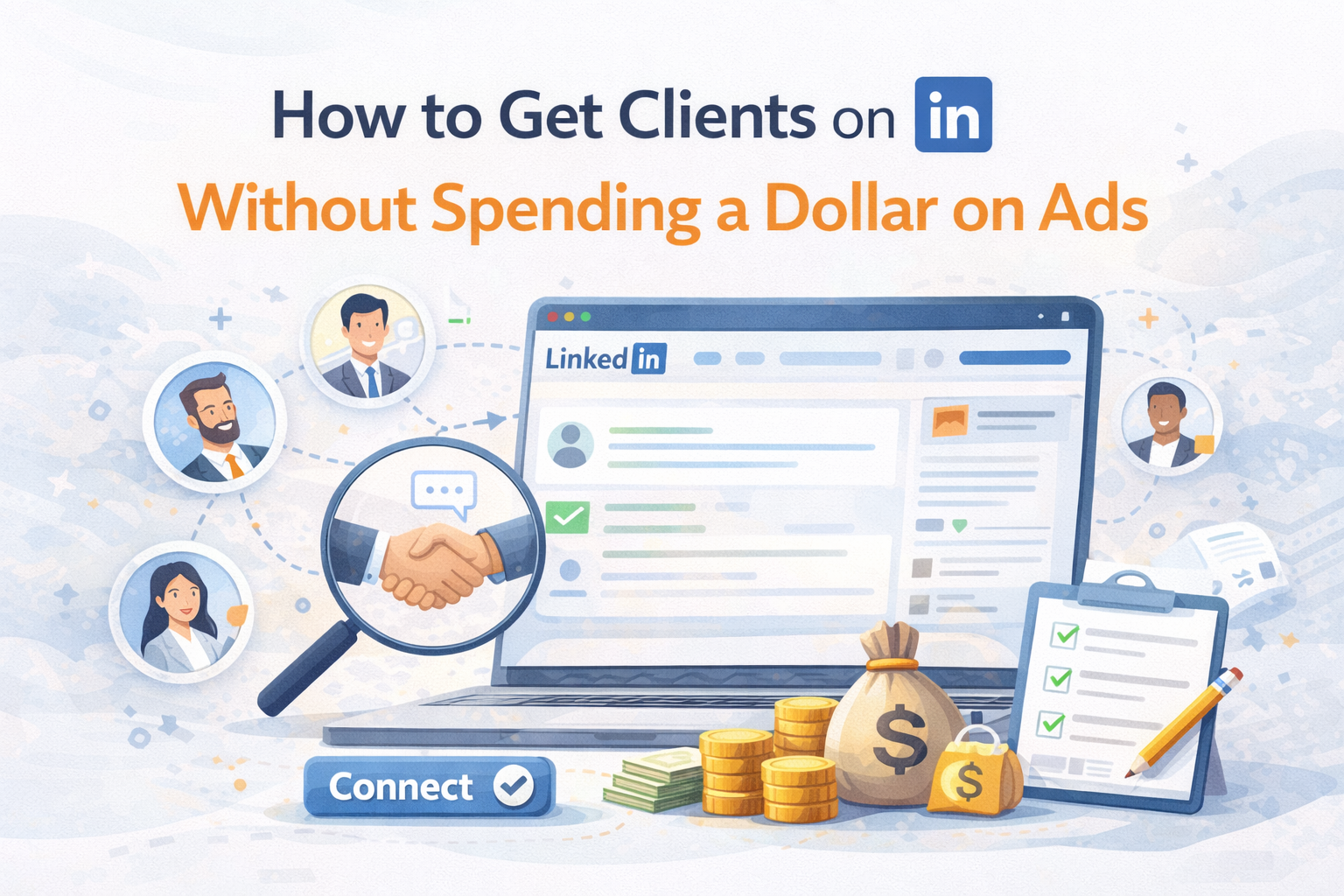
Most people treat LinkedIn like a digital tombstone. They set up a profile, list their experience, connect with a few colleagues, and then wait. For what, exactly, is never quite clear.
A smaller group of people treat it like a client machine. Same platform, same algorithm, completely different results — and the difference has nothing to do with ad budgets.
Here’s how the second group thinks, and what they actually do.

A quick reality check: In 2026, LinkedIn’s spam filters have become incredibly sophisticated. Generic AI-generated pitches that worked a year ago are now a fast track to a “shadowban.”
We’ve shifted our strategy toward “Micro-Interactions.” Instead of lead-gen automation, we focus on engaging with a prospect’s content for 48 hours before sending a connection request. Our internal data shows that a “naked” connection request (with no note) from a fully optimized profile now has a 35% higher acceptance rate than one containing a standard sales template. People are tired of bots; they want authentic networking.
Why LinkedIn Works Differently Than Every Other Platform
Before getting into tactics, it helps to understand why LinkedIn is worth your attention in the first place — because the numbers are legitimately strange compared to other social networks.
LinkedIn drives 80% of all B2B leads generated through social media. Not 40%, not 60%. Eighty. Facebook, Instagram, TikTok, and X combined split the remaining 20%. For anyone selling a service, a product, or their own expertise to other businesses or professionals, this is a platform you cannot rationally ignore.
But here’s the part that makes LinkedIn genuinely unusual: it still rewards organic text content. On Instagram, you need visuals. On TikTok, you need video production. On Facebook, organic reach for business content is effectively dead. On LinkedIn in 2026, a well-written text post from a nobody with 800 connections can reach 50,000 people if it hits the right notes. Video gets five times more engagement than static posts, and document posts (PDFs, carousels) outperform almost everything — but plain text still punches way above its weight compared to any other major platform.
Only 5.2% of LinkedIn’s daily active users post original content. Which means that if you show up consistently with something worth reading, you are already ahead of 94.8% of the platform by default.
The opportunity is absurd. Most people just don’t take it.
Step 1: Stop Optimizing Your Profile for Recruiters

If your LinkedIn profile reads like a resume — job titles, company names, dates, a list of responsibilities — you have optimized it for the wrong audience.
Recruiters want to know where you worked. Potential clients want to know what you can do for them, and more importantly, what you have already done for people like them.
These are fundamentally different documents, and most people write the resume version by default because that’s what LinkedIn was originally designed for.
Rewrite your headline. “Marketing Consultant | 10 years experience” tells a potential client nothing useful. “I help e-commerce brands cut their customer acquisition costs using paid social” tells them exactly what they need to know in one line. If your headline doesn’t explain who you help and how, rewrite it today. It is the first thing anyone sees, and it determines whether they read further.
Rewrite your About section as a pitch, not a biography. Lead with the problem you solve, not your career history. The first two lines are visible before someone clicks “see more” — those two lines need to earn the click. Talk about results you’ve delivered. Use numbers where you have them. End with a clear call to action: what should someone do if they want to work with you?
Use the Featured section. This is prime real estate that most people leave empty. Pin your best piece of content, a case study, a link to book a call, or a lead magnet. Anyone who visits your profile and gets past the headline will see it immediately.
The goal is simple: a potential client lands on your profile and within 30 seconds understands who you help, what results you deliver, and how to get in touch. If your current profile doesn’t do that, it is costing you clients every day.
Step 2: The Content Strategy That Actually Brings Inbound Leads

Here is the uncomfortable truth about LinkedIn content: consistency matters more than quality, at least in the beginning.
Not because bad content is fine — it isn’t. But because the algorithm rewards accounts that post regularly, and because your first 20 posts will not be your best. You need to write your way into finding your voice and your audience, and that requires actually publishing, not just planning.
Post at least three times a week. This is the threshold where LinkedIn’s algorithm starts treating your account as an active creator and distributing your content beyond your immediate network. Less than that and you are mostly talking to your existing connections. More is better, but three is the minimum.
The formats that reliably generate inbound leads:
Personal stories with a professional punchline. Tell a real story from your work — a client situation, a mistake you made, a result you didn’t expect — and end with the lesson. These perform well because they’re human, they’re specific, and they demonstrate expertise without lecturing. The structure is simple: here’s what happened, here’s what I learned, here’s why it matters for you.
Contrarian takes. Pick a widely held belief in your industry and argue against it, with evidence. “Everyone says you need to post daily on social media. Here’s why that’s wrong for most businesses.” This creates engagement because people either agree and share, or disagree and comment — both of which expand your reach.
Specific, numbered observations. “5 things I noticed after auditing 30 landing pages this month.” Not listicles for their own sake, but genuine observations from real work. The specificity is what makes these credible and shareable.
Client results, carefully. Without breaking confidentiality, describe outcomes you’ve helped clients achieve. “A client came to me with a 4% email open rate. Three months later it was 31%. Here’s what we changed.” Concrete numbers, real situations, no need to name names.
What doesn’t work: Generic motivational content (“Success is a journey, not a destination”), vague industry commentary without a specific point of view, and posts that are clearly written to perform rather than to say something real. LinkedIn audiences are sophisticated. They can smell content marketing from a mile away.
Write for skimmability. Most LinkedIn posts are read on mobile, usually while someone is between meetings. Short paragraphs. One idea per line. White space between thoughts. The aesthetic looks strange when you write it, but it dramatically increases read-through rates.
Step 3: Outreach That Doesn’t Feel Like Spam

The reason most LinkedIn outreach fails isn’t that cold messaging doesn’t work. It’s that most cold messages are terrible.
The standard LinkedIn cold message follows a predictable template: compliment the person, introduce yourself at length, describe your services in detail, and ask for a call. This message gets ignored for a simple reason — it is entirely about the sender and asks for a significant commitment (30 minutes of someone’s time) from a stranger with no established relationship.
The approach that actually gets responses:
Keep the first message short. Not a pitch — a genuine observation or question related to something they posted, a problem they mentioned, or their specific situation. The goal of the first message is not to sell. The goal is to get a response.
A message like: “Saw your post about struggling with content consistency — I’ve been thinking about this a lot lately. Are you finding it’s mostly a time issue or more of a strategic one?” is a question that’s easy to answer and signals that you read their content and thought about their situation.
After they respond, you have a conversation. After a few exchanges, you can mention what you do in a way that feels natural rather than forced. The sequence is: establish rapport, demonstrate relevance, then and only then introduce the possibility of working together.
What you should never do: send a connection request and then immediately — within 24 hours — follow up with a pitch. This is the single most reliable way to get ignored and muted. It signals that the connection was a pretext for a sales approach, which it is, but the effective approach is to make that less obvious.
Use the search function strategically. LinkedIn’s search lets you filter by job title, company size, industry, location, and more — without paying for Sales Navigator. Spend time identifying the specific type of person you want to work with, find 10–20 of them, and study their profiles and recent posts before reaching out. The personalization this enables is worth more than any message template.
Step 4: Turn Followers Into Clients
Growing an audience and converting that audience into clients are two different activities. Many people do the first and then wonder why the second doesn’t happen automatically.
It doesn’t happen automatically because people rarely reach out unprompted. You need to make the next step obvious.
Include a soft CTA in your posts periodically. Not in every post — that gets exhausting — but perhaps every fourth or fifth. “If this resonates with your situation, send me a message — I’m happy to share what’s worked for my clients.” This is low-pressure and specific. It gives people permission to reach out without making them feel like they’re responding to a sales pitch.
Create a lead magnet and mention it consistently. A practical free resource — a checklist, a short guide, a template — that solves a specific problem your ideal client has. Offer it in posts and in your Featured section. Everyone who downloads it has self-identified as someone interested in your area of expertise. Following up with these people is significantly warmer than cold outreach.
Use newsletters. LinkedIn’s native newsletter feature has exploded — over 184,000 newsletters are now published on the platform. A LinkedIn newsletter lets you reach subscribers directly, builds a recurring touchpoint outside the algorithm, and positions you as a consistent source of value. Starting one in your niche in 2026, while still relatively uncrowded, is the equivalent of starting a blog in 2012.
Respond to every comment. This sounds obvious but most people don’t do it. Every comment is a signal of genuine interest. Responding extends the conversation, increases post reach through engagement, and creates a relationship with someone who has already demonstrated they find your content valuable.
How Long Does This Actually Take?

Honestly? Three to six months before you see consistent inbound leads. Possibly longer before the quality and volume feel reliable.
This is the part most guides skip because it’s discouraging — and it’s also the reason why most people quit before the strategy starts working.
The mechanics of LinkedIn growth are slow at first because they compound. Your first 20 posts might reach a few hundred people each. But each post adds followers, each follower is a potential sharer, and the algorithm increasingly distributes your content to larger audiences as your engagement history builds. By month four or five, posts that would have reached 500 people in month one are reaching 5,000 or 10,000.
The people who build real client pipelines through LinkedIn are not doing anything fundamentally different from what’s described in this article. They are just doing it longer than everyone else.
Compare this to the alternatives: paid ads require ongoing budget and expertise to manage profitably; SEO takes 6–12 months minimum to show results; cold email has declining open rates and increasing spam filter sophistication. LinkedIn organic is slower than people want it to be, but it builds an asset — an audience, a reputation, a body of content — that continues to generate leads without ongoing spend.
The Simple Version
If you stripped this entire article down to its core, it would look like this: optimize your profile so it speaks to clients, not recruiters. Post three times a week with content that demonstrates expertise and shows you’re a real person. Reach out to people with genuine curiosity rather than immediate pitches. Make the path to working with you clear and low-friction.
None of this requires ad budget, a large existing audience, or any particular technical skill. It requires consistency and a willingness to show up when it feels like nothing is happening — which is exactly when most people quit.
The platform is built for this. Most people are using it wrong. The gap between those two facts is where the opportunity lives.
FAQ
Not exactly. CPA marketing is the broader model — getting paid per action (registration, deposit, install). Traffic arbitrage is the specific practice within CPA where you buy traffic cheaper than the commission you earn on it. All traffic arbitrage is CPA marketing, but not all CPA marketing involves buying paid traffic. A blogger with an affiliate link is doing CPA marketing. A media buyer running Facebook campaigns for a casino offer is doing traffic arbitrage.
Mostly because they don’t need to. Amazon Associates, SaaS affiliate programs, and comparison sites pay enough to build a real business within platform rules. The risk-reward calculation simply looks different when you’re earning $3,000/month from a niche site in the UK versus $300/month doing the same work from Kyiv. Grey-hat tactics became normalized in Eastern Europe because the legitimate alternatives paid too little relative to local costs — not because Eastern European marketers are inherently more willing to break rules.
Realistically, $500–$2,000 to run meaningful tests and learn whether a campaign is viable. Unlike SEO, where the main investment is time, paid traffic requires real budget upfront — most of which will be lost during the learning phase. This capital requirement is both a barrier to entry and a filter: it keeps casual participants out and creates a culture where people take calculated risks rather than experimenting indefinitely for free.
Yes, technically. Most are accessible globally and accept international payments. The barrier isn’t access — it’s awareness and language. The documentation, tutorials, and community knowledge around these tools exists almost entirely in Russian. A Western marketer who doesn’t read Russian would struggle to use them effectively even if they found them, because the practical knowledge of how to combine them into a working campaign lives in Russian-language Telegram channels and forums, not in English-language guides.
It’s evolving, not shrinking. Each time a platform closes one door — stricter Facebook ad policies, Google Play removing gambling apps, iOS limiting push notifications — the industry adapts. PWAs replaced native apps when stores tightened moderation. Telegram Mini Apps are emerging as Facebook becomes harder. The people who built this industry learned to treat platform restrictions as engineering problems, not existential threats. The margins have compressed and the sophistication required has increased, but the fundamental model — buying traffic cheaper than the commission it generates — remains intact.


Leave a Reply