
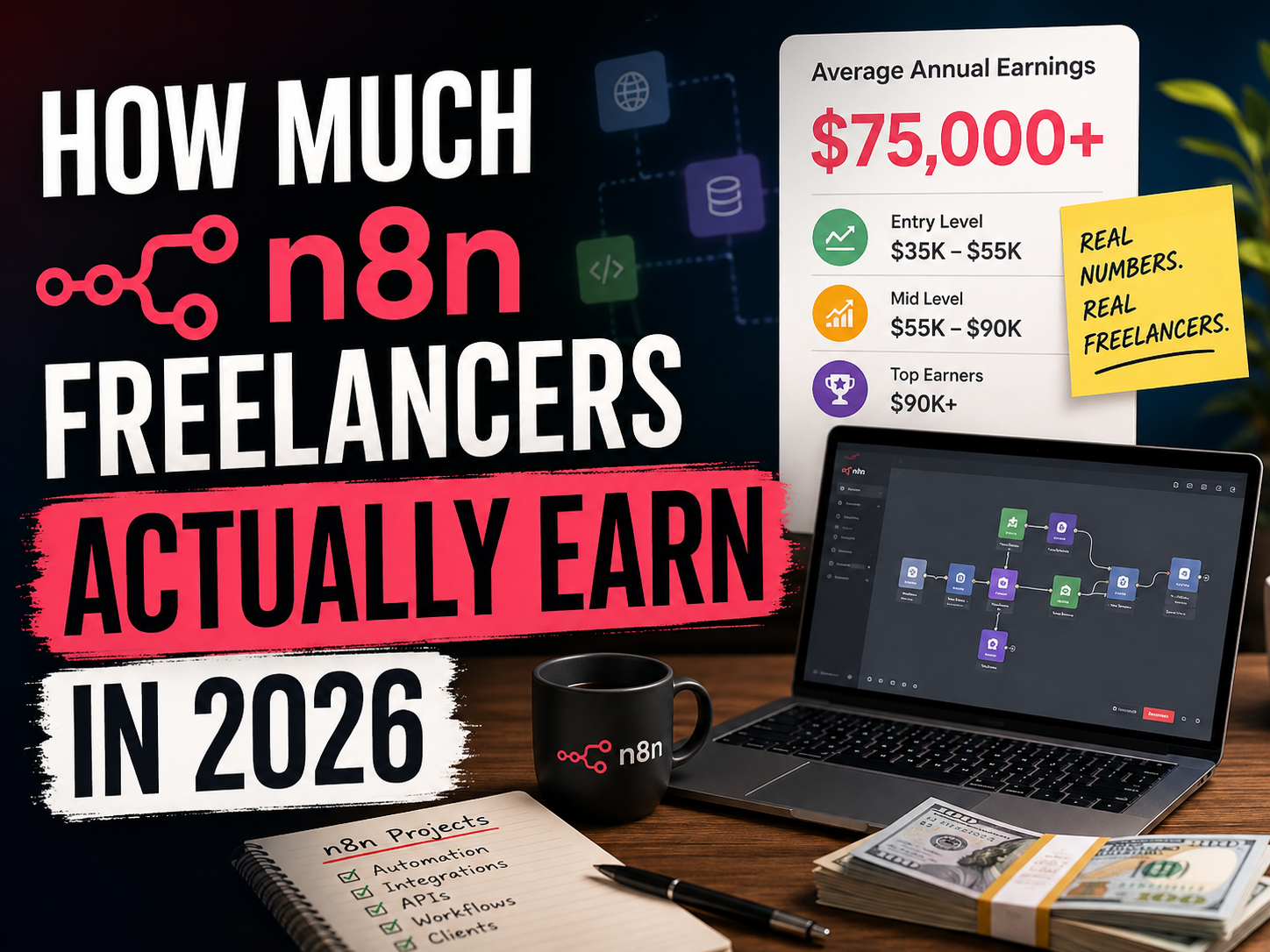
How much does an n8n freelancer cost in 2026? There is no single market rate. Current marketplace data puts n8n work anywhere from roughly $15–$100+ per hour, depending on complexity, experience, client type and where the work is sold. Upwork currently describes n8n expert hiring at about $40–$100/hour, while recent datasets of actual job postings show lower medians around $25–$40/hour. Project pricing is also common, from a few hundred dollars for a simple workflow to several thousand for multi-system automation.
The important distinction is that these numbers are different market measurements, not one universal salary table. A marketplace’s published expert range, a freelancer’s profile rate and the budget on a specific job can all be different. This guide separates those numbers so you can see what n8n freelancers actually charge — and what those rates can mean for monthly income.
Quick Answer: n8n Freelancer Rates in 2026
| Work / market | Current benchmark | What it means |
|---|---|---|
| Lower-priced freelance work | ~$15–$30/hr | Basic workflows, integrations and commodity automation |
| Recent n8n job datasets | ~$25–$40/hr median | Observed budgets/rates in published freelance jobs |
| Upwork n8n expert benchmark | $40–$100/hr | Current general hiring range |
| Senior / specialist work | $100+/hr | Complex automation, engineering and specialist AI work |
| Simple workflow projects | ~$200–$600+ | Small, well-defined automation builds |
| Custom integrations | ~$800–$2,500 | More involved API and multi-step development |
| Multi-system automation | $3,000+ | Larger production automation projects |
Upwork’s current n8n expert page lists $40–$100/hour as a general hiring range and gives project examples of roughly $200–$600 for app-to-app workflows, $800–$2,500 for custom integration development, and $3,000+ for multisystem automation. Independent 2026 analyses of n8n freelance postings report lower medians, so these figures should be treated as benchmarks for different parts of the market rather than as one average.

What Does an n8n Freelancer Charge on Upwork in 2026?
Upwork is one of the clearest places to see the spread in n8n pricing. Its current hiring guide says n8n experts generally cost around $40–$100/hour. At the same time, individual profiles can be listed much lower or higher, so the published range should not be mistaken for a marketplace median.
Recent analyses of hundreds of Upwork n8n-related jobs provide another view. One dataset of 700 jobs found a median hourly budget of about $25, with most hourly jobs falling between $15 and $60. Another 2026 analysis of 70 n8n hourly-priced posts put the median at about $40, with the middle half between $25 and $50. The samples use different collection methods, so they are market signals rather than official statistics.
This is why an n8n freelancer profile at $75/hour does not contradict a job-posting dataset with a $25 median. The first measures a listed specialist rate; the second measures budgets across a much broader set of jobs.
How Much Does an n8n Automation Project Cost?
| Project type | Typical benchmark | Main cost drivers |
|---|---|---|
| Simple workflow | $200–$600+ | Apps, triggers and basic logic |
| Custom integration | $800–$2,500 | API work, authentication, data transformation and testing |
| Multi-system automation | $3,000+ | Multiple systems, reliability, monitoring and deployment |
| Ongoing support | Retainer-based | Monitoring, fixes, new workflows and response requirements |
These are starting points, not fixed n8n prices. Scope matters more than the number of nodes in a workflow: custom APIs, authentication, error handling, deployment, documentation and monitoring can turn a small-looking automation into an engineering project.
Hourly Rate vs. Monthly Income
An hourly rate is not a salary. A freelancer charging $50/hour does not automatically earn $8,000 a month because not every working hour is billable. Time spent finding clients, writing proposals, calls, revisions, administration and gaps between projects is unpaid unless it is built into the business model.
| Billable hours / month | $25/hr | $50/hr | $100/hr |
|---|---|---|---|
| 40 | $1,000 | $2,000 | $4,000 |
| 80 | $2,000 | $4,000 | $8,000 |
| 120 | $3,000 | $6,000 | $12,000 |
| 160 | $4,000 | $8,000 | $16,000 |
This is gross billable revenue, not take-home income. Marketplace fees, taxes, software, hosting and periods without client work still have to come out of it. Project pricing changes the calculation again: a freelancer who completes a $2,000 project in 20 billable hours has a very different effective rate from someone who needs 60 hours for the same deliverable.
n8n Freelance Rates by Experience
Experience matters, but n8n years alone do not explain the price. A developer who can debug APIs, write JavaScript, deploy n8n, handle failures and integrate production systems is selling a different service from someone assembling pre-built nodes.
| Level | Illustrative market band | Typical work |
|---|---|---|
| Junior | ~$15–$30/hr | Simple triggers, templates and straightforward integrations |
| Mid-level | ~$30–$70/hr | Multi-step workflows, APIs and error handling |
| Senior | ~$70–$150+/hr | Production deployments, custom code and complex systems |
| Specialist | $100+/hr | High-complexity AI, enterprise or architecture-heavy work |
These bands are illustrative rather than official salary brackets. Current evidence supports a wide distribution rather than a clean four-tier rate card. Premium specialist rates exist, but they represent a narrower segment of the market.
Project Pricing, Retainers and Recurring Revenue
Many experienced n8n freelancers stop pricing every task by the hour. A fixed project can be easier for the client to approve and can reward efficiency, while a retainer turns maintenance and ongoing development into recurring revenue.
Fixed-Price Builds
A simple automation may be priced in the hundreds of dollars. Custom integrations and multi-system workflows move into the low thousands, while production systems with many integrations, monitoring, documentation and AI components can go considerably higher.
Retainers
Ongoing support can cover monitoring, troubleshooting, new workflow development, API changes and infrastructure work. Small support arrangements may be priced in the hundreds of dollars per month, while more involved automation support can reach the low thousands. Response time, number of workflows, hosting responsibility and included development all affect the retainer.
Zapier-to-n8n Migration
Migration can be a useful service because the client already has an identifiable automation bill and an existing workflow inventory. But the savings case should be calculated from the client’s actual usage rather than presented as a universal number. Migration fees depend on how many workflows are involved, how much logic they contain, whether APIs need changes and whether the freelancer also handles n8n hosting and ongoing support.
For larger migrations, the value is not simply “replace Zapier with n8n.” The freelancer is also taking responsibility for rebuilding logic, testing data flows, handling failures and making sure the new system remains maintainable.

Which n8n Skills Command Higher Rates?
The strongest premium usually comes from solving a harder business problem, not from simply adding “AI” to an n8n profile.
- Custom API and JavaScript work: useful when standard nodes are not enough.
- Self-hosting and deployment: Docker, server configuration, backups, monitoring and reliability.
- AI and LLM integrations: useful when the project needs more than a basic prompt node.
- RAG and agent workflows: higher-complexity systems can justify higher project budgets, but the premium depends on actual production requirements.
- CRM and revenue workflows: lead routing, enrichment, follow-up and reporting are easier to sell when the business outcome is measurable.
- Monitoring and maintenance: clients may pay recurring fees for reliability after the initial build.

Does Region Still Matter?
Yes, but global freelance marketplaces make the relationship less direct than a traditional local salary comparison. A freelancer can sell to clients in another country, so client budget, language, timezone overlap and demonstrated experience can matter as much as the freelancer’s home market.
That does not mean geography has stopped affecting prices. Generalist work in lower-cost markets is often priced below comparable work in higher-cost markets, while senior technical freelancers can compete internationally when they have strong portfolios and communication skills. Country-level software-developer rate tables should not be presented as precise n8n salary statistics unless the underlying dataset actually measures n8n work.
North America and Western Europe
These markets tend to support higher client budgets, especially for production automation, engineering and consulting. But even on Upwork, n8n rates vary substantially by profile and project. The useful comparison is between the client’s budget and the complexity of the work, not a fixed “US n8n rate.”
Latin America, Eastern Europe and Asia
Freelancers in these regions can compete on international projects while offering timezone overlap, English-language communication or lower total cost. The actual rate still depends on specialization and client type. Recent n8n-specific marketplace data is more useful for this question than generic software-developer country averages.
What Do Real n8n Freelancers Actually Make?
Income reports from individual freelancers are useful, but they should not be confused with representative market statistics. One published account of an n8n freelancer’s first four months reported about $4,200 total, including months of roughly $1,500, $800 and $2,100. The useful lesson is not that $4,200 is a typical income; it is that freelance revenue can be uneven while a portfolio and client base are being built.
At the other end, online communities contain stories of freelancers reaching $10,000+ months through retainers, agency work or AI automation. Those examples are possible but subject to strong selection bias. There is not enough reliable evidence to present $10K/month as a normal outcome for an n8n beginner.
A more useful way to think about monthly income is to combine an achievable billable rate with realistic billable hours, then add fixed-price projects and recurring retainers as the business matures. The resulting revenue can vary widely from month to month.
FAQ
How much does an n8n freelancer cost?
Current marketplace benchmarks range from roughly $15–$100+ per hour depending on the work and freelancer. Upwork currently gives $40–$100/hour as a general n8n expert hiring range, while recent job datasets show lower medians around $25–$40/hour.
What is the n8n hourly rate in 2026?
There is no single rate. Basic freelance work can appear around $15–$30/hour, many marketplace jobs cluster around $25–$50/hour, and specialist or senior work can exceed $100/hour. Upwork’s current published expert range is $40–$100/hour.
How much do n8n freelancers charge on Upwork?
Upwork currently says hiring an n8n expert generally costs about $40–$100/hour, but individual profiles and job budgets vary widely. Recent analyses of Upwork n8n jobs have reported medians around $25–$40/hour, so the published expert range should not be treated as the marketplace median.
How much does an n8n automation project cost?
Upwork currently lists roughly $200–$600 for a simple app-to-app workflow, $800–$2,500 for custom integration development and $3,000+ for multisystem automation. Larger projects can cost more when they include production deployment, monitoring, complex APIs or multiple business systems.
How much can an n8n freelancer make per month?
It depends on billable hours, rate, project volume and recurring clients. For example, 80 billable hours at $50/hour produces $4,000 in gross billable revenue, while 120 hours at $100/hour produces $12,000. These are calculations, not typical-income claims, and they exclude fees, taxes and non-billable time.
Can you make money with n8n without coding experience?
Basic visual workflows can be built with little or no code, but higher-value freelance work usually requires stronger technical skills. Custom APIs, JavaScript, debugging, authentication, deployment and reliable error handling are useful when clients are paying for production automation rather than a simple template.
Is n8n or Zapier more profitable for freelancers?
That depends on the service being sold. n8n can create opportunities around self-hosting, custom integrations and migrations, while Zapier has a much larger non-technical user base. For a freelancer, the opportunity usually depends more on the problem being solved — such as migrating an expensive automation stack, integrating an API or maintaining a production workflow — than on the brand name of the platform.
If you are turning n8n skills into a business rather than taking one-off jobs, see our guides on starting an n8n automation agency and selling n8n workflow templates. They cover two paths that can sit alongside freelance project work.
Bottom Line
The 2026 n8n freelance market is better described as a wide distribution than as one standard hourly rate. Current Upwork guidance places n8n experts around $40–$100/hour, while recent job-posting analyses show lower medians around $25–$40/hour. Project budgets range from hundreds of dollars for simple workflows to several thousand for custom and multisystem automation.
If you’re pricing n8n services, start with the actual scope: integrations, complexity, deployment, reliability and ongoing support. Then choose hourly, fixed-price or retainer billing based on the project. Higher rates are possible when you can solve technically difficult or business-critical problems, but no single premium rate or $10K/month income figure should be treated as typical for the whole market.




Leave a Reply