
Getting SEO traffic and building a profitable affiliate project are two different jobs. It’s a lesson that sounds obvious and still gets ignored all the time.
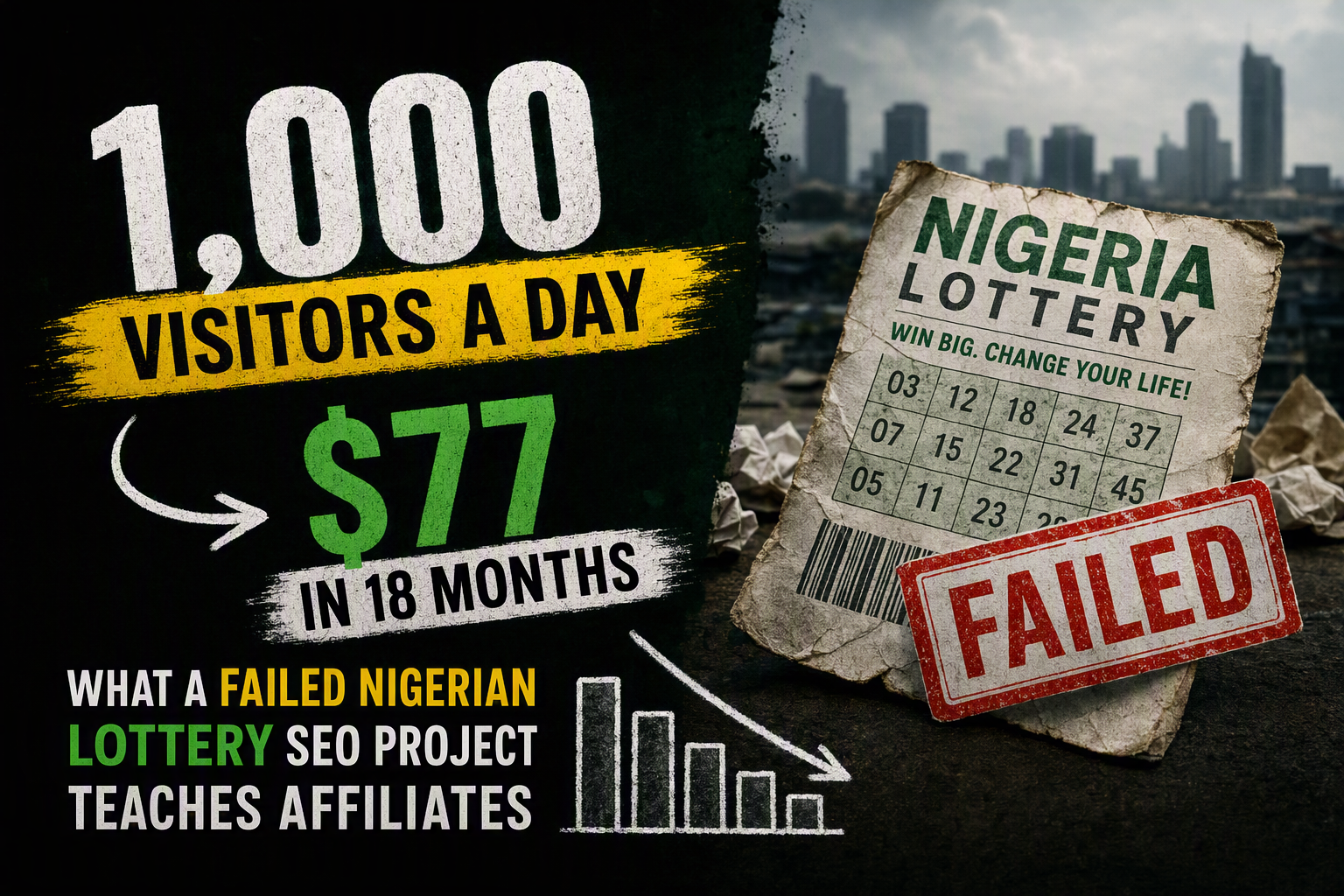
A good illustration is a Nigerian lottery project described by an affiliate SEO practitioner. The site eventually settled at around 1,000 visitors a day, with a peak of roughly 2,500. After about 18 months, its total affiliate revenue was $77.16.
Nobody would call that a success story, which is exactly why we think it’s worth a closer look. This article is our own analysis of the case, not a retelling of the original.

The idea: a Nigerian lottery portal
It started with a simple observation. Nigerians search a lot for lottery results and predictions, and one brand stood out: Baba Ijebu, which according to the case pulls around 1.5 million searches a month.
The first plan was a site built around that single brand. Keyword research changed it. Much of the demand turned out to be about results and predictions in general, not the brand itself, and Nigeria has several other big lottery operators. So the project grew into a small portal covering multiple lotteries.
The competition looked beatable: weak sites, many of them monetized with little more than AdSense. The plan was to build a better portal, capture the traffic, monetize it with gambling affiliate offers, and then use the profit to buy up and improve other low-quality lottery sites. On paper, a reasonable affiliate-media strategy.
The SEO part worked
The developer wrote parsers that pulled results from the official lottery websites. The site also generated prediction pages based on draw schedules and game formats. According to the case, the numbers in those predictions were randomly generated and presented as data-based. We’re not endorsing that, but it’s part of how the project worked.
Whatever you think of the method, the traffic came. This wasn’t an affiliate who failed to rank. The site found demand, ranked for it, and people showed up. What happened after they arrived is where it fell apart.
The numbers
Over roughly a year and a half, the project tried several affiliate programs and formats: banners, buttons, text links, different gambling products, and crash games. Here is what the case reports:
| Affiliate program | Result | Revenue |
|---|---|---|
| 1win | 520 registrations | $47.00 RevShare |
| GG Agency | 81 lottery subscriptions | $29.56 |
| Melbet | 3 registrations | $0.45 RevShare |
| 1xBet | 1 registration | $0.15 RevShare |
| Total | $77.16 |
Our rough estimate: if the site averaged anything close to 1,000 visits a day, that’s at most around half a million visits in total (less, in practice, since traffic had to ramp up). $77 over that many visits comes to about 15 cents per thousand visitors.
The obvious conclusion is “not enough traffic.” That’s wrong. Even ten times the traffic would have meant under $800 in 18 months.
What probably went wrong
We can’t know for sure from the outside, but the most likely culprit is intent. Search volume and commercial value are not the same thing.
Take someone searching “Baba Ijebu results.” Most likely they just want to know what came up in the last draw. “Baba Ijebu prediction” is a bit closer to a betting mindset, but still a long way from “I’m ready to register at a sportsbook.” Compare that with queries like “best betting site Nigeria” or “Baba Ijebu online betting” (our examples, not from the case), where the person is already looking for somewhere to play.
The site seems to have collected mostly informational and navigational traffic and then tried to monetize it with offers that need a completely different state of mind.
The 1win numbers add a second clue. 520 registrations earned $47, about 9 cents each. So people did click and sign up. They just didn’t deposit, or deposited very little. That points beyond intent to the audience itself: low purchasing power, limited payment options, a GEO where the product doesn’t convert into real players, or a mix of all three. The offers didn’t fail to get clicks. They failed to get money.

Why 1,000 visitors can be worth less than 50
Picture two sites. Site A gets 1,000 visitors a day, most of them checking lottery results. Site B gets 50, most of them comparing operators, hunting for payment methods, or deciding where to make a first deposit. Site A looks far better in Google Analytics. Site B is probably worth more.
The formula we use for a quick sanity check is traffic × commercial intent × conversion rate × payout, plus retention if you’re on RevShare. If any one of those is close to zero, the rest can’t compensate.
This also explains why tweaking the monetization didn’t help. The case tested several programs and formats, so it wasn’t a matter of one badly placed banner. When the audience came for one thing and the offer asks for another, no button color fixes it.
What we’d do differently
Before building a big portal around a high-volume keyword, we’d test monetization on a small sample of pages and look for answers to a few questions:
- Which queries show commercial intent?
- Do users click operator links at all?
- Do those clicks turn into registrations, and do the registrations turn into deposits?
- Does RevShare or CPA make more sense here?
- Can the GEO support the payouts you need?
- If not, is the traffic valuable enough to sell as direct advertising?
Only if those signals look good does it make sense to scale the SEO architecture. So the order becomes: identify intent, test the offer, measure the economics, then build. It’s less exciting at the start and a lot cheaper if you’re wrong.
The $77 lesson
The number worth remembering from this case isn’t the 1.5 million monthly searches or the 2,500-visitor peak. It’s $77.16, because it forces the question that keyword tools never answer: what is this traffic actually worth?
From an SEO point of view, the project did its job. From a business point of view, it didn’t, and both statements are true at once. SEO can solve the traffic problem and leave the business problem completely untouched. Finding that out after 18 months of building is an expensive way to learn it.


Leave a Reply