
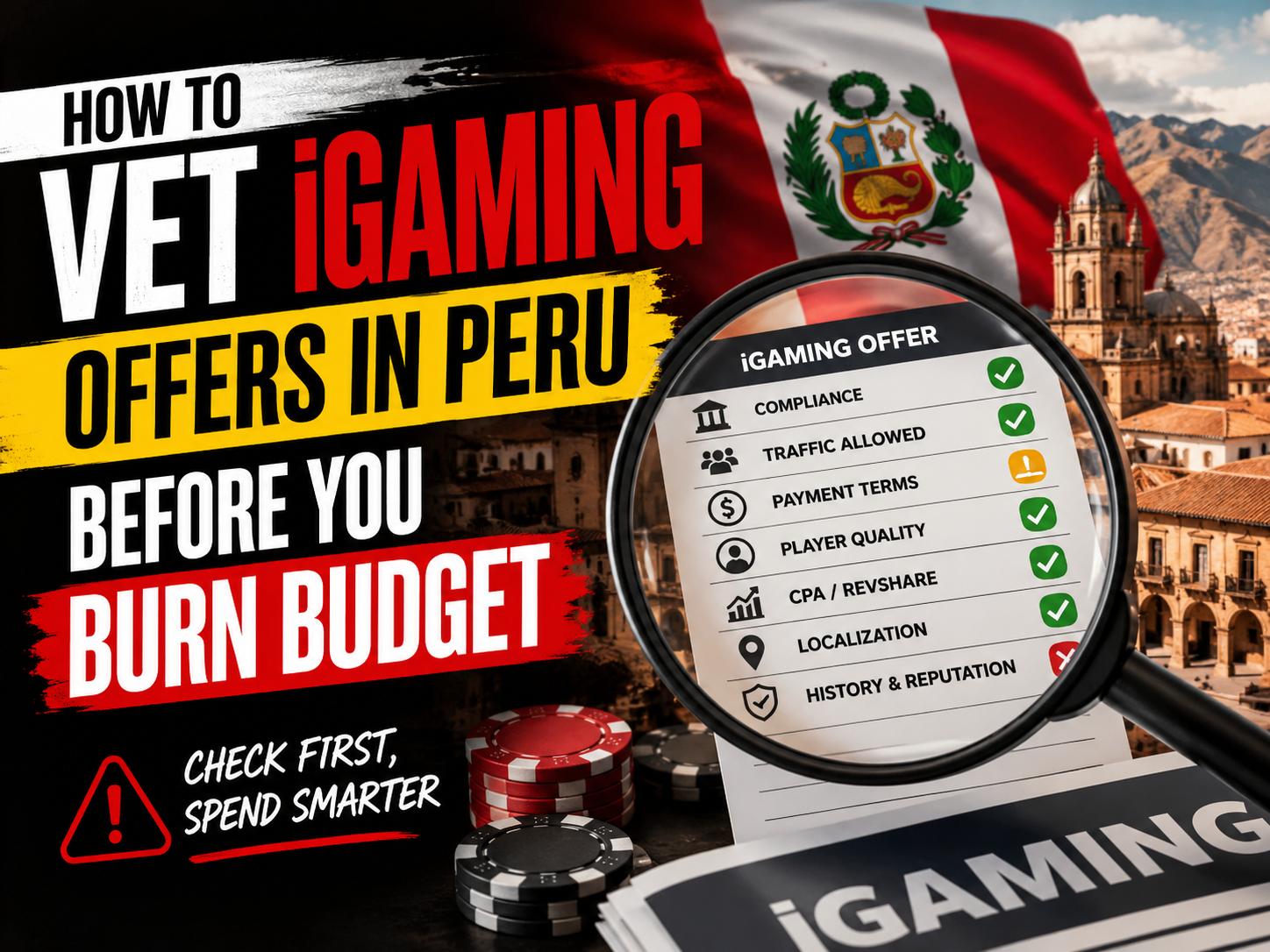
Peru finished the messy transition from grey hat market to regulated iGaming faster than most of Latin America expected. By mid-2026, MINCETUR had more than 90 operator licenses on the books, a functioning enforcement regime, and a domain rule that tells you in three seconds whether a brand is even allowed to take Peruvian traffic. None of that made offer vetting easier. It made it different — the risk moved from “is gambling legal here” to “is this specific offer actually compliant, and will it actually pay.”
Most affiliates entering Peru right now are running the same playbook they used for Brazil two years ago. That playbook is outdated. Peru’s regulator behaves differently, the payment stack is dominated by two apps you won’t find in a generic LatAm media buying brief, and the affiliate networks claiming “Peru GEO” range from genuinely solid to recycled offers nobody bothered to update. This is the checklist I wish existed before I started sending traffic there.

Quick Answer
Vet a Peru-facing iGaming offer by checking three things before anything else: whether the operator holds an active MINCETUR license (verify the .bet.pe domain and the public registry, not the network’s word for it), whether the minimum deposit is realistic against a monthly minimum wage of roughly S/1,130, and whether the network’s stated CPA terms match what you can confirm in the dashboard — not the sales pitch. If any of those three fail, don’t run the offer, no matter how good the payout looks.
Peru iGaming Market Snapshot 2026
Peru regulates online gambling nationally, the market runs on two mobile wallets instead of cards, and roughly half the country is still online only through a phone.
Regulatory status. Peru’s Law No. 31557, passed in 2022, put MINCETUR — the Ministry of Foreign Trade and Tourism, acting through its casino and slot-machine directorate — in charge of licensing every online casino and remote sports betting operator, whether the company is Peruvian or foreign. Amendments under Law No. 31806 filled in gaps around taxation and foreign operator eligibility, and by February 2024 the licensing requirement was fully live: no operator, local or international, can legally take a Peruvian player without going through MINCETUR first. Operators pay gross gaming revenue tax plus a smaller consumption tax on individual bets, and unlicensed operation carries fines that run into the hundreds of thousands of soles. As of mid-2026, MINCETUR itself says the licensed pool has passed 90 operators, and the agency has been public about tightening its data-sharing pipeline with licensed platforms to squeeze out offshore and VPN-based access.
Here’s the shortcut that makes half of this checklist unnecessary: every gambling site holding a real Peruvian license has to operate on a domain ending in .bet.pe. See a .com instead? That operator almost certainly isn’t licensed locally. Bookmark that rule — it’ll save more vetting time than any spreadsheet you build.
Payment infrastructure. This is where a lot of imported LatAm strategy quietly falls apart. Peru isn’t a card-first market, not even close. Mobile wallets now handle more than half of all cashless transactions in the country, having pulled ahead of traditional cards entirely — Yape alone covers roughly 54% of in-person transactions, with Plin taking another 34%. For players without a card or a wallet balance, PagoEfectivo fills the gap by generating a payment code the player settles in cash at a partner bank or agent — a real, commonly used deposit path, not a legacy checkbox nobody clicks. If an offer’s cashier only lists Visa and Mastercard, that’s not a minor UX gap. It’s a sign the operator built for a different market and bolted Peru on as an afterthought.
Device split. Peru’s internet population sits around 28 million people, with penetration above 80% of the total population, and the growth curve from here is almost entirely mobile — forecasts put mobile internet penetration near 95% by the end of the decade. Practically, that means building and testing every landing page mobile-first, and treating a network’s conversion-rate claims with suspicion if their own demo cashier isn’t smooth on a mid-range Android phone over an average mobile connection.
| Factor | What matters for vetting |
|---|---|
| Regulator | MINCETUR — Dirección General de Juegos de Casino y Máquinas Tragamonedas |
| Legal basis | Law 31557 (2022), amended by Law 31806 (2023), fully in force since Feb 2024 |
| License check | Domain must end in .bet.pe; cross-check the public MINCETUR licensee registry |
| Operator count | 90+ licensed operators as of mid-2026, per MINCETUR |
| Dominant payment rails | Yape, Plin (wallets), PagoEfectivo (cash-based), local bank transfer |
| Card usage | Secondary rail — don’t build a Peru funnel around card-only cashiers |
| Internet access | ~82% penetration, growth trajectory is mobile-driven |
Key Takeaway: Peru is regulated, not informal — license verification is a 30-second check against a public domain rule, and any offer that isn’t built around Yape, Plin, or PagoEfectivo is going to underperform regardless of the headline CPA.


Red Flags When Vetting a Peru-Facing Offer
The offer is a problem if the operator can’t show a .bet.pe license, the minimum deposit doesn’t match local income, the CPA terms hide a hold period the network won’t confirm in writing, or the “Peru” GEO tag doesn’t match how the operator actually geo-fences traffic.
Licensing risk isn’t just the operator’s problem — it’s yours. MINCETUR has said openly that its enforcement approach targets the whole funnel — legal, technical, financial, and operational — rather than relying on shutting down one weak point at a time. Sending traffic to an unlicensed .com brand isn’t a compliance footnote you can shrug off. It’s the fastest way to get a domain or ad account flagged with zero warning.
Minimum deposit versus real purchasing power. Peru’s legal minimum wage runs about S/1,130 a month, and the national average gross salary sits closer to S/2,200. Run that math before approving anything. A $20 minimum-deposit requirement on a card-only cashier is asking a minimum-wage worker to commit around 6% of an entire month’s income in a single transaction, through a rail most of your traffic base doesn’t even use. Offers actually built for this market price minimum deposits in soles — single digits to low tens — through Yape or PagoEfectivo, not as a converted USD figure lifted straight from a US or UK offer sheet.
CPA caps and hold periods that never make it into the pitch. Affiliate managers will quote a clean CPA number over a call. What doesn’t always get volunteered is the hold period before that CPA actually clears, or the deposit-qualification rules buried in the fine print — first deposit only versus cumulative deposits, a minimum stake requirement before a lead counts, and so on. Ask for the hold period in writing before sending a single click. If a manager can’t give you a number, treat that as your answer.
Geo-targeting that doesn’t match real geo-fencing. “Peru” on a network’s offer list sometimes hides looser geo-fencing than advertised on the operator’s own side — Lima traffic converts fine, while a chunk of secondary-city or rural traffic gets silently rejected at the deposit step because the operator’s KYC or payment integration doesn’t reach that far. This never shows up in the offer description. It shows up as a conversion rate that’s inexplicably weak compared to a similar market, and by then the budget’s already spent.
- Confirm the operator’s domain ends in .bet.pe and cross-check it against the MINCETUR registry directly
- Get the minimum deposit figure in soles, not a USD conversion, and check it against a S/1,130 monthly wage baseline
- Get hold-period and qualification terms in writing before sending traffic
- Run a small geo-fencing test across multiple regions, not just Lima, before committing real budget
- Confirm the cashier actually supports Yape, Plin, or PagoEfectivo yourself — screenshot it, don’t take the offer sheet’s word for it
Key Takeaway: Every one of these checks takes under ten minutes and none of them need the network’s cooperation — that’s the whole point. Build the habit of verifying independently, because the offer sheet is a sales document, not a compliance document.

Framework: 5-Point Scoring System
Score a Peru offer across licensing, payment fit, deposit economics, payout terms, and geo-fencing accuracy — weight licensing and payment fit highest, because those two kill campaigns that would otherwise convert just fine.
This builds on the same weighted-scoring logic behind our AI-assisted offer-scoring framework — the difference here is that every criterion is Peru-specific, and each one maps to something you can confirm in ten minutes without needing your affiliate manager’s permission.
| Criterion | Weight | How to check (10 minutes or less) |
|---|---|---|
| MINCETUR license status | 30% | Domain ends in .bet.pe; cross-check the name against the public MINCETUR licensee register |
| Payment method fit | 25% | Open the cashier yourself; confirm Yape and/or Plin and/or PagoEfectivo are actually live, not just listed |
| Deposit economics | 20% | Convert the minimum deposit to soles; compare it against the S/1,130 monthly minimum wage |
| Payout terms clarity | 15% | Get the hold period and qualification rules from the affiliate manager, in writing |
| Geo-fencing accuracy | 10% | Test clicks from two or three different Peruvian regions, not just Lima, and compare conversion rates |
Score each criterion 0–10, multiply by its weight, and sum the total. Anything scoring below 6/10 on licensing or payment fit alone should disqualify the offer regardless of the overall total — those two criteria aren’t compensating factors, they’re gatekeepers. An offer with perfect deposit economics but a .com domain isn’t a borderline case. It’s a fail.
Key Takeaway: Weight licensing and payment fit above everything else — a great CPA number on a non-compliant or payment-mismatched offer is a number you’ll never actually collect.

Where to Find Legit Peru-Facing Offers
Peru-facing gambling offers mostly show up on general iGaming CPA networks under a broader LatAm GEO list, not on Peru-specific networks — so the real work shifts from finding the offer to confirming the network’s Peru terms are current, not just recycled from a wider regional sheet.
Most networks bundle Peru into a LatAm GEO block alongside Brazil, Chile, Argentina, Ecuador, and Colombia. One current listing puts this in concrete terms: a $20 CPA offer against a $5 qualifying deposit, running across that same country group, with the network stating an average hold period of no more than seven days. That’s a useful reference point for what a reasonable Peru CPA and hold period look like right now — not a specific recommendation, since network terms shift constantly and anything you find needs re-verifying before you actually run it.
What to check directly in the network dashboard, not on the sales page:
- Filter offers to Peru specifically — don’t accept a bundled “LatAm” listing without confirming Peru is genuinely included and actively converting, not just present on paper
- Check payout speed history — ask other affiliates running the same GEO for real payment dates if the network won’t show you internal data
- Confirm the hold period inside the dashboard terms, not just what an affiliate manager says on a call
- Cross-reference the operator’s name against the MINCETUR registry before committing budget — the network listing the offer isn’t the party that needs the license, the operator is
On brand selection: Peruvian land-based operators moving online — Apuesta Total, Inkabet, and Te Apuesto among them — have built solid positions on the back of existing retail networks and name recognition that predates online betting entirely. International brands like Betsson, 1xBet, Unibet, Betway, and Rabona have localized for the market from the other direction. Local brands tend to convert better on cold traffic thanks to that name recognition; international brands often have cleaner cashier UX and faster iteration on Yape and Plin support. Test both before assuming one category wins by default.
Key Takeaway: Treat every “Peru” GEO tag on a general LatAm offer sheet as unverified until you’ve confirmed it in the dashboard yourself — the offer list is a starting point, not a source of truth.
Mini Case: Test Campaign Numbers
A modeled S/3,000 test budget on a compliant, Yape-first offer, run at realistic Peru conversion benchmarks, should tell you within one week whether the offer is worth scaling.
The figures below are a modeled example built from the CPA and deposit benchmarks discussed above — not a real campaign or any specific advertiser’s actual results. Use it as a planning template, not a promised outcome.
Assume you’ve vetted an offer that scores well on the 5-point framework: .bet.pe licensed, Yape-integrated cashier, $20 CPA against a $5 qualifying deposit, seven-day hold period. You run a S/3,000 test budget (roughly $870 at a ~S/3.45-to-the-dollar rate) over one week across push and native traffic.
| Metric | Modeled figure | Note |
|---|---|---|
| Test budget | S/3,000 (~$870) | One-week test, push + native |
| Clicks | 8,500 | Blended CPC across both sources |
| Registrations | 340 (4.0% CR) | Mobile-first landing page, Yape-optimized cashier |
| Qualified deposits | 95 (28% reg-to-dep) | $5 minimum deposit via Yape |
| CPA payout | $20 × 95 = $1,900 | Before the hold period clears |
| Gross ROI | ~118% | Pre-hold-period, before any void or chargeback adjustment |
| Post-hold ROI (estimate) | ~95–105% | After a typical 5–10% void rate on qualified deposits |
The reg-to-deposit rate is the number that actually tells you whether an offer is viable. A strong registration CR paired with a weak deposit rate usually means the cashier is dropping Yape or Plin users somewhere in the flow — exactly the kind of mismatch a five-minute manual cashier test would have caught before you spent a single sol.
Key Takeaway: Run the smallest test budget that gives you a statistically usable reg-to-deposit number before scaling — for Peru that’s typically 5,000 to 10,000 clicks, not 500.

Common Mistakes Affiliates Make Entering Peru
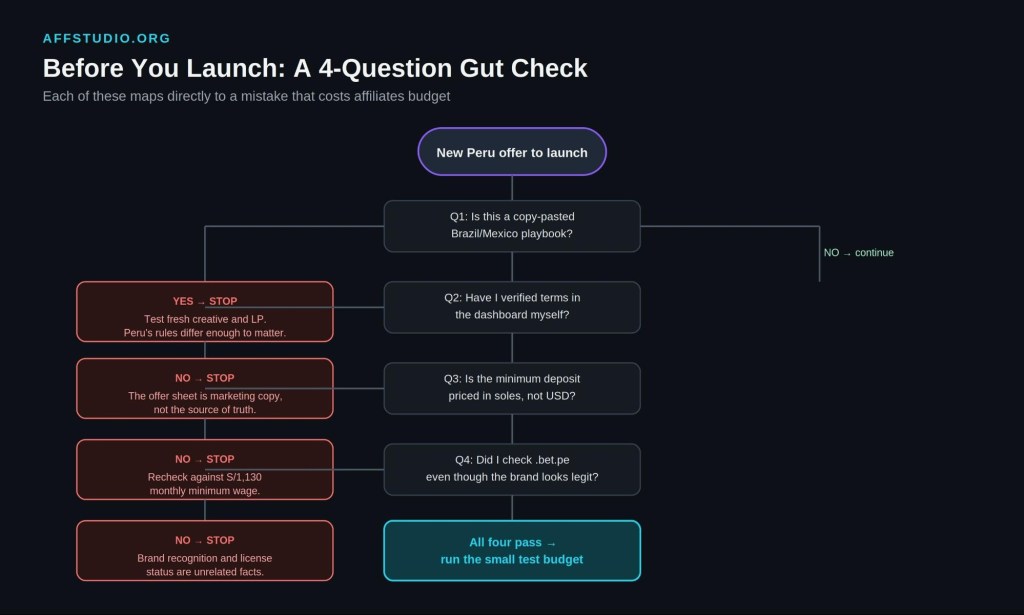
The three mistakes that show up over and over: treating Peru as a Brazil clone, trusting a network’s GEO tag without dashboard verification, and pricing deposits in USD instead of soles.
- Copy-pasting a Brazil or Mexico playbook. Peru’s regulator, payment stack, and licensing markers are different enough that a creative angle or landing page tested in Brazil often just underperforms here — test fresh, don’t assume it transfers.
- Trusting the offer sheet over the dashboard. “Peru: available” on a network’s public list is marketing copy. The dashboard terms, the actual cashier, and the actual hold period are the only things that matter.
- Pricing minimum deposits in USD. A $10 minimum deposit sounds small until you realize it’s close to 1% of a minimum-wage worker’s entire monthly income, and it’s paid through a rail — cards — that most of the local audience doesn’t use.
- Skipping the .bet.pe check because the brand “looks legit.” Recognizable brand names get grandfathered into affiliate assumptions. Verify anyway — brand recognition and license status are two completely unrelated facts.
- Running geo tests only in Lima and assuming the rest of the country behaves the same. Payment access and conversion behavior vary more between Lima and secondary cities than most affiliates expect going in.
Key Takeaway: Almost every costly mistake on this list is a five-minute verification step skipped under deadline pressure — the fix isn’t more research, it’s not skipping the checklist to save time.
FAQ
Is iGaming legal in Peru in 2026? Yes. Peru’s Law No. 31557 has been in force since 2022, amended by Law No. 31806, and it created a full licensing framework for online gambling and remote sports betting administered by MINCETUR. Unlicensed operation carries real financial and legal penalties, and enforcement has only tightened through 2026.
What’s the minimum deposit for Peru iGaming offers? It varies by operator, but offers actually built for the local market typically price minimum deposits in single-digit to low-double-digit soles, payable through Yape or PagoEfectivo. Anything priced only as a converted USD figure through a card-only cashier is a sign the operator hasn’t really localized.
Which affiliate networks have the best Peru payouts? That changes too fast to name a permanent winner — always verify current terms in the dashboard before running anything. What stays constant is what you’re checking for: a CPA confirmed against a Yape- or Plin-integrated cashier, a hold period under two weeks, and payout history you can verify against other affiliates, not just the network’s own marketing.
Does an offer need MINCETUR licensing to be safe to promote? Yes, treat this as non-negotiable. Every locally licensed gambling site runs on a domain ending in .bet.pe — that’s the fastest verification step available, and it should be the first thing you check, not the last.
Final Verdict
Bottom Line: Peru in 2026 is a genuinely regulated, genuinely underserved market — that combination is rare, and it’s exactly why the opportunity is real. But “regulated” cuts both ways: the upside is a dead-simple licensing check (.bet.pe) that most affiliates aren’t bothering to run, and the downside is that skipping it now carries real enforcement risk, not just a weak CR. Run the 5-point framework on every offer before committing budget, price everything in soles against local income, and build your cashier expectations around Yape and Plin rather than cards. Do those three things and you’re already ahead of most of the traffic currently hitting this GEO.
Related reading: our Brazil iGaming AI campaign framework for a look at how a more mature LatAm regulatory environment shapes vetting priorities differently, and our AI-assisted offer-scoring framework for the scoring methodology this Peru framework builds on.




Leave a Reply