
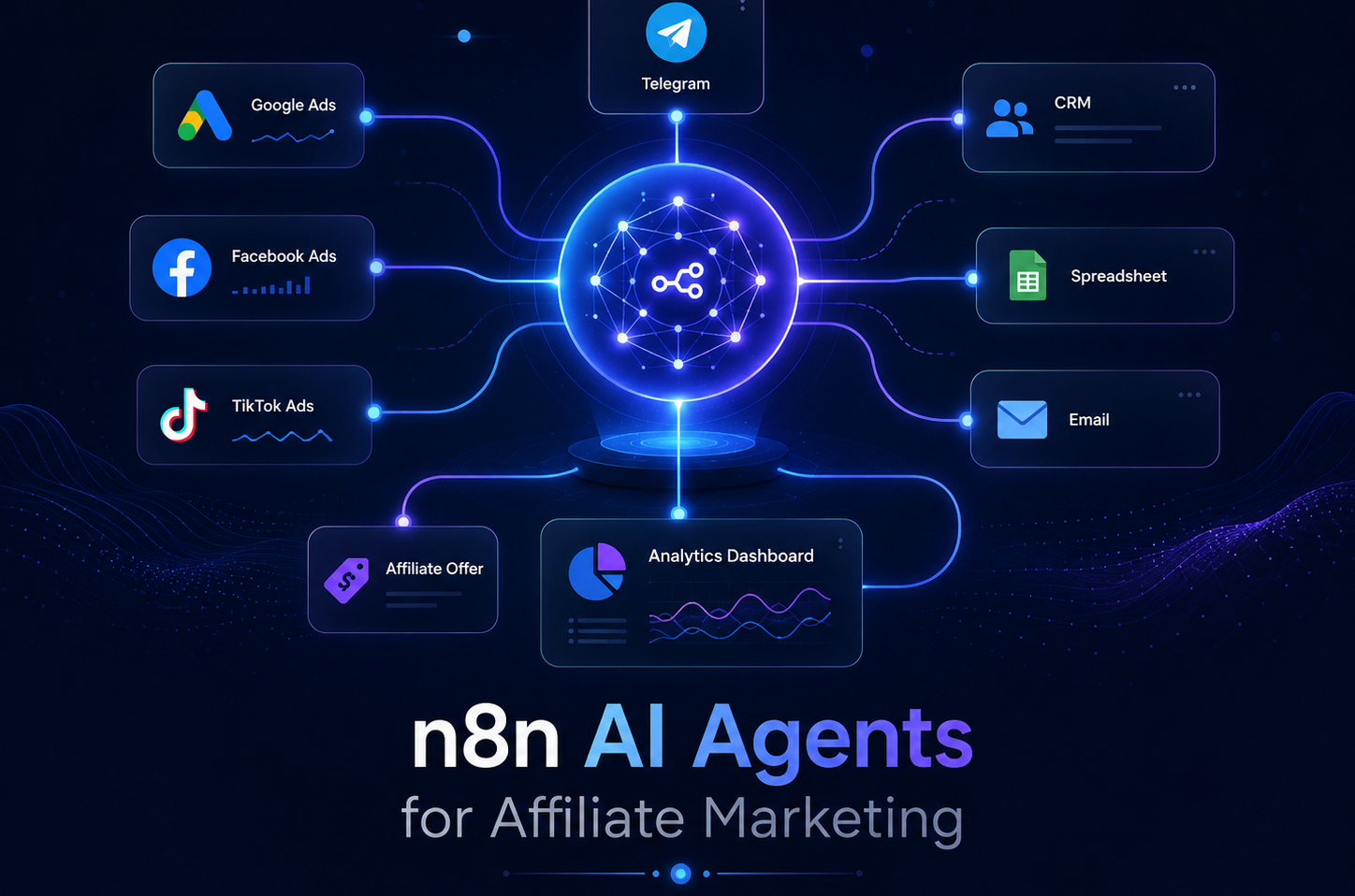
If you’ve been running n8n for more than a few months, you already know what a workflow can do: pull data, move it somewhere else, apply an if/then rule, repeat. That’s automation, and most affiliate teams have already squeezed the easy wins out of it — auto-reporting, Telegram alerts on spend thresholds, basic Google Sheets syncs.
The problem is that the affiliate business doesn’t run on fixed rules. A ROAS drop can mean creative fatigue, a tracking break, a GEO restriction, or just a slow Tuesday. A payout change on a network dashboard might be noise or might mean pulling an offer today. Deciding which one it is used to require a human looking at the data. That’s the gap AI agents close — not by replacing your workflows, but by adding a reasoning layer on top of them that can analyze, decide, summarize, generate, monitor, and recommend without you writing a branch for every possible scenario.
This isn’t an intro to n8n or a “what is ChatGPT” primer. You already know the tools. What follows is how experienced teams are actually wiring n8n AI Agents into affiliate operations right now — with the workflow logic, the trade-offs, and the mistakes that cost people money.
What Is an AI Agent, Really?
Skip the textbook definition. Here’s the distinction that matters on the canvas:
- Automation moves data from A to B on a fixed schedule. No decisions.
- Workflow adds conditional branches — IF ROAS < 1.5 THEN pause. Still deterministic; you wrote every branch in advance.
- AI assistant is a chat window. You paste data into Claude or ChatGPT and ask a question. A human drives every step.
- AI agent is given a goal, a set of tools, and memory, and it decides which tool to call, evaluates what comes back, and decides what to do next — without you having pre-written the decision tree.
Concretely: a workflow says “if CTR drops 20%, send an alert.” An agent looks at 14 days of CTR data, cross-references it against your creative launch dates and the account’s historical seasonality, and decides on its own whether this looks like fatigue, a tracking issue, or nothing worth flagging — then chooses whether to alert, log, or dig deeper by pulling additional data. The n8n AI Agent node is what makes this possible inside a workflow: it wraps a chat model, memory, and a list of callable tools into a single node that runs a reasoning loop (often ReAct-style) until it reaches a stopping point, rather than following a script you wrote line by line.

Why Affiliate Teams Benefit More Than Almost Anyone
Affiliate and media buying operations have a specific shape that makes them unusually good AI agent candidates: high transaction volume, thin margins where speed matters, data scattered across ad platforms, trackers, network dashboards, and Telegram groups, and constant change that punishes anyone who isn’t watching closely.
Where this shows up in practice:
- Campaign monitoring across dozens of accounts and GEOs that no single person can watch in real time.
- Reporting that currently means manually stitching together numbers from three or four different platforms.
- Creative production at the volume performance marketing actually requires — headlines, angles, hooks, refreshed weekly or more.
- Landing page analysis where a broken redirect or missing pixel silently burns spend for days before anyone notices.
- GEO monitoring, since restrictions and compliance rules shift by country and by network with little warning.
- Competitor research that’s valuable but too time-consuming to do consistently by hand.
- Offer analysis, since payouts, caps, and creative approval rules change on network dashboards constantly.
- Anomaly detection on spend, CTR, and conversion rate, where a same-day catch versus a three-day catch is the difference between a bad afternoon and a wasted week of budget.
The business case is straightforward: multiply the hours currently spent on this analytical grunt work by the hourly cost of the person doing it, and you get the real ROI number. The bigger, harder-to-quantify win is reaction time — an agent that flags a tracking break within an hour instead of two days in prevents spend loss that a weekly report never would have caught in time anyway.
10 Real AI Agent Use Cases for Affiliate Marketing
These are workflows built around problems affiliate teams actually deal with, not generic “AI can help with marketing” examples. Each one is realistic enough to build with moderate n8n and prompting effort.
1. Campaign Performance Analyst
Problem: A media buyer running 40+ campaigns across Google Ads and Meta can’t check every account daily. Anomalies — a CTR crash, a CPC spike, unusual budget burn — get caught two or three days late, after real money is already gone.
Agent Logic: Schedule Trigger (every 4 hours) → Google Ads/Meta node pulls campaign stats → Code node normalizes the data → AI Agent node (Claude) compares current performance against a 7-day rolling baseline pulled from a Google Sheets tool, and decides whether the deviation is a genuine anomaly or normal noise → Decision branch → Telegram alert to the buyer’s group + logged row in Google Sheets for audit.
Business Value: Anomalies get caught the same day instead of after a multi-day lag, without anyone manually reviewing 40 dashboards every morning.
Possible Improvements: Add a gated “pause campaign” tool call behind n8n’s human-review step so the agent can act, not just alert, once you trust its judgment. Advanced teams also let the buyer reply directly in the Telegram thread and ask the agent to explain its reasoning.

2. Creative Performance Reviewer
Problem: Creative fatigue sets in gradually. By the time a buyer notices CTR has been sliding for a week, budget has already been wasted on tired ad sets.
Agent Logic: Ads platform node pulls creative-level CTR trends → AI Agent flags creatives with a declining slope over a rolling window, referencing a stored set of past top performers as context → generates fresh headline variants matching the brand’s tone → pushes drafts to a Notion review board → notifies the designer via Telegram.
Business Value: Shifts creative refresh from a weekly manual review to a same-day flag, keeping CTR from bleeding out unnoticed.
Possible Improvements: Connect an image-generation tool so the agent proposes new creative concepts, not just copy, and feed A/B test results back in so it learns what actually worked, not just what looked reasonable on paper.
3. Affiliate News Research Agent
Problem: Industry news — network policy changes, GEO bans, payment processor issues — is scattered across Telegram channels, forums, and X. Missing one update can mean running a dead offer for days.
Agent Logic: Daily Schedule Trigger → HTTP Request/RSS nodes pull from a curated source list → AI Agent summarizes and scores each item 1–5 for relevance to the team’s active GEOs and verticals → compiles a ranked digest → publishes to Telegram and stores it in a Notion database.
Business Value: Replaces 30–45 minutes of manual scrolling per person, per day, with a two-minute read.
Possible Improvements: Add a vector store of past digests so the agent can flag patterns over time — “this is the third payout cut from this network in two months” — instead of treating each item in isolation.
4. Landing Page Quality Inspector
Problem: Prelanders and landers break silently. A broken redirect, a missing postback pixel, or a slow load time can kill a campaign’s numbers for days before anyone connects the dots.
Agent Logic: Scheduled check → HTTP Request loads each active landing URL, checks status codes and redirect chains → a headless-browser tool call verifies load time and confirms tracking parameters are present in the page source → AI Agent ranks findings by severity → report sent to Telegram and logged to Sheets.
Business Value: This is one of the highest-ROI agents on the list, because tracking failures are both silent and expensive — catching one early can save a full day of wasted spend.
Possible Improvements: Chain the finding into an auto-pause tool call scoped to the specific campaign tied to the broken lander, gated behind human approval.
5. Competitor Intelligence Agent
Problem: Knowing what competing affiliates are running — angles, GEOs, landing page styles — is valuable, but manually checking spy tools, Reddit, and X threads daily doesn’t scale across a team.
Agent Logic: API/scraping calls to a spy tool plus search calls against Reddit and X → AI Agent extracts recurring angles, offer types, and creative patterns → summarizes into a structured weekly brief → stored in Notion, pushed to the team lead.
Business Value: Turns scattered competitive noise into a structured brief the team can actually act on, useful for spotting new angles before they saturate.
Possible Improvements: Add a scoring rule that prioritizes signals seen across three or more independent sources over one-off mentions, to cut down on false patterns.

6. Offer Research Agent
Problem: Payouts, GEO restrictions, and landing pages on affiliate networks change without much notice. A manager running dozens of offers can’t check every network dashboard daily.
Agent Logic: Scheduled scrape/API pull of offer pages → Code node diffs against yesterday’s snapshot stored in Postgres → AI Agent decides which diffs matter (payout change over 10%, GEO added or removed, cap changes) versus noise → targeted Telegram alert to the relevant affiliate manager only.
Business Value: Managers get alerted only to changes that affect their live campaigns instead of scanning dashboards manually, cutting the lag between a payout cut and pausing wasted spend.
Possible Improvements: Extend with a drafting tool — the agent writes the clarification message to the network’s affiliate manager, and a human just approves the send.
7. Content Assistant
Problem: Producing headlines, outlines, FAQs, and social posts for a content calendar at volume eats hours that would be better spent on strategy and distribution.
Agent Logic: Trigger fires on a Notion status change (“Ready for AI Draft”) → AI Agent reads the brief and keyword list → generates an outline, headline variants, an FAQ block, and social captions using a system prompt that encodes house style → writes everything back into Notion sub-pages → notifies the editor.
Business Value: Cuts first-draft turnaround from hours to minutes while keeping a human editor as the actual quality gate — this is an assist role, not a replacement for editorial judgment.
Possible Improvements: Connect a style-guide reference (banned phrasing, tone rules, formatting conventions) so the agent self-checks against house style before handing off, instead of the editor catching every issue manually.
8. Google Ads Optimization Agent
Problem: Reviewing budget pacing, bid adjustments, and search term reports across many accounts is repetitive, and it’s the first thing to get skipped when a buyer is busy firefighting.
Agent Logic: Google Ads node pulls CPC, pacing, and search term data → AI Agent flags unusual spend velocity, low-quality search terms burning budget, and underperforming ad groups → proposes specific changes (negative keywords, bid caps) → routes to Telegram for approval → on approval, a tool call pushes the change back into Google Ads.
Business Value: Keeps optimization cadence consistent even in weeks a human buyer would otherwise skip, while the approval gate keeps a person in the loop for anything touching live spend.
Possible Improvements: Set a confidence threshold so low-risk changes (negative keyword additions) execute automatically, while budget or bid changes always require explicit sign-off.

9. Affiliate Reporting Agent
Problem: Pulling data from ad platforms, trackers, and network dashboards into one weekly report for stakeholders eats a chunk of a Friday afternoon.
Agent Logic: Weekly Schedule Trigger → parallel HTTP/API calls to ad platforms, tracker, and network → Merge node combines datasets → AI Agent writes an executive summary highlighting top and bottom performers and notable shifts → formatted as HTML → emailed to stakeholders.
Business Value: Replaces a manual, multi-source reporting task with a consistent, on-time report and frees up the analyst for actual analysis instead of data assembly.
Possible Improvements: Give the agent access to last week’s report so it highlights week-over-week trend changes rather than just repeating static numbers.
10. Knowledge Base Assistant
Problem: Onboarding a new media buyer or affiliate manager at an agency means answering the same questions repeatedly — tracking setup, network-specific quirks, internal SOPs.
Agent Logic: Internal docs (SOPs, network notes, tracking guides) chunked into a vector store → AI Agent with a retriever tool answers questions via Slack or Telegram, citing which internal doc it pulled the answer from → escalates to a human when confidence is low or the question involves a judgment call.
Business Value: Agencies using this pattern report meaningfully shorter onboarding ramps, since new hires get sourced answers instantly instead of waiting on a senior teammate. It also reduces the risk of losing tribal knowledge when someone leaves.
Possible Improvements: Log unanswered questions so the ops team knows exactly which SOPs are missing or outdated — the agent doubles as a documentation gap-finder.
Agent Overview
| AI Agent | Difficulty | Business Value | Best For |
|---|---|---|---|
| Campaign Performance Analyst | Medium | High | Media buyers running many accounts |
| Creative Performance Reviewer | Medium | High | Teams running high creative volume |
| Affiliate News Research Agent | Low | Medium | Whole team / ops |
| Landing Page Quality Inspector | Medium | Very High | Anyone running paid traffic to landers |
| Competitor Intelligence Agent | Medium | Medium | Media buying teams, GEO leads |
| Offer Research Agent | Medium | High | Affiliate managers |
| Content Assistant | Low | Medium | Content and SEO teams |
| Google Ads Optimization Agent | High | High | Google Ads-heavy accounts |
| Affiliate Reporting Agent | Medium | Medium | Agencies with stakeholder reporting |
| Knowledge Base Assistant | High | Medium (compounding) | Agencies onboarding regularly |
AI Models Comparison for Affiliate Automation
n8n’s AI Agent node lets you swap the underlying model per workflow without touching the rest of the logic, so picking a model is a per-agent decision, not a one-time platform choice.
Claude is the strongest default for anything involving reporting, analysis, or multi-step reasoning where you need the agent to explain why it flagged something. It consistently produces more structured, better-organized output over long documents, and it tends to follow complex formatting and system-prompt instructions more reliably — which matters when a report or Telegram alert needs to look the same way every time.
GPT (the ChatGPT family) is well suited to agents that chain a lot of tool calls in sequence — think the Landing Page Quality Inspector or a browser-automation-heavy workflow — where speed through multi-step tool orchestration matters more than nuanced prose.
Gemini stands out for anything involving screenshots, video, or audio without preprocessing — reviewing a landing page visually, analyzing a recorded call, or processing a batch of creative assets — and it’s typically the cheapest option at volume, which matters for agents that run every few hours across dozens of accounts.
Local LLMs (via Ollama or a self-hosted endpoint) make sense for anything touching sensitive data you don’t want leaving your infrastructure — internal payout structures, partner contracts, or compliance-sensitive documents — at the cost of weaker reasoning than the frontier options.
| AI Model | Strengths | Weaknesses | Best Use Case |
|---|---|---|---|
| Claude | Structured output, long-context reasoning, consistent formatting | Higher cost than budget models | Reporting, campaign analysis, editorial content |
| ChatGPT (GPT) | Fast multi-step tool orchestration, mature function calling | Less consistent long-form structure | Multi-tool agents, browser/computer-use tasks |
| Gemini | Native multimodal input, lowest cost at volume, huge context window | Less polished prose output | High-frequency monitoring, visual/video review, batch jobs |
| Local LLMs (Llama, Mistral, etc.) | Full data privacy, no per-token cost | Weaker reasoning, more prompt-tuning required | Sensitive internal data, high-volume low-stakes tasks |

Many teams don’t pick one model — they route different agents to different providers based on the job, which is straightforward in n8n since the chat model is just a sub-node you can swap.
MCP Servers: Why They Matter for n8n Agents
MCP (Model Context Protocol) is the standard that lets an AI agent discover and call tools without you hand-building a custom integration for every service. Instead of writing a bespoke HTTP node configuration every time you want an agent to talk to a new tool, an MCP server exposes its capabilities in a format any MCP-compatible agent can read and use — n8n included, both as a client calling external MCP servers and as a server other systems can call into.
For affiliate teams, the practical upside is fewer one-off integrations to maintain. If your tracker, spy tool, or internal dashboard exposes an MCP server, any agent you build — regardless of which model powers it — can use it the same way, without re-writing tool definitions each time you change providers.

It’s not required to build useful agents in n8n today — most of the use cases above work fine with standard HTTP Request tool nodes — but as more affiliate-space tools ship native MCP support, it becomes the lower-maintenance way to wire an agent into your stack.
Common Mistakes Teams Make
- Giving agents too much autonomy too soon. Letting an agent pause campaigns or shift budget with no approval gate is how a bad prompt turns into a bad week.
- Poor prompts. A vague system prompt produces inconsistent tone and formatting, which breaks anything downstream expecting a predictable structure.
- Missing validation. Skipping a structured output parser means one malformed response can silently break a Google Sheets write or a Notion update.
- No logging. Without a record of what the agent saw and decided, you can’t debug a bad call three days later — or prove to a client what happened.
- No human approval on high-stakes actions. Anything that touches live budget or pauses a campaign should have a person in the loop until the agent has a track record.
- Ignoring API failures. No retry logic or fallback path means one rate limit or timeout takes down the whole workflow.
- Treating hallucination risk as zero. Always cross-check numbers an agent reports against the actual source of truth before trusting them in a stakeholder-facing report.
Best Practices
- Modular workflows. Separate the agent’s decision-making from the execution step, and call the execution logic as a sub-workflow or tool — easier to debug and reuse.
- Reusable, versioned prompts. Store system prompts somewhere reviewable (Notion, Git) instead of hardcoding them inside a node, so changes are tracked.
- Structured outputs. Use an output parser with a defined schema so downstream nodes get predictable JSON instead of free-form text.
- Version control. Export workflow JSON and track it like code, especially once multiple people are editing the same automation.
- Logging. Record every agent decision — input, reasoning, output — to a database for audit and debugging.
- Monitoring. Track token spend and set alerts for cost spikes; a looping agent can burn through API credits fast if something goes wrong.
- Fallbacks. If the primary model call fails, default to a cheaper model or a “notify a human” step rather than letting the workflow silently die.
The Future of AI Agents in Affiliate Marketing
A few directions worth watching without overselling them:
- Browser automation that lets agents log into ad panels and network dashboards directly, closing the gap for platforms without solid APIs.
- More autonomous campaign management, where agents shift budget within pre-approved guardrails — still early, and still something most teams should gate behind human review.
- Multimodal agents reviewing creatives and video directly instead of relying on text metrics alone.
- Voice interfaces for quick status checks — “what changed on Campaign X overnight” — read out rather than typed.
- Human-in-the-loop stays the standard for anything touching live budget for the foreseeable future, not because the technology can’t do more, but because the cost of a confident, wrong decision at scale is too high to hand over without a checkpoint.
Conclusion
AI agents in n8n are not a replacement for your team — they’re a way to automate the repetitive analytical work that currently eats a media buyer’s or affiliate manager’s day: watching dashboards, checking landing pages, compiling reports, scanning for news. The highest ROI comes from handing agents that grinding, pattern-matching work while keeping humans responsible for the calls that actually require judgment — which offer to scale, which GEO to test next, which client relationship needs a phone call instead of a Telegram alert.
Start with one agent that solves a real, specific problem your team has right now — most teams get the most immediate payoff from a Landing Page Quality Inspector or a Campaign Performance Analyst — before building out a full multi-agent stack.
| Agent | Estimated Weekly Time Saved |
|---|---|
| Campaign Performance Analyst | 4–6 hours |
| Creative Performance Reviewer | 2–4 hours |
| Affiliate News Research Agent | 2–3 hours |
| Landing Page Quality Inspector | 3–5 hours |
| Competitor Intelligence Agent | 2–3 hours |
| Offer Research Agent | 3–4 hours |
| Content Assistant | 4–8 hours |
| Google Ads Optimization Agent | 3–5 hours |
| Affiliate Reporting Agent | 2–4 hours |
| Knowledge Base Assistant | Ongoing, compounds over time |
| Workflow Complexity | Recommended Team Size |
|---|---|
| Single agent, one data source | 1 person (solo marketer or buyer) |
| Multi-agent with approval gates | 2–3 people (buyer + ops/automation owner) |
| Enterprise multi-agent orchestration | Dedicated automation engineer + ops team |
If you’re still setting up the fundamentals, our guides on How to Make Money with n8n in 2026 and Best n8n Workflows for Affiliate Marketers cover the groundwork these agents sit on top of. For teams still deciding on a platform, n8n vs Make for Affiliate Marketing breaks down why most agencies land on n8n once agents enter the picture. And if you’d rather buy than build, Best n8n Templates to Sell and Best AI Tools for Affiliate Marketers are worth a look before you start from a blank canvas.
FAQ
It’s a node (or set of connected nodes) that combines a chat model, memory, and callable tools into a system that reasons through a task and decides its own next steps, rather than following a fixed sequence you defined in advance.
Yes. The AI Agent node and other AI-family nodes support Anthropic’s Claude models as the underlying chat model, alongside OpenAI, Google, Mistral, and self-hosted options.
No — they sit on top of your existing workflows. Agents handle the judgment calls; deterministic workflow steps still handle the reliable, repeatable execution around them.
There isn’t one universal answer. Claude tends to win for reporting and analysis, GPT for multi-tool orchestration, and Gemini for cost-sensitive, high-volume, or multimodal tasks. Most mature setups route different agents to different models.
An agent can propose and, with approval, push specific changes like negative keywords or bid caps back into Google Ads. Most teams keep a human approval gate on anything touching live budget.
Token costs scale with how often an agent runs and how much context it processes. A campaign monitor checking every few hours costs far less than a chat-style agent handling continuous conversations — budget and monitor token spend accordingly.
At minimum, an API key for your chosen model provider (Anthropic, OpenAI, or Google) plus API or scraping access to whatever data source the agent needs to read — an ads platform, a tracker, or a network dashboard.
No. Standard HTTP Request tool nodes work fine for most of the use cases above. MCP becomes valuable once you’re maintaining many integrations across multiple agents and want a standardized way to reuse them.
If you’re already comfortable with standard n8n workflows, the jump to AI Agent nodes is manageable — start with a low-stakes agent like the News Research Agent before attempting anything that touches live spend.
The Landing Page Quality Inspector or the Campaign Performance Analyst — both solve problems that cost real money when missed, and both are achievable without heavy multi-tool orchestration.
Gate any action that touches budget, pausing, or client-facing output behind a human approval step, use structured output validation, and log every decision so you can audit and correct course quickly.
Not constant, but not zero either. Review logs periodically, especially in the first few weeks, and keep monitoring in place for cost and confidence thresholds even after the agent has earned some trust.


Leave a Reply